
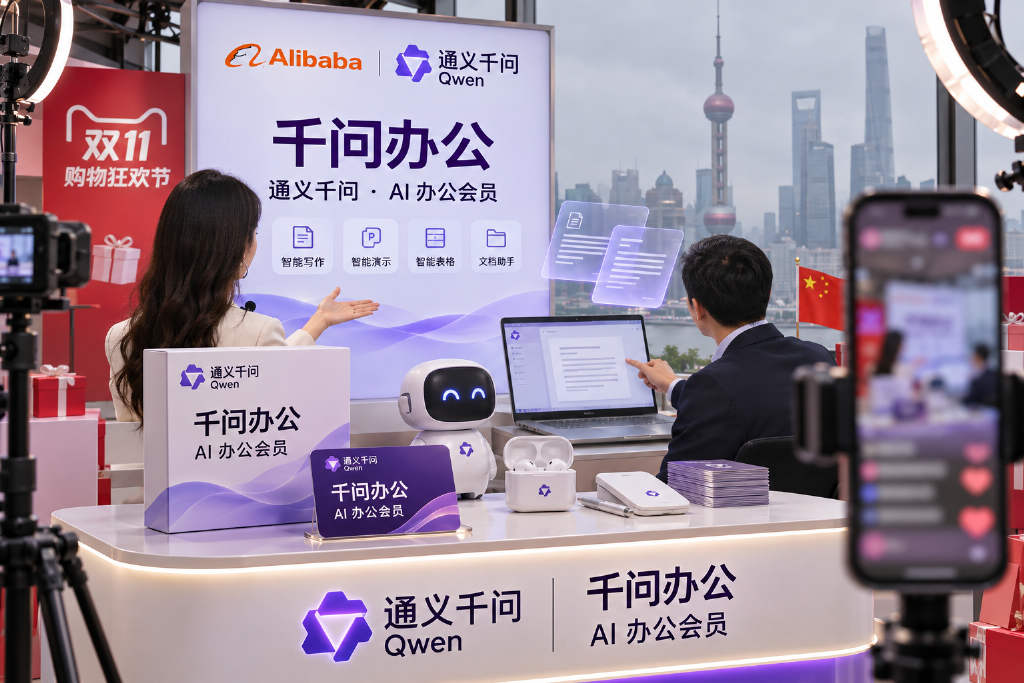
Li Jiaqi’s Double 11 livestream put “Qwen Office Token” on sale on the night of Nov. 2. According to Caijing.com, cited in the source article, the product sold 100,000 personal monthly memberships within 30 minutes, with cumulative usage reaching about 2 trillion tokens. Viewers in the comment section repeatedly posted “321, shang Token,” a reference to the livestream’s fast-paced sales rhythm.
The article said these tokens were not crypto-market tokens. They referred to large-model token usage, or AI computing credits, used to redeem Qwen Office memberships and generation quotas. In practical terms, the livestream was selling standardized AI office usage packages that could be used right away.
Qwen Office CEO joined the livestream
Qwen Office CEO Chen Yusen appeared in the session and spoke with Li Jiaqi about everyday AI office use. When Li asked whether an “AI avatar” could chat with women around the clock, Chen replied that “AI cannot replace Li Jiaqi,” and said he would rather use AI to help fans deal with routine tasks, including getting off work on time, keeping cats and dogs company, and caring for family members.
Several use cases were demonstrated during the stream. They included organizing children’s homework papers and turning them into training mini-games, generating business analysis reports for livestream operations with one click, and helping fishing enthusiasts create and launch a global fishing map. The source article said those demonstrations helped drive interaction and purchases in the livestream room.
First AI computing product sold in Li Jiaqi’s livestream
Sina Tech, cited earlier in the source article, said this was the first time Li Jiaqi’s livestream had sold an AI computing product in token form. The article also said Chen is Alibaba’s youngest vice president and that both Chen and Li were born in 1992. The livestream also previewed AI PCs, AI note-taking cards, and desktop robots, while linking them to the “Tmall Qwen Office AI Computer Plan.”
The source article contrasted this sale with the usual Double 11 livestream lineup of beauty products, apparel, and home appliances. This time, “Token / monthly membership cards” were inserted directly into the flash-sale format, which the article described as a move toward selling AI services themselves rather than only hardware accessories with AI functions.
Alibaba pushes Qwen Office through Double 11 channels
The article said the figures — 100,000 monthly cards sold in half an hour and about 2 trillion tokens in total — showed that usage packages are easier for consumers to understand than abstract model parameters. Buyers were paying for office usage quotas they could use immediately, not for a technical white paper.
From Alibaba’s side, the article said Qwen Office was using Tmall’s Double 11 campaign and a top livestream host to extend the Tongyi Qianwen ecosystem from an app and e-commerce assistant into a consumer AI subscription product that can be priced and sold in flash-sale form.
The article added that once AI token usage can be sold with a “3, 2, 1, now live” cadence, commercialization of large models is no longer limited to developer consoles or enterprise tenders. It is also entering the language of livestream e-commerce, built around limited-time offers, limited quantities, monthly cards, and usage quotas. The next point the market will watch, according to the source article, is whether users who grabbed memberships will stay and renew, and whether hardware-plus-subscription bundles such as the “Tmall Qwen Office AI Computer” can turn a one-off flash sale into a longer usage cycle.



