

Lilian Weng, co-founder of Thinking Machines Lab and former OpenAI vice president of research and safety, said tomorrow will be her last day at the company.
Weng posted a departure letter on social media, ending a 20-month run since she co-founded Thinking Machines with former OpenAI CTO Mira Murati. The announcement came only days after the startup released Inkling, its first open-source large language model, which Weng called “an incredible milestone in the company’s history.”
The timing drew attention. A co-founder is stepping down just after the company’s first model launch.
Health was the focus of her letter
In her message, one word kept surfacing: health.
Weng said she had been sick more often over the past seven months than at any other period in her life. During the company’s sprint to launch Inkling, she had to take sick leave while also dealing with guilt over not being able to work. She described that period as one in which rest itself became difficult because it came with a sense of letting people down.
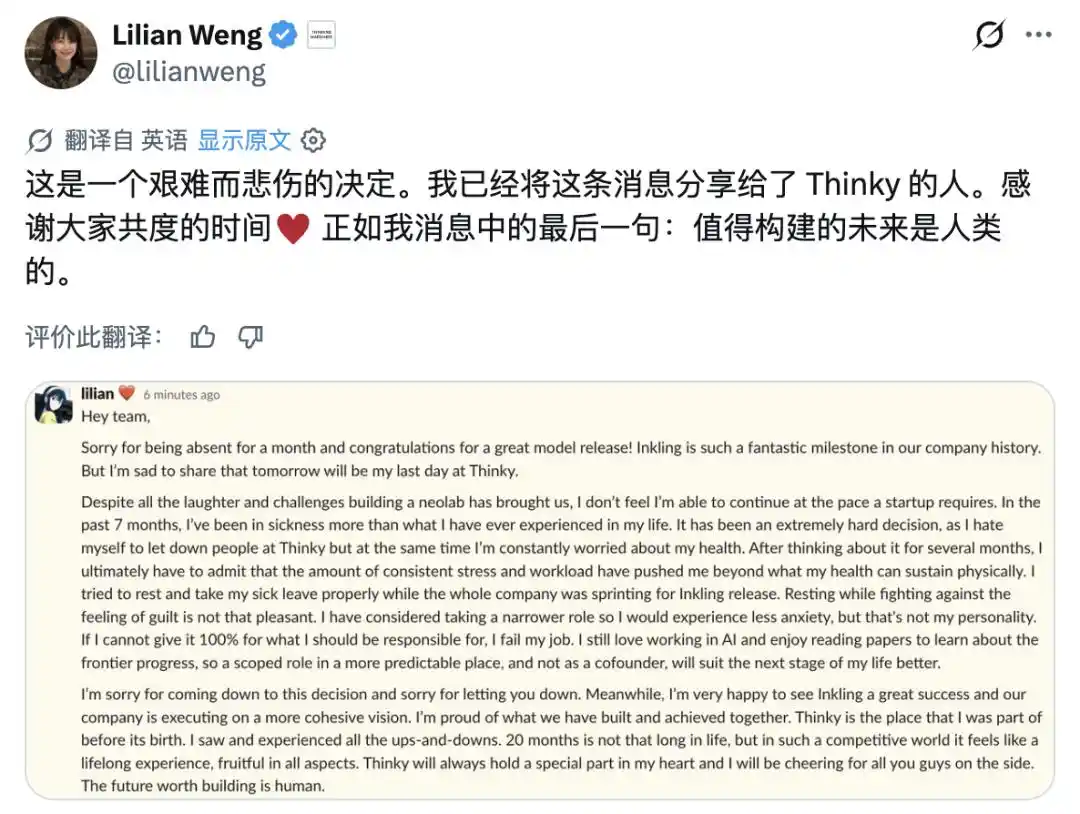
She also said she had considered narrowing her responsibilities and taking on a role with less pressure and uncertainty. In the end, she concluded that such an arrangement was not right for her. As she framed it, if she could not give her full energy to the things she owned, she would feel she was not doing the job properly.
Her note repeatedly used phrases such as “sorry” and “letting you down.” For someone who once built OpenAI’s safety team from scratch and later led a group of more than 80 people, the concern that came through most clearly was not status or title, but disappointing colleagues.
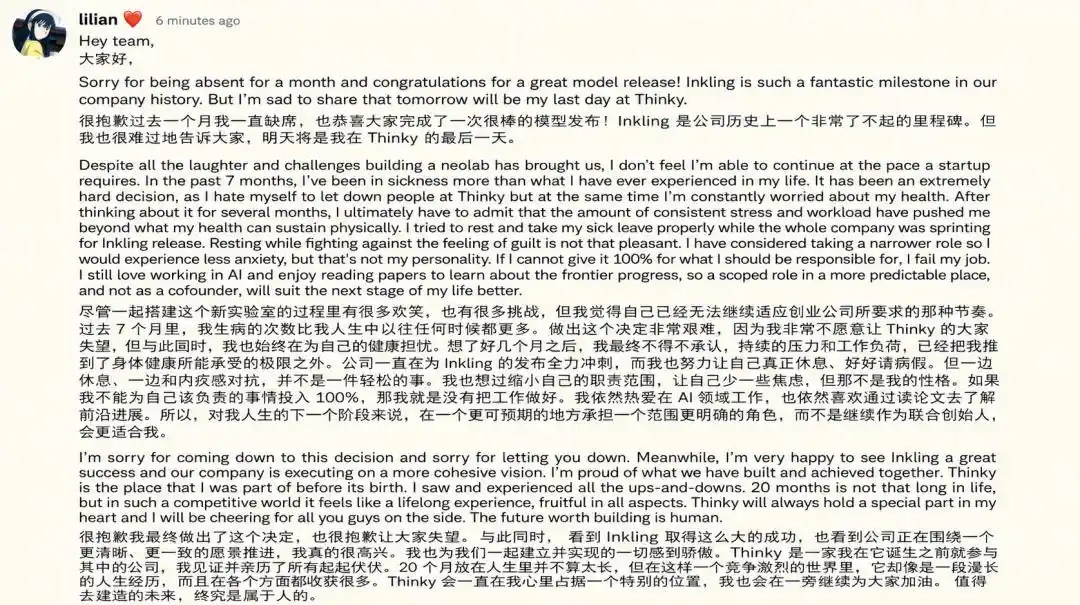
Responses came quickly from former co-workers and peers. Murati said building Thinking Machines together had been deeply meaningful and added that she was glad Weng had chosen to put her health first. PyTorch core developer Soumith Chintala and Saurabh Garg were among those who also left supportive messages, most of them centered on the same point: rest matters more.
From OpenAI safety work to Lil'Log
Weng may not be a daily public-facing figure in the way some AI executives are, but her role in the field has been substantial.
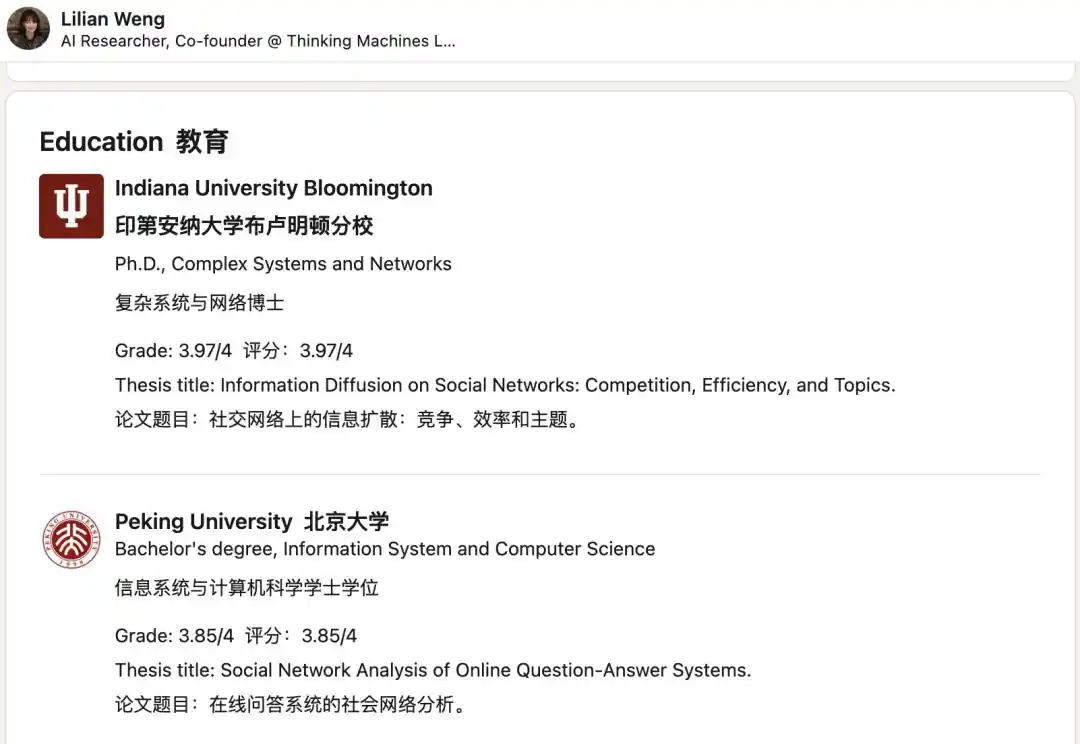
Born in Shaanxi, she won first prize in the Shaanxi division of China’s National High School Mathematics League in 2004 and entered Peking University in 2005 to study information management and information systems. During her undergraduate years, she received a national scholarship. She later pursued a PhD at Indiana University Bloomington, focusing on network science, complex systems and information diffusion in social networks, work that was distinct from the large-model research with which her name would later become more closely associated.
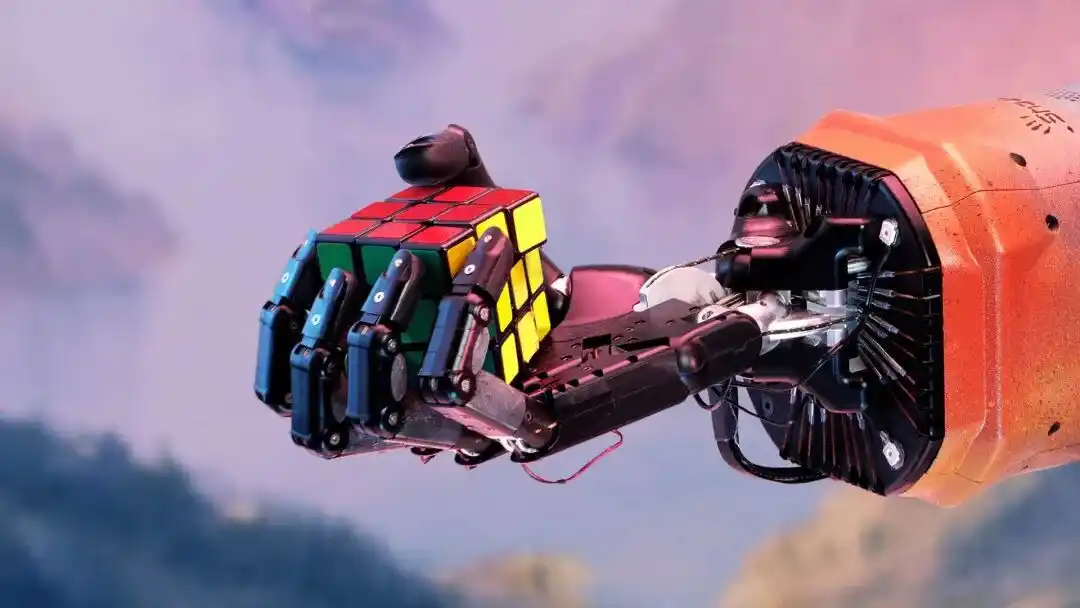
She joined OpenAI in 2018. One of her earliest major projects there was Dactyl, the robotic hand effort in which the research team spent two years training a hand to manipulate a Rubik’s Cube with one hand. Weng was one of the project’s core contributors.
After GPT-4 was released, she began building the Safety Systems team from the ground up. By the time she left OpenAI, the team had grown to more than 80 people. Parts of the safety mechanisms and evaluation systems now used in ChatGPT are tied to work she pushed forward during that period.
In August 2024, Weng was promoted to OpenAI vice president of research and safety. Three months later, she left the company. In February 2025, she co-founded Thinking Machines Lab with Murati and others.
She is also widely known in technical circles as the author of Lil'Log. The blog has long offered structured explainers on reinforcement learning, Transformers and agents, and has become one of the most widely read personal technical blogs in AI. Some of its posts have been assigned as reference material in university courses. Weng once wrote that the best test of whether you truly understand an idea is whether you can explain it clearly. That line captures a large part of her influence in the AI community.
Thinking Machines grew fast, then hit pressure points
Weng’s departure takes on a different shape when set against the company’s path over the past year.
Thinking Machines drew attention from the start. In July 2025, it raised about $2 billion in a seed round, setting what was described at the time as a record for startup seed financing. Andreessen Horowitz, or a16z, led the round, with Nvidia, AMD and Jane Street among the participants. The post-money valuation reached $12 billion.
At that stage, the company had not released any formal product. There were also reports that Apple and Meta had both expressed interest in investing in or acquiring the startup, but Murati declined.
That early profile came with heavy expectations. Product progress and team stability did not move as smoothly afterward. In November 2025, Thinking Machines tried to open another financing round at a valuation between $50 billion and $60 billion. By January 2026, those talks had not been completed, and the market valuation had fallen back to about $12 billion.
The core team also went through continued changes. Co-founder Andrew Tulloch was recruited by Meta. In January 2026, co-founder and CTO Barret Zoph and co-founder Luke Metz left and returned to OpenAI.
Zoph’s exit later spilled into public disagreement. Murati said he had been dismissed over “misconduct.” OpenAI then said it did not agree with Thinking Machines’ characterization of the matter. More researchers left the company afterward.
Questions around Thinking Machines have focused on several areas: an elevated valuation, slower-than-expected product delivery, large compute costs and a business model that has not yet been proven. The continued movement of key talent added to the uncertainty.
Even so, the company still controls sizable resources. It has entered a multiyear strategic partnership with Nvidia and plans to deploy at least 1 gigawatt of next-generation Vera Rubin systems starting in 2027. It has also signed a multibillion-dollar compute agreement with Google Cloud.
On the product side, its model fine-tuning tool Tinker is already live, and Inkling has now been released. The company has begun moving from a story centered on fundraising and talent to one tied to actual product delivery.
A limit that people cannot scale past
Weng’s departure letter did not discuss valuation, fundraising or internal personnel issues. It stayed on one point: the strain had gone beyond what her body could carry.
She said she still loves AI and is still reading papers and tracking research progress. What she wants next is an environment with a more predictable pace and clearer boundaries, without the constant pressure and uncertainty that come with being a co-founder.
This year, the AI race has moved at a tempo that often feels measured in days. One model ships and the countdown to the next update begins. A capability becomes standard and another technical path appears almost immediately after. Startups are trying to keep up with product, compute, fundraising and hiring at the same time, and many people fear that falling behind even once could mean missing the next wave.
In the hottest part of the sector, speed is no longer just an edge. It has also become a form of pressure that is hard to escape. Models can add parameters, stretch context windows and keep running on more compute. People have harder limits. Sleep cannot be compressed, recovery cannot be skipped, and accumulated exhaustion does not disappear because a product has gone live.
Twenty months is not a very long time, but Weng wrote that the experience “feels like a lifetime.”
Inkling is now a milestone for Thinking Machines, and the AI industry will keep moving. New models will arrive, new companies will emerge and the rankings will keep shifting. For Weng, the more immediate task is to stop and recover.
Leaving does not always mean failure. At times, recognizing that the body cannot keep taking the load, setting unfinished responsibilities down and taking care of yourself requires its own kind of resolve.