


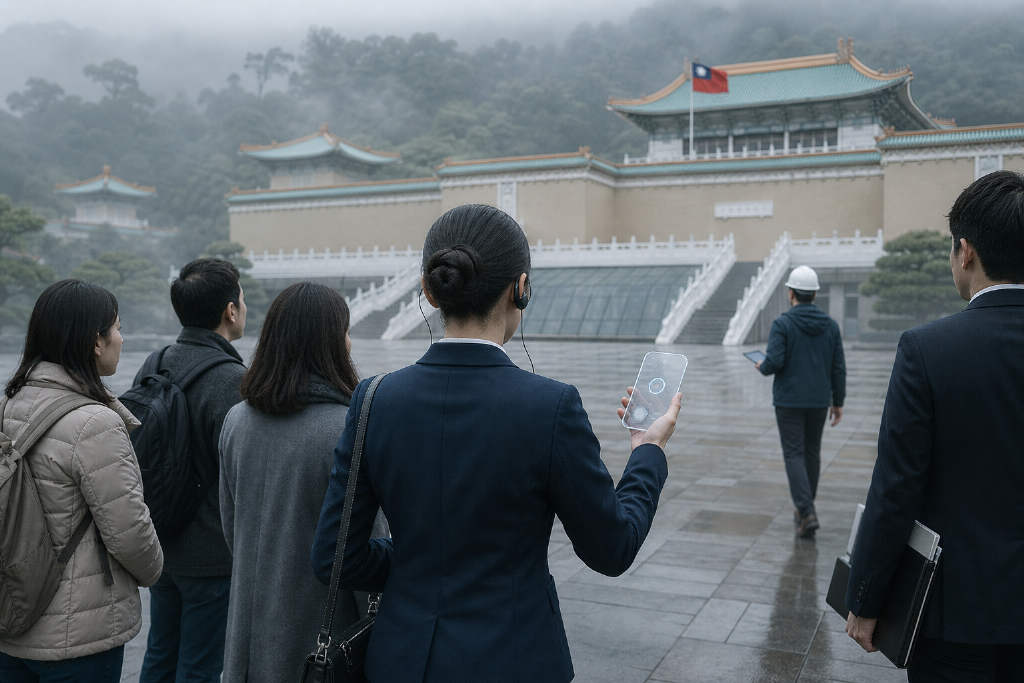
Lawyer Lin Shanglun wrote after appearing on TTV News Hotline that AI’s "hunting radius" is widening, moving beyond high-value professions such as lawyers and engineers and into work once seen as more dependent on in-person explanation and humanistic expertise, including museum guides.
Lin said he had previously estimated that AI would need at least another year and a half before it could begin replacing part of a lawyer’s core work. He now says the pace of change over the past three months has already eaten through that buffer.
What Lin took from the TTV interview
Lin said AI has become a central topic across industries and that he used the TTV interview to lay out his view of where the technology is heading and how it is reshaping work. In his telling, public debate is still stuck on whether AI will replace people at all, while the technology has already spread from high-output professions into a wider set of roles.
The interview focused in part on current AI use cases across sectors, with particular attention on law. Lin wrote that junior lawyers in the United States have already fully integrated AI into their workflow, that Singapore’s legal sector uses it at high frequency, and that AI-written filings are now appearing regularly in court documents around the world. He added that courts have gone as far as naming the issue directly in judgments and warning legal professionals not to misuse AI when drafting submissions.
A shift from skepticism to recognition
Lin said he once firmly believed that drafting and reviewing legal documents formed a professional barrier unique to lawyers and was not work non-lawyers could handle. After spending more time examining AI output, he said, that assumption no longer holds up as cleanly as before.
He described a path that he believes many lawyers have followed. At first, they saw generated responses, found obvious flaws, and dismissed them. Now, he wrote, clients sometimes tell lawyers, "What you’re saying sounds the same as what AI said."
For Lin, that line is not a joke. He said it shows AI has reached a level in legal knowledge synthesis and presentation that can stand alongside professional output. He argued that earlier AI systems were strongest at reorganizing existing information, what he called integrating truths from "1 to 100." With the rise of precise databases, multi-agent coordination, and support from various web search tools, he said AI is now iterating rapidly in the more creative and precise "0 to 1" stage as well.
Lin wrote that even when abstract and complex questions come from people without legal training, AI can now produce answers that are structured and relatively precise. Final verification still needs a lawyer, he said, but the share of work AI can already complete has become strikingly high.
The timeline, in his view, has collapsed
Lin said one of the most overlooked parts of the shift is speed. In his view, the pace of AI development is breaking the timelines many professionals had used to judge when disruption might arrive.
His prior estimate gave lawyers at least another year and a half before AI started replacing part of their core work. After the last three months, he no longer sees that cushion as intact. He wrote that once development costs are pushed down and iteration cycles get shorter, there is little basis for clinging to older work models.
He also said the TTV report captured a key turn: while many people still discuss AI as if it were a toy, it is already compressing frontline tasks from work that once took days and teams of dozens into jobs that can be done in seconds, especially in data collation and first-draft preparation. Lin framed that change not as gradual improvement, but as an accelerating replacement process.
Why lawyers and engineers were hit first
Lin’s explanation for why lawyers and engineers are among the earliest professions under pressure was direct. They generate the highest output.
He wrote that in commercial terms, high output means the largest potential gains from efficiency improvements. If AI can replace even part of that work, the profit released can be substantial. For that reason, he said, the smartest capital and strongest technical teams naturally targeted those two sectors first. In his account, AI research and product development for law and software engineering have already become relatively mature, and the basic structure of both industries has largely been redefined by AI.
That does not mean other sectors are safe, he added. Once the hardest and most valuable legal and engineering tasks are cracked, the same technical frameworks are likely to spread quickly into more traditional fields.
A museum visit and AI’s move into guided interpretation
Lin also used a recent visit to the Rembrandt exhibition at Fubon Art Museum to show how AI is entering settings usually associated with physical presence and cultural interpretation.
At the exhibition, he wrote, AI-powered image recognition had become hard to ignore. Visitors no longer necessarily need to rent the venue’s audio guide or rely on a professional guide’s narration. By using a phone camera and pointing it at a painting, without turning on the flash, a user can get an AI system to explain the work in detail.
According to Lin, the system can cover the artist’s background, anecdotes from the artist’s life, and the symbolism or implied meaning behind the work, while delivering the explanation in a vivid and accurate way. Used with personal earphones, he said, the experience can also outperform older in-house museum equipment in audio quality and comfort.
That visit led him to conclude that AI’s reach is expanding quickly. Scenes once assumed to require strong humanistic training, art expertise, or face-to-face interaction have already entered AI’s range. If museum audio guides and professional interpretation can be challenged this easily, he wrote, the next industry to be swept in may not be far behind.
Two questions Lin addressed in the piece
Why AI is likely to hit lawyers and engineers first
Lin’s answer was output. These professions produce high economic value, which makes efficiency gains more lucrative. In his view, that is why capital and technical talent moved into those areas first.
How long he originally thought lawyers had
Lin wrote that he had originally estimated at least another year and a half before AI could start replacing part of lawyers’ core work. He now says the pace seen in the past three months has sharply shortened that window.