
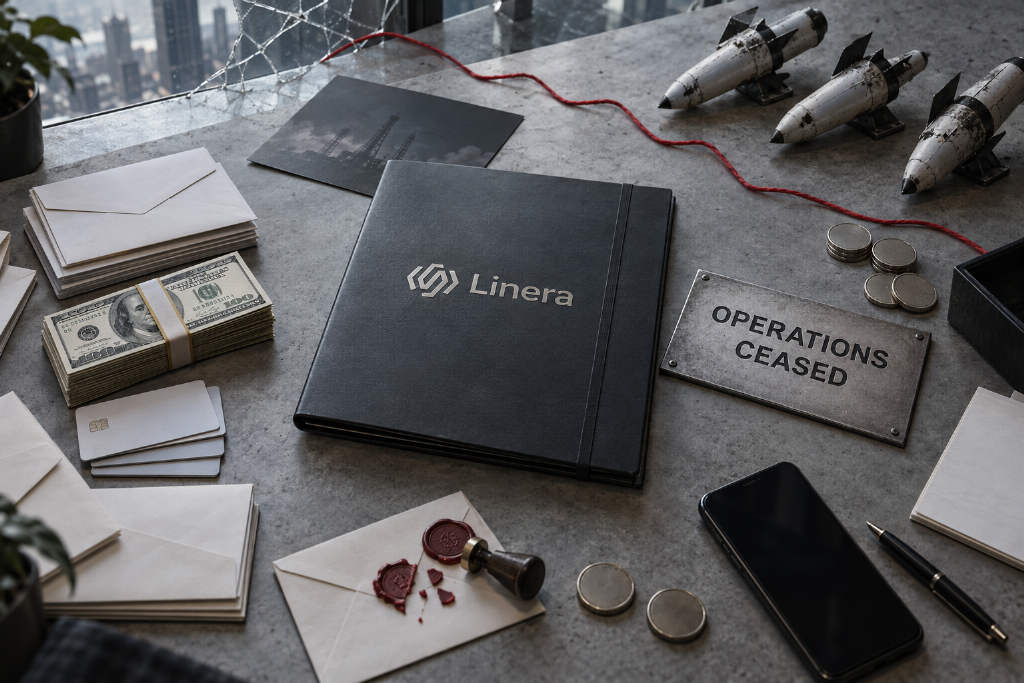
Linera has shut down after its LNRA community token sale failed to meet the minimum fundraising threshold, closing the chapter on a Layer 1 project that had spent years building expectations around a future mainnet and possible airdrop.
In an analysis piece, PANews said Linera’s closure adds to a widening wave of blockchain shutdowns and shows that elite founding teams, high-profile investors, and big technical narratives are no longer enough to hold market confidence on their own.
Token sale fell short of the minimum target
Late last month, Linera publicly said it wanted to build the "next Hyperliquid" and signaled that an LNRA token sale was coming. On Sept. 1, the project opened its LNRA community round at $0.16 per token, implying a $160 million fully diluted valuation. Early participants were also offered a discounted entry price as low as $0.02.
Demand did not match the pitch. The community round moved slowly and market interest remained weak. In the end, 617 participants from 69 countries and regions pledged about $848,000. That was far below the $8 million fundraising cap and also below the $1.5 million minimum required for the sale to go through.
On Sept. 19, Linera founder Mathieu Baudet said on Discord that because the LNRA sale had not reached the minimum amount needed to complete the offering, all subscription funds had been refunded and the project would cease operations immediately. Before that, the team had tried to raise emergency funding to keep the project running until mainnet launch, but it could not secure the required amount.
Years of community participation ended with no payout
The shutdown surprised many users who had spent years interacting with the Linera ecosystem. Testnet activity, task completion, badge collection, weekly community participation, and Discord role accumulation had become routine for a group of users betting that long-term engagement might eventually lead to an airdrop.
One user wrote on social media that over the past three years, they had continued participating in the Linera ecosystem, spent about 40,000 to 80,000 MGS, posted more than 100 pieces of content, attended 69 community events, and collected 30 badges, only to end up with "zero return" and not even get a chance to check for an airdrop.
Other users questioned how a project backed by top-tier venture firms including Andreessen Horowitz, or a16z, could still fail to launch its mainnet after several years and then close because of funding pressure. Comments such as "Four years and still no mainnet, and the money is gone. Who’s next?" began spreading in the community.
Some reactions were harsher. One user wrote that "VCs dump ghost chains on retail and walk away," while another said, "We were farming points. Linera was farming our time."
From a high-profile launch to a stalled mainnet
Linera no longer looks like a star Layer 1, but when it launched in 2022 it carried many of the labels that the market favored at the time. The project was founded by former Meta researcher Mathieu Baudet. Because of the founding team’s background, Linera drew immediate attention and was at one point grouped with Aptos and Sui as part of the "Move trio."
In 2022 and 2023, Linera completed two funding rounds, raising about $12 million in total. a16z participated in both rounds. Other investors included Borderless Capital, GSR, Matrixport Ventures, and Flow Traders. Even so, PANews argued that this list of investors did not become a moat strong enough to help the project survive the cycle.
Linera is now gradually shutting down its applications and Discord community. User point balances will remain on record, but the team said it cannot promise that those points will ever be redeemed for any kind of benefit. As for protocol development and application launches, the team said it still hopes to continue in the future, but it cannot provide a clear timetable for now.
Linera’s closure fits a broader market pattern
PANews said Linera’s end may look sudden, but it did not come without warning. As more public blockchains move from peak attention into decline, and in some cases are forced to shut down or pivot, the industry appears to be going through more than a routine market adjustment. The deeper issue is a reassessment of liquidity, business models, and value capture.
In recent months, projects including Harmony, Scroll, Moonbeam, Secret Network, Saga, Vanar, and Zero have announced shutdowns or strategic shifts. Some of them were once closely watched. They had attracted attention through technical narratives, funding rounds, and ecosystem incentives, and they had at times built up meaningful on-chain liquidity. But as market heat faded and incentives pulled back, transaction volumes and user activity dropped sharply, leaving some chains effectively as "ghost chains."
The pressure has increased as new chains backed by traditional giants, including Robinhood Chain, have entered the market and given users and capital more options. That has accelerated liquidity migration across ecosystems. For chains without clear differentiation, once users and capital leave, rebuilding the ecosystem often becomes far more expensive.
Scale still matters, but revenue matters more
Citing DeFiLlama data, the article said the top ten public chains, including Ethereum, Solana, Base, and BNB Chain, account for about 90% of the market. In that setting, relying only on a new-chain story, short-term incentives, or token issuance is becoming less effective as a long-term strategy.
Development paths are also starting to diverge. Instead of general-purpose chains trying to cover every application scenario, more projects are exploring vertical blockchains built around specific demands, where real applications bring in users and liquidity. Some older chains are also moving toward niches such as AI and payments in search of new growth.
Still, no route avoids the same core issue: a sustainable business model. For crypto projects without recurring income, treasury reserves and token sale proceeds may keep the team operating for a while, but they cannot replace stable operating cash flow. Once fundraising becomes difficult and reserves keep shrinking, projects may have to cut spending, scale back development, or shut down entirely. PANews said Linera is a clear example that financing can buy time, but it cannot indefinitely replace a project’s own ability to generate income.
The market’s framework for valuing public chains is changing as well. In the past, technical narratives, investor rosters, ecosystem size, and airdrop expectations were often enough to bring attention and valuation premiums. As more projects move into actual operation, the market is re-examining how much of that growth came from real demand and how much depended on short-term incentives.
On-chain volume and total value locked still matter as indicators of ecosystem scale and user activity, but they do not automatically mean a project has a sustainable profit model. For investors, whether a protocol can keep generating revenue, and whether that revenue can be transmitted effectively to token holders, is becoming a more important part of project evaluation.
Buybacks are rising, but buybacks alone are not the answer
The article pointed to strong token performances by Hyperliquid, Uniswap, NEAR, Venice, Arbitrum, Aave, and Lighter as signs that the market is paying closer attention to the alignment between protocol revenue and token incentives.
According to Unfolded data cited by PANews, crypto projects have spent $638 million on token buybacks so far this year, higher than $545 million in the same period last year. The figure for the same period in 2024 was just $366,000. Hyperliquid and Pump.fun together accounted for nearly 90% of the total.
But the piece also stressed that buybacks do not automatically equal sustainable value capture. Their real effect still depends on where the money comes from, how large the buybacks are, how total token supply changes, and whether the project can continue generating revenue in the future. Without steady operating cash flow, buybacks may amount only to temporary value spending rather than long-term support.
As technical stories and narrative momentum lose their power to attract liquidity on their own, competition among public chains is shifting. The test now is not who can draw the most attention, but who can show real demand, recurring revenue, and a credible path for returning value.