
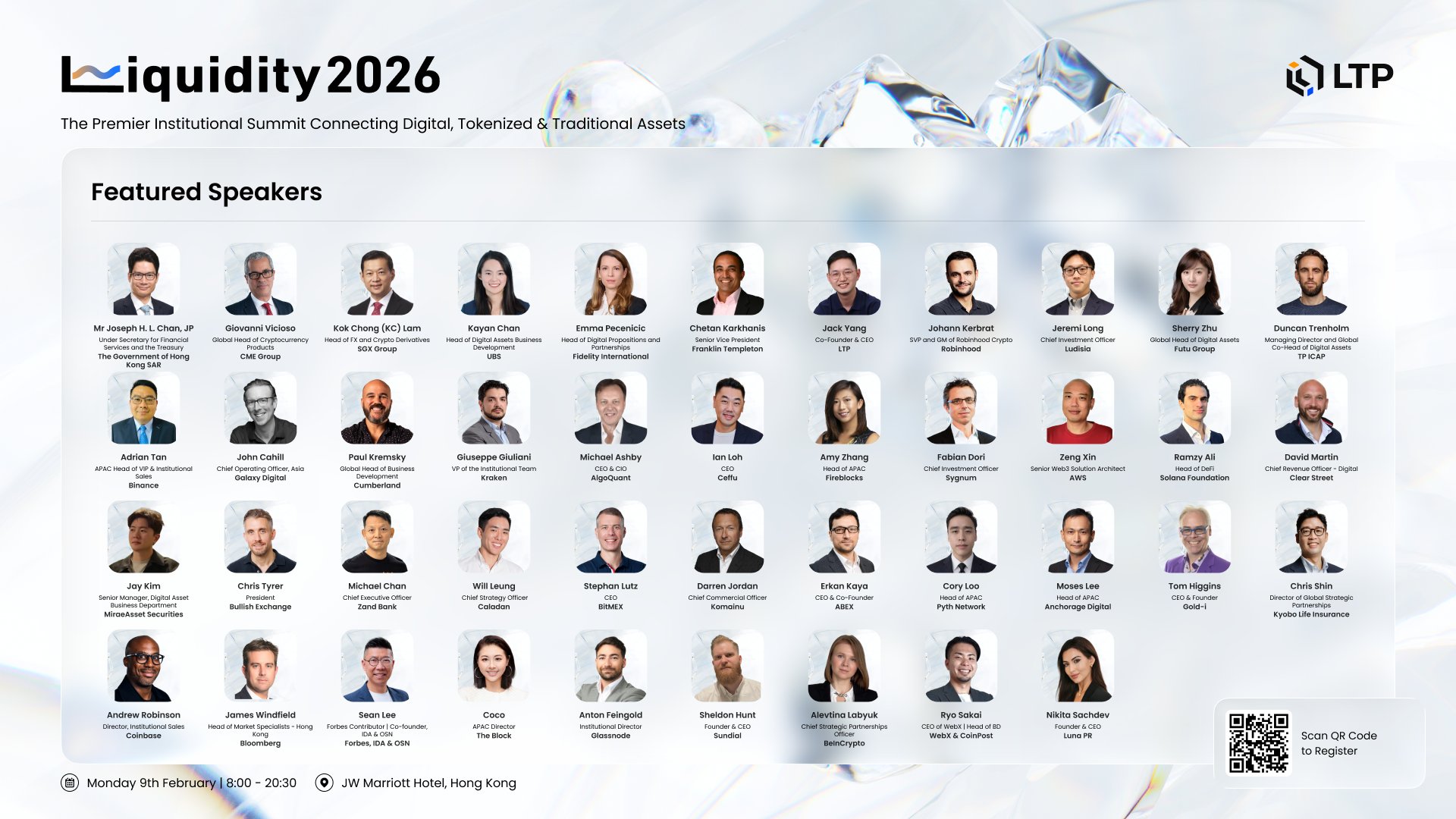
On February 9, 2024, LTP HK held its flagship institutional digital asset summit, Liquidity 2026, in Hong Kong. The fourth consecutive edition brought together hedge funds, market makers, HFT firms, family offices, asset managers, exchanges, custodians, banks, and tech providers to examine the next phase of digital asset and TradFi convergence.
Multi-Asset Trading: From Peak Performance to Compliance Integration
BitMex CEO Stephan Lutz told attendees that CIOs can no longer ignore this asset class. As institutions formally incorporate digital assets into allocation frameworks, the design logic for trading systems is shifting: the focus is no longer pure performance but how to achieve smooth integration within existing governance structures, API architectures, and risk controls. Gold-i founder and CEO Tom Higgins stressed that system design must assume failure will occur, using multi-exchange aggregation for resilience and redundancy. Regulatory fragmentation was widely cited as a key barrier to global interoperability—without cross-jurisdictional rule coordination, true multi-asset market integration remains constrained.
Custody Transformation: From Safekeeping to Callable Assets
Discussions on settlement and custody pointed in one clear direction: custody is evolving from simple asset safekeeping into a core layer supporting clearing, settlement, and risk management. Ceffu CEO Ian Loh stated that trust should be embedded in executable on-chain mechanisms, enabling assets to generate real returns through custody and prime broker collaboration. Fireblocks APAC head Amy Zhang argued the industry must rely on mature third-party technology, noting that Europe is becoming a new strategic hub for digital asset institutions. Komainu chief commercial officer Darren Jordan said the future of custody lies in asset availability, and redundancy should be introduced at the infrastructure level to reduce systemic disruption risk.
Data and Infrastructure Overhaul: Pyth and Robinhood in Action
Pyth Network APAC head Cory Loo described market data as a giant but underappreciated industry—generating over $50 billion in annual revenue, with data costs rising more than 15x over the past 25 years. Pyth aims to rebuild the traditional data chain by feeding data directly from trading venues and exchanges into a price layer, delivering multi-asset sub-millisecond updates at lower cost and higher quality. Pyth Pro launched roughly two months ago, has already attracted over 80 subscribers, and hit a first-month ARR exceeding $1 million. The plan is to route subscription revenue into the DAO, which then buys back tokens and accumulates reserves, creating systematic value accrual.
Robinhood Crypto SVP and GM Johann Kerbrat shared that Robinhood is evolving from a crypto exchange into a universal financial infrastructure, using blockchain to rebuild payments, settlement, and traditional asset trading while hiding all underlying complexity from users. TradFi's core bottleneck is settlement efficiency (T+1 or longer), whereas crypto systems naturally offer 24/7 instant transfer and fragmentation capabilities, significantly reducing capital costs and counterparty risk. Robinhood is advancing stock tokenization on a 1:1 physical backing basis under regulatory frameworks, predicting tokenization will expand beyond stablecoins to stocks, ETFs, private equity, and more. The real challenge, he said, is regulatory enablement and collective adoption, not technology.
Institutional Capital Shift: From Narrative to Real Demand
A clear shift emerged in discussions on capital flows and allocation trends: institutional capital is moving away from narrative-driven assets toward core assets with genuine demand and regulatory predictability. Sygnum CIO Fabian Dori noted that after the metaverse narrative cooled, institutions are focusing on value chain integration and process automation through smart contracts. Risk management capability is replacing return fantasy as the primary screening criterion for strategies. Tokenization is widely seen as a structural rather than incremental change, but its scaling depends on the emergence of real customer demand, not technological push. CME Group head of crypto currency products Giovanni Vicioso observed that the future will likely feature a convergence of multiple technologies and market structures.
Tokenization: Not a Moat, a Functionality Boost
As the summit closed, attendees converged on a strong consensus: tokenization alone does not confer a competitive advantage. The real dividing line is whether it delivers clear, quantifiable functionality improvements in reserves, trading, or settlement. ABEX CEO Erkan Kaya argued that tokenization has the potential to completely absorb traditional finance into the crypto system, predicting a tipping point in dominance within the next decade. Anchorage Digital APAC head Moses Lee concluded, "Tokenization does not equal success. Its value depends on whether it provides clear functional advantages in reserve, trading, or settlement scenarios." With compliance qualifications, system stability, and user experience becoming the new competitive battleground, financial infrastructure evolution has entered an irreversible phase.