
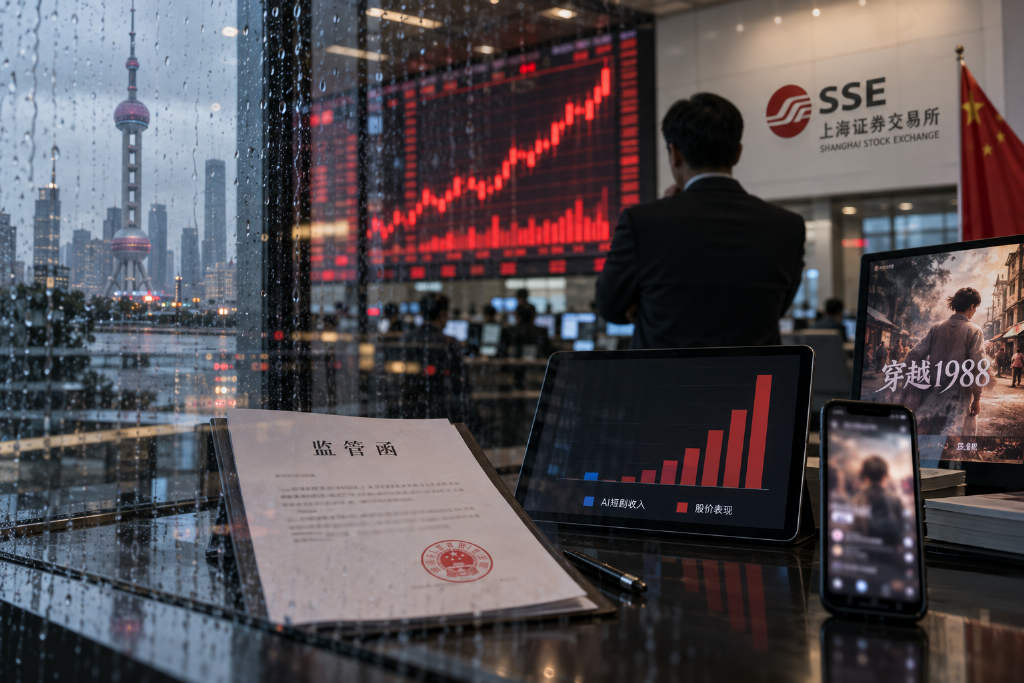
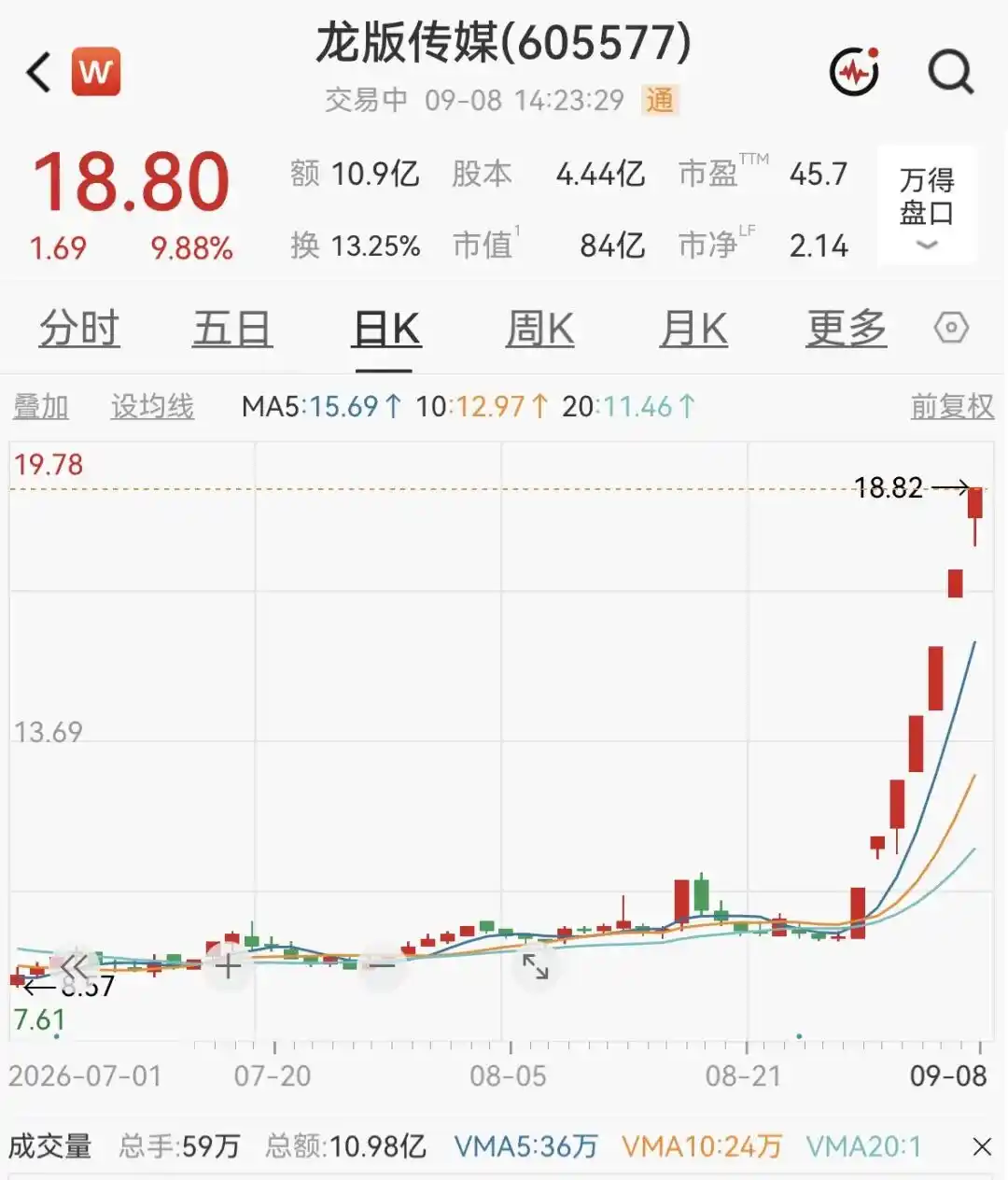
Longban Media’s AI video business generated only about RMB 80 in June, yet the disclosure became part of a stock run that nearly doubled the company’s market value in days. Since Aug. 31, the Heilongjiang-based state-owned publisher has recorded seven straight limit-up sessions. Its share price rose from RMB 9.58 to RMB 18.82, while market capitalization expanded from RMB 4.3 billion to RMB 8.3 billion.

The dispute centers on the gap between the company’s disclosed AI video income and the valuation the market assigned to the story.
Half-year report mentioned an AI comic drama before market sentiment shifted
The timeline began on Aug. 26, when Longban Media said in its half-year report that its first AI comic drama, "Across 1988," had completed 170 episodes and gone online. The company said the title had surpassed 120 million views across the internet and reached a Hongguo popularity score above 40 million.
That disclosure did not trigger an immediate market reaction. The turn came on Aug. 31, when Mango Excellent Media’s AIGC-produced 30-episode drama "Post-Journey to the West" debuted in Hunan TV’s prime-time slot. According to the source text, the first broadcast ranked No. 1 among provincial satellite TV channels in the same time slot and also made the Weibo trending list. Mango Excellent Media hit a 20% daily limit that day and another 20% limit the next day, pushing its market capitalization to about RMB 38.1 billion within two sessions.

Against that backdrop, funds began applying an "AI cuts costs and improves efficiency" narrative to publishers, film and television companies, and short-drama businesses with intellectual property libraries and existing story assets. Longban Media, with a relatively small market cap, became one of the purest concept names in that basket and was the first AI comic-drama stock in the segment to hit limit-up on Aug. 31.
Seven trading days, seven limit-ups
From Aug. 31 through the latest seven trading days, Longban Media posted seven limit-up moves. The stock climbed from RMB 9.58 per share to RMB 18.82, a cumulative gain of 96.45%. Over the same stretch, market value increased from RMB 4.3 billion to RMB 8.3 billion.
Then came the Sept. 4 risk notice. Longban Media said its AI video business generated about RMB 80 in June and about RMB 75,000 in July, representing less than 0.01% of its audited 2025 operating revenue.

That filing drew immediate scrutiny. In abnormal-trading disclosures issued in the prior two trading days, the company had stated that its AI video business had not generated operating revenue. Within three days, the public description moved from no revenue to about RMB 80 in revenue.
Shanghai Stock Exchange issued a regulatory warning
On Sept. 4, the Shanghai Stock Exchange issued a regulatory warning to Longban Media and its board secretary, Sun Fujun. The exchange said the company’s disclosure was inaccurate, its risk warning was insufficient, and its statements were inconsistent across filings, which could mislead investor decision-making.
Asked about the source of the roughly RMB 80 in June revenue, the board secretary’s office told media that the amount came from the AI comic drama "Across 1988." It added: "As far as we know, the show went online in late June to the end of June, and we are not quite sure on which exact day. If it went online late enough, relatively small revenue can also be understood."

That explanation landed next to the company’s earlier disclosure that the title had exceeded 120 million views and registered a Hongguo popularity score above 40 million. The mismatch between traffic and revenue became a central issue in the discussion.
The core business is still textbook and teaching-aid distribution
Longban Media remains, at its base, a traditional publishing and distribution company. It was established in 2014 and listed in 2021. The source text describes it as the only listed cultural enterprise in Heilongjiang province, with a full editing-printing-distribution chain and exclusive distribution qualifications for primary and secondary school textbooks across the province.
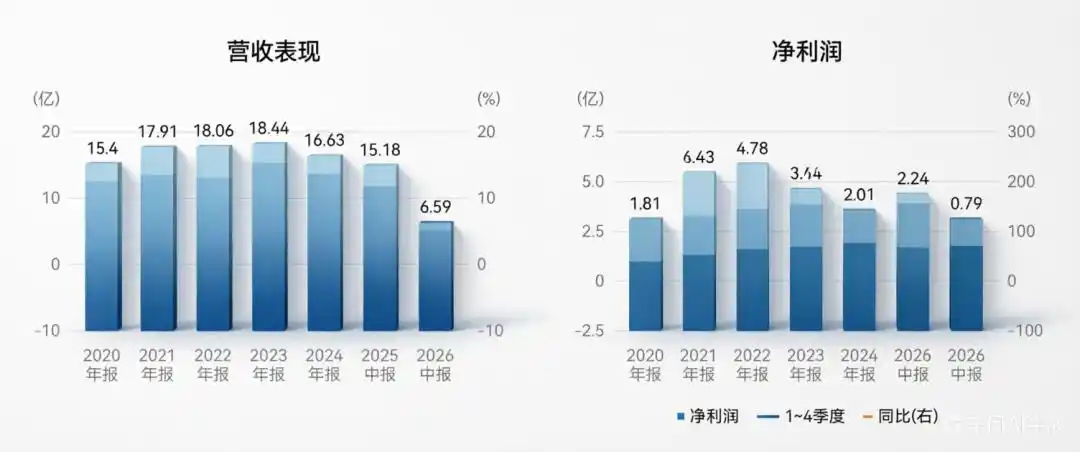
For full-year 2025, Longban Media reported revenue of RMB 1.518 billion. Textbooks and teaching aids contributed RMB 1.029 billion, or 67.78% of the total. General books brought in RMB 385 million, or 25.35%. Combined, the two segments accounted for more than 90% of revenue.
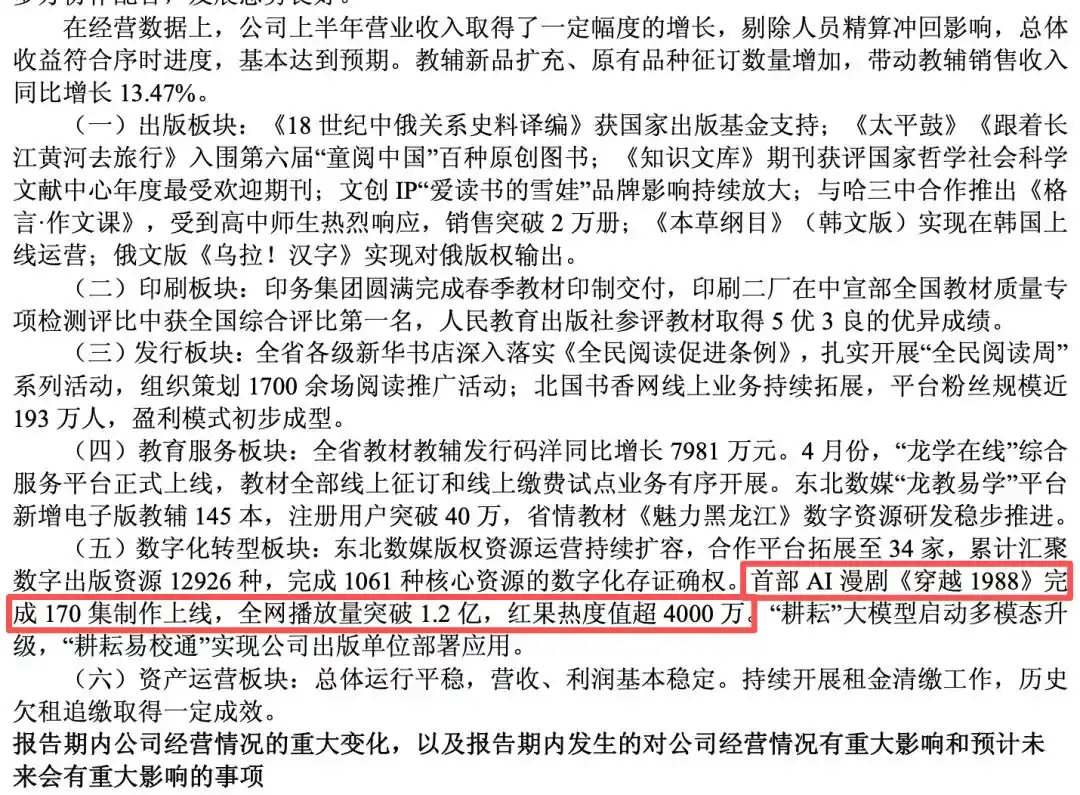
In other words, before June this year, the company was still primarily a textbook distributor rather than an AI video operator.
Profit pressure was already visible in the financials
The company’s financial report shows first-half revenue of RMB 659 million, up 5.62% year over year. Net profit attributable to shareholders was RMB 78.68 million, down 34.46%. Net margin fell by 7.3 percentage points from a year earlier. Looking at the second quarter alone, net profit dropped 492.81% year over year.
The source text says this pattern of rising revenue but falling profit is not unique to Longban Media. It links the pressure on the traditional publishing industry to a shift in reading habits toward short video and AI short dramas.
As a comparison, the source text cites Central South Media. Its revenue fell 8.24%, while net profit slipped 8.25%, and net profit still stood at RMB 933 million. The source argues that textbook and teaching-aid businesses tied to the education system can offer a stronger cushion when the general book market contracts and online discount competition intensifies. Against that comparison, Longban Media’s steeper profit decline points to deeper pressure in cost structure and channel distribution, according to the source text.
High view counts and tiny income created the central contradiction
Based on the disclosed figures, Longban Media’s AI comic drama is real, and the 120 million view count is also part of the company’s filing. But the income attached to that traffic remained extremely small: about RMB 80 in June and about RMB 75,000 in July, less than RMB 80,000 combined for the two months.
The source text calculates that this works out to roughly RMB 1 in revenue for every 16,000 views.
In the source author’s framing, that level of income would be a marginal line item in most content-company financial statements. Yet in a few trading days it was tied to a market-value jump of roughly RMB 4 billion. The article raises a narrow question on that basis: how a traditional publishing company was quickly interpreted by the market as an AI company, and how disclosure around a still very small business may have shaped expectations that the AI segment had already reached commercialization.
The original article was published on the WeChat account of Phoenix Technology and written by Lu Chunfeng. MarsBit republished the piece.