

Luxiao Technology (002617.SZ) said on the evening of July 7 that it would formally terminate two silicon carbide fundraising projects tied to its 2021 private placement and permanently redirect the remaining RMB 1.217 billion to working capital. In the eight trading days after the disclosure, the company’s stock fell by nearly 40%.
The move has thrown fresh attention on the silicon carbide expansion story Luxiao has been telling since 2020. Across two private placements, the company raised about RMB 3.2 billion, with net proceeds of roughly RMB 3.156 billion. Of that total, only around RMB 242 million actually went into silicon carbide equipment, production line construction, and research and development, or about 7.75%. The rest, close to RMB 2.9 billion, was redirected through working-capital replenishment, debt repayment, and similar uses.
Two placements raised about RMB 3.2 billion, but less than RMB 300 million reached SiC construction
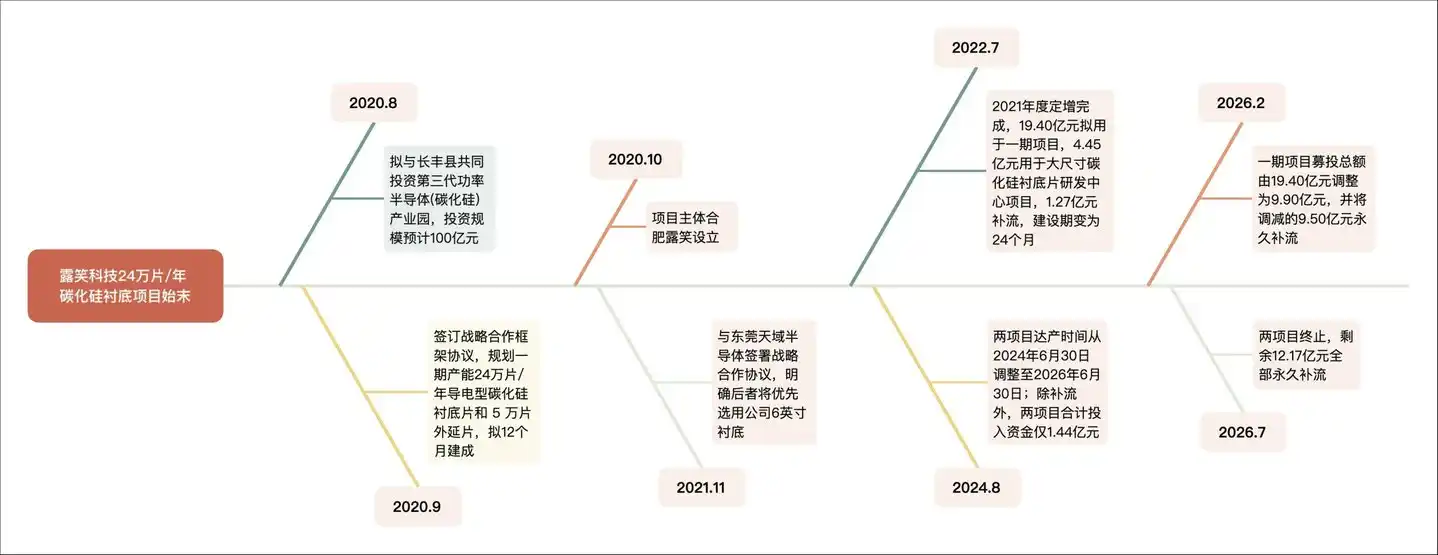
Luxiao began laying out its silicon carbide substrate business in 2020. At the time, China’s third-generation semiconductor sector was in a favorable policy window. In August that year, the company announced plans to build a third-generation power semiconductor, or silicon carbide, industrial park with Changfeng County in Hefei, with total investment expected to reach RMB 10 billion.
Under that plan, phase one called for RMB 2.1 billion of investment, annual capacity of 240,000 conductive SiC substrate wafers and 50,000 epitaxial wafers, a 12-month construction schedule, and projected annual revenue of RMB 1.274 billion with net profit of RMB 152 million once operations stabilized. The project vehicle, Hefei Luxiao Semiconductor Materials Co., Ltd., was registered in October 2020.
To finance the narrative, the company pushed through two private placements within three years.
First placement: net proceeds of RMB 615 million, then the SiC projects were shut down
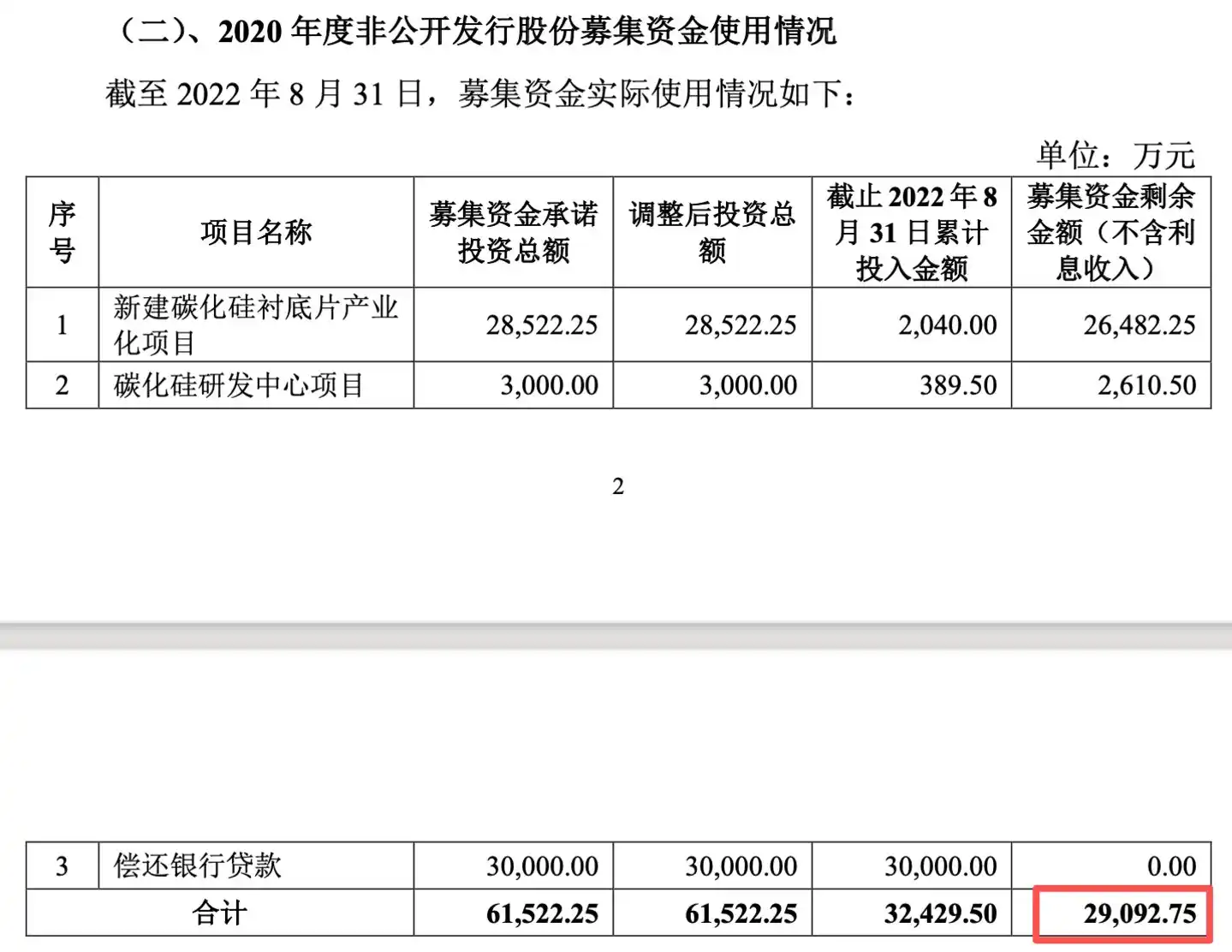
The first placement started in April 2020 and was completed in February 2021. Luxiao had initially planned to raise RMB 1 billion, but ultimately brought in RMB 643 million, with net proceeds of RMB 615 million. Of that amount, RMB 285 million was earmarked for a new silicon carbide substrate industrialization project covering 4-inch and 6-inch products, RMB 30 million for a silicon carbide R&D center, and RMB 300 million for bank debt repayment.
By Dec. 31, 2021, however, the industrialization project had received only RMB 20.4 million in actual investment, while the R&D center had received just RMB 3.895 million. The full RMB 300 million for debt repayment had already been used. On Sept. 30, 2022, Luxiao’s board approved the termination of those two fundraising projects, and the remaining funds, equal to 96.05% of the amount tied to them, were permanently redirected to working capital.
Second placement: net proceeds of RMB 2.513 billion, with spending already cut before final termination
The second placement plan was disclosed on Nov. 23, 2021 and completed in June 2022. By the time that financing was done, most of the silicon carbide funds from the first placement had still not been used.
The second deal raised RMB 2.567 billion in gross proceeds and RMB 2.513 billion net. Luxiao allocated RMB 1.94 billion to the first phase of its third-generation power semiconductor, or silicon carbide, industrial park for 6-inch products, and RMB 445 million to a large-diameter SiC substrate R&D center aimed at 8-inch products.
Progress remained slow. In January 2026, the company cut the industrial park’s planned investment from RMB 1.94 billion to RMB 990 million, freeing up RMB 950 million that was then permanently redirected to working capital. In July 2026, Luxiao terminated the two projects entirely and moved the remaining RMB 1.217 billion to working capital as well.
Across both placements, Luxiao’s net proceeds totaled around RMB 3.156 billion, but only about RMB 242 million was actually put into silicon carbide equipment, production line construction, and R&D.
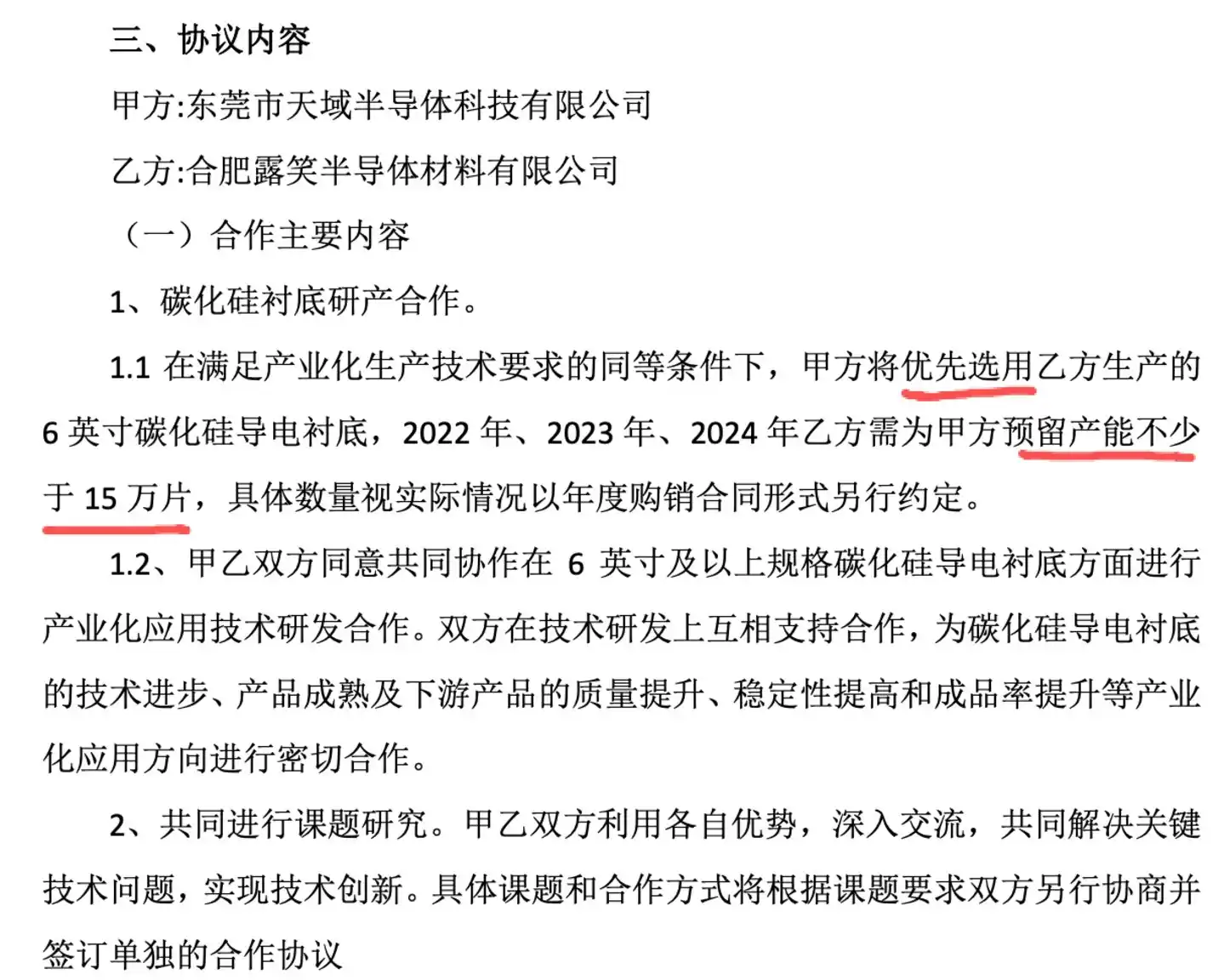
Before the projects were shut down, the company had repeatedly expressed confidence in their prospects in periodic reports and investor communications. In November 2021, Luxiao also announced a strategic cooperation agreement with Dongguan Tianyu Semiconductor Technology Co., Ltd., under which the other party would give priority to the company’s 6-inch SiC substrates.
When Luxiao finally pulled the plug on July 7 this year, it said 6-inch silicon carbide substrate capacity and supply had become excessive, while the company’s R&D spending on large-diameter SiC substrates was already sufficient for its current research needs.
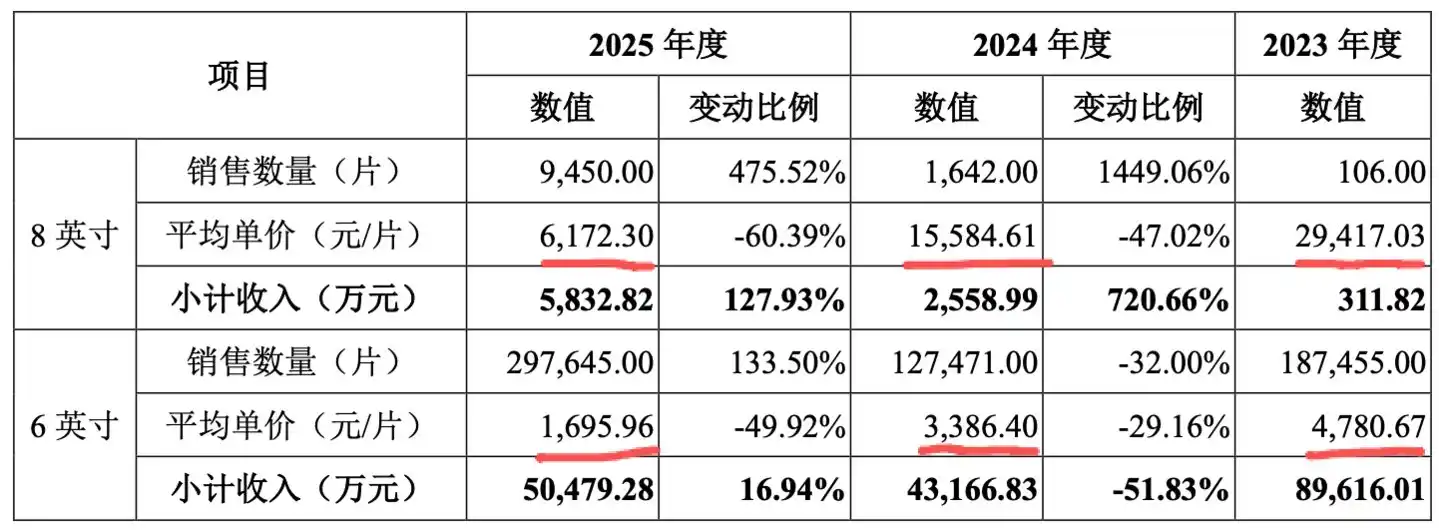
The report cites industry data that partly supports that explanation. Tianke Heda’s average selling price for 6-inch substrates fell from RMB 4,780.67 per wafer in 2023 to RMB 1,695.96 in 2025. Wolfspeed, described in the report as a global silicon carbide pioneer, filed for bankruptcy in 2025.
Questions remain around capacity, while Hefei Luxiao posted cumulative losses of RMB 344 million from 2022 to 2025
After years of delays, one basic question remains unresolved in public disclosures: how much silicon carbide substrate capacity has Luxiao actually built?
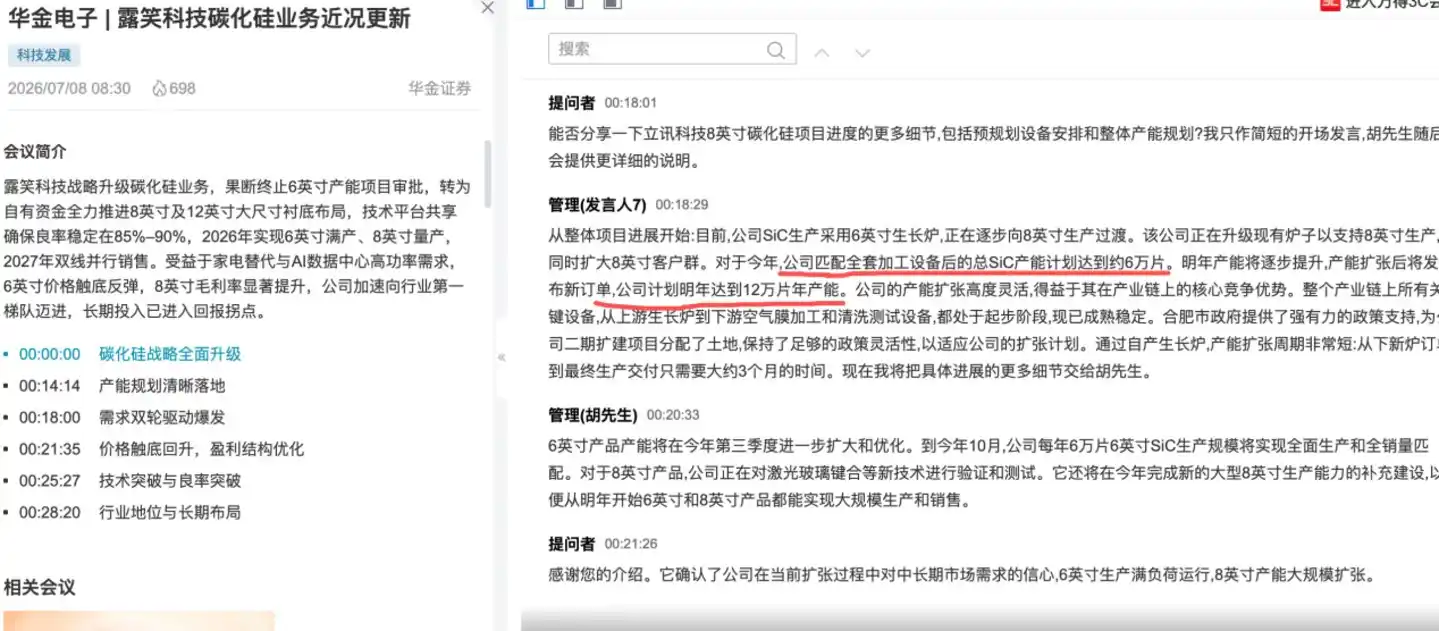
According to a company research note released in May, phase one at Hefei Luxiao has already been completed and ramped to 60,000 wafers per year, with a preliminary plan to launch further expansion in the second half of 2026 and gradually lift capacity to 120,000 wafers a year.
But in a conference call held by Huajin Securities on the morning of July 8, company board secretary Li Chentao and Hefei Luxiao general manager Hu Yang described the situation differently. According to remarks cited in the report, the company said that after matching the full set of processing equipment this year, total capacity was planned to reach 60,000 wafers, and by October the annual 60,000-wafer 6-inch SiC production scale would achieve full production and full sales matching.
There is a material gap between saying capacity has already been built and saying it is planned to reach that level. The report says a call to Luxiao in the name of an investor did not clarify the issue. A company staff member said they did not have the relevant figures and simply referred the caller to public disclosures.
The operating results have also been weak regardless of how the capacity question is answered. Based on periodic reports, Hefei Luxiao recorded cumulative revenue of RMB 3.2492 million and cumulative losses of RMB 344 million from 2022 through 2025.
From 4-inch to 6-inch and now 8-inch and 12-inch, Luxiao says it will keep pushing larger wafers
Even after scrapping the original projects, Luxiao has not said it is leaving silicon carbide. In both its filing and the conference call, the company said SiC remains a strategic development direction and that it will keep advancing 8-inch and 12-inch substrate business using its own funds or self-raised capital.
The company also said its current SiC production uses 6-inch growth furnaces and is gradually shifting toward 8-inch production. For 8-inch products, it said it is validating and testing new technologies including laser glass bonding, and plans to complete supplementary construction of new large-scale 8-inch production capacity this year.
But the industry has been moving for years. The production center of gravity has already shifted from 4-inch and 6-inch substrates toward 8-inch wafers, while 12-inch development and pilot manufacturing are being pushed forward as well.
As laid out in the report, Tianke Heda achieved preliminary 6-inch industrialization in 2016-2017, mature 6-inch mass production in 2019-2020, successful 8-inch R&D in 2022, and mature 8-inch mass production in 2025. By 2025, its SiC substrate capacity had reached 410,700 wafers per year, with output of 398,600 wafers.
SICC Co., Ltd. (688234.SH, 02631.HK), identified in the report as Tianyue Advanced, put 6-inch products into mass production in 2019 and 8-inch products into mass production in 2023. By 2025, its output had reached 690,400 wafers, up 68.31% year on year.
Tianyue Advanced also disclosed in its annual report that equipment entered its Shanghai production base in January 2023, product delivery began in May the same year, and annualized mass-production capacity of 300,000 wafers was reached in the first half of 2024, ahead of the original 2026 target.
The report quotes a person at a leading SiC substrate company as saying that 6-inch products are still the market mainstream today, but the shift to 8-inch is happening quickly. With demand rising from electric vehicles, photovoltaic power generation, energy storage, AI computing infrastructure, and AR glasses, the industry is moving to larger wafers because larger sizes mean lower edge loss, higher utilization, and better cost control.
Yole’s statistics and forecasts, as cited in the report, put 6-inch shipments at 88% of the market in 2025, while 8-inch products rise to 8%. By 2030, 8-inch share is expected to reach about 35%. At the same time, major manufacturers are pushing both development and mass production of 12-inch products.
At the company level, the market picture is becoming more concrete. In 2025, 8-inch products made up 44% of revenue at Tianyue Advanced, with global market share above 50%. The company introduced what the report described as the industry’s first 12-inch substrate in November 2024 and has already received orders and delivered products to major customers. Tianke Heda said it successfully developed a 12-inch substrate in 2025, while revenue contribution from 8-inch products rose to 10.22% that same year. Jingsheng Electromechanical (300316.SZ) also disclosed in July that it is advancing global customer validation for 8-inch substrates, has secured batch orders from domestic and overseas clients, and has achieved a breakthrough in 12-inch substrate R&D with small-batch production underway.
The report adds that Luxiao never really captured the upside from the 6-inch cycle. Now it is trying to turn to 8-inch and 12-inch products at a time when planned 8-inch capacity in China has already exceeded 4 million wafers.
The same industry source said an inflection point for 8-inch products is expected in 2027, and if the planned capacity is actually built by then, competition will most likely become extremely intense. In that person’s view, the industry is entering a later stage where success will depend less on a single performance metric and more on stable large-scale mass production and a complete self-controlled supply chain.
Luxiao does not appear to have an edge in capacity versus peers, and the report says its R&D profile also lags. In 2025, the company’s R&D spending was RMB 101 million, equal to 2.74% of revenue, versus more than 8% at the peer companies cited in the report. The share of R&D personnel was broadly similar, but Luxiao disclosed only nine employees with master’s degrees and no doctorate holders, while peers reported master’s and doctoral talent accounting for more than 29%.
Chief scientist Chen Zhizhan is still with the company, but disclosures leave open questions
In Luxiao’s 2020 refinancing materials, Chen Zhizhan was presented as a key figure. The company described him as an expert who was among the earlier researchers in China to work on silicon carbide crystal growth. He held the title of chief scientist and was granted 1 million company shares through the 2021 employee stock ownership plan.
But after the 2023 annual report, Luxiao no longer mentioned Chen in public filings and did not announce whether he had left. The report says the company told an inquiry caller that Chen “is still employed by the company.” When asked whether he still leads the technical work for silicon carbide substrates, and whether the team and its technology still hold a competitive position in the industry, staff did not answer directly. Instead, they said the company’s products have advantages and added that they did not know much about the more technical details.
The report raises another point: if Chen is still at the company, why has Luxiao not disclosed any doctorate holders in its breakdown of R&D personnel qualifications since 2021?
Chen’s links with the company go beyond an employment relationship. On Oct. 10, 2020, Chen and his spouse Zhou Wenhong set up Changfeng Tetrahedron New Materials Technology Center (Limited Partnership), holding 1% and 99%, respectively. On Oct. 27 that year, when Hefei Luxiao completed industrial and commercial registration, Changfeng Tetrahedron was already one of its shareholders with an initial 5% stake.
According to a 2023 company filing, Changfeng Tetrahedron also served as an outsourced R&D contractor for Luxiao’s silicon carbide business. For 2021 and earlier, 2022, and the first quarter of 2023 alone, Luxiao paid outsourced R&D fees of RMB 23.8364 million, RMB 24.4115 million, and RMB 122,700, respectively.
In March 2023, the company also planned to acquire the 2.61% stake in Hefei Luxiao held by Changfeng Tetrahedron, but the acquisition was not completed. Qichacha-equivalent data cited in the report from Tianyancha shows that Changfeng Tetrahedron still holds 11.30% of Hefei Luxiao.
The article also reviews Chen’s publicly traceable academic and patent record. A search for “Chen Zhizhan” on the website of the Shanghai Institute of Ceramics, Chinese Academy of Sciences, returned limited results: 11 papers, all published in or before 2007, and six patents, all filed in or before 2011. The School of Physics at Shanghai Normal University lists him as holding a senior professional title. A CNKI search shows his latest published paper in 2016, while Web of Science lists his latest paper in 2017.
A search on Patent Star for “Chen Zhizhan” returned 31 patents in total, including four valid patents, 26 invalid patents, and one pending application. The four valid invention patents were all announced in 2011 or 2012, and the current assignee for each is Anhui Weixin Yangtze Semiconductor Materials Co., Ltd. The pending invention application, dated Dec. 12, 2025, lists Shanghai Normal University as the rights holder.
The report cites one R&D professional as saying that, based on searchable publications, journal impact factors, citation counts, and invention records, it is difficult to directly associate Chen with research spending of more than RMB 100 million. At the same time, that person noted that a slowdown in academic output could also mean a shift in focus toward industrial applications. The article argues that Luxiao’s vague disclosures around its technical lead only add to outside doubts.
Fifteen years of chasing hot sectors, with cumulative direct financing of RMB 7.069 billion
Viewed over a longer period, silicon carbide is only the latest chapter in Luxiao’s broader pattern of capital operations. Since its 2011 listing, the company has repeatedly stretched beyond its enamel wire base business, moving into electromechanical equipment, sapphire, new-energy vehicles, photovoltaics, silicon carbide, and aerial work platforms.
In 2015, China’s new-energy vehicle and photovoltaic sectors were both entering an upward cycle. In 2016, Luxiao planned to buy Aido Energy and Shanghai Zhengyun through a share-and-cash transaction in a bid to enter those hot sectors, but the plan ultimately failed.
In September that year, Luxiao established a wholly owned subsidiary, Shuntong New Energy Vehicle Service Co., Ltd., with registered capital of RMB 1 billion. Publicly available data cited in the report shows that the unit posted revenue of RMB 103 million and net profit of RMB 93.0162 million in 2017, but in other years either recorded zero revenue or losses, or did not disclose results. Across the four years for which figures are available, cumulative losses reached RMB 542 million. In 2018 and 2019 alone, bad debt provisions tied to accounts receivable were RMB 378.2293 million and RMB 67.9823 million.
In January 2017, Luxiao acquired 100% of Shanghai Zhengyun for RMB 350 million at roughly a sixfold premium and, in the same month, bought 100% of Jiangsu Dingyang for RMB 550 million in cash at a 241% premium to move into photovoltaics. In 2018, the company booked goodwill impairment of RMB 270 million for Shanghai Zhengyun and RMB 264 million for Jiangsu Dingyang. In 2019, it booked another RMB 106 million impairment for Jiangsu Dingyang. Luxiao later divested the two companies in 2019 and 2020 for RMB 28 million and RMB 172 million, respectively, to Zhejiang Luxiao New Materials, with a 99% stake in the buyer, and Tang Wenhu, with 1%. The report says Zhejiang Luxiao New Materials was effectively controlled by Lu Xiaojun and Li Boying.
The acquisition of Shunyu Jieneng stands out as one of the few deals the article treats as relatively successful. In 2019, Luxiao bought 92.31% of Shunyu Jieneng through a share issuance and related fundraising, in a deal valued at RMB 1.485 billion, adding photovoltaic power generation to its business.
By 2023, the company had also entered the aerial work platform business. Its operations then covered enamel wire, photovoltaic power generation, silicon carbide, and aerial work platforms, but enamel wire still contributed most of the revenue while profit depended largely on Shunyu Jieneng.
In 2025, for example, Luxiao posted revenue of RMB 3.672 billion. Enamel wire contributed RMB 2.114 billion, or 57.58% of the total, but with a gross margin of only 6.26%. Net profit attributable to shareholders was RMB 212 million, while Shunyu Jieneng alone generated RMB 208 million of net profit in the same period.
Wind data cited in the report shows that Luxiao has completed seven direct financing rounds in total, including its IPO, raising RMB 7.069 billion. The article says many of the acquisitions and investments mentioned above were completed through share-based transactions or with fundraising proceeds. It also says idle funds from the 2021 placement were temporarily redirected to liquidity support and mainly used to expand the company’s new aerial work platform business.
Against that financing record, profitability and shareholder returns look limited. According to Wind data cited in the article, the company has generated cumulative profit of RMB 221 million since listing and has paid total dividends of RMB 88.8312 million. Its parent company still has uncovered losses.
Working-capital pressure has also been evident. In 2024 and 2025, accounts receivable plus notes receivable accounted for 59.30% and 77.86% of revenue, respectively.
As of the end of the first quarter of 2026, Luxiao had RMB 767 million in short-term borrowings and RMB 297 million in non-current liabilities due within one year. Against that, it held RMB 503 million in cash and RMB 104 million in trading financial assets.
The report also focuses on selling by the controlling family. It says Luxiao’s share price rose after “924” in 2024 as the company picked up exposure to popular themes, and members of the controlling shareholder family completed a round of selling at relatively high price levels between December 2025 and January 2026.
By the report’s rough calculation, the controlling family has cashed out about RMB 1.993 billion in total since 2018. In early June this year, the family disclosed another reduction plan covering no more than 33.4105 million shares. Based on the July 17 closing price cited in the report, that would amount to another RMB 200 million in proceeds.