
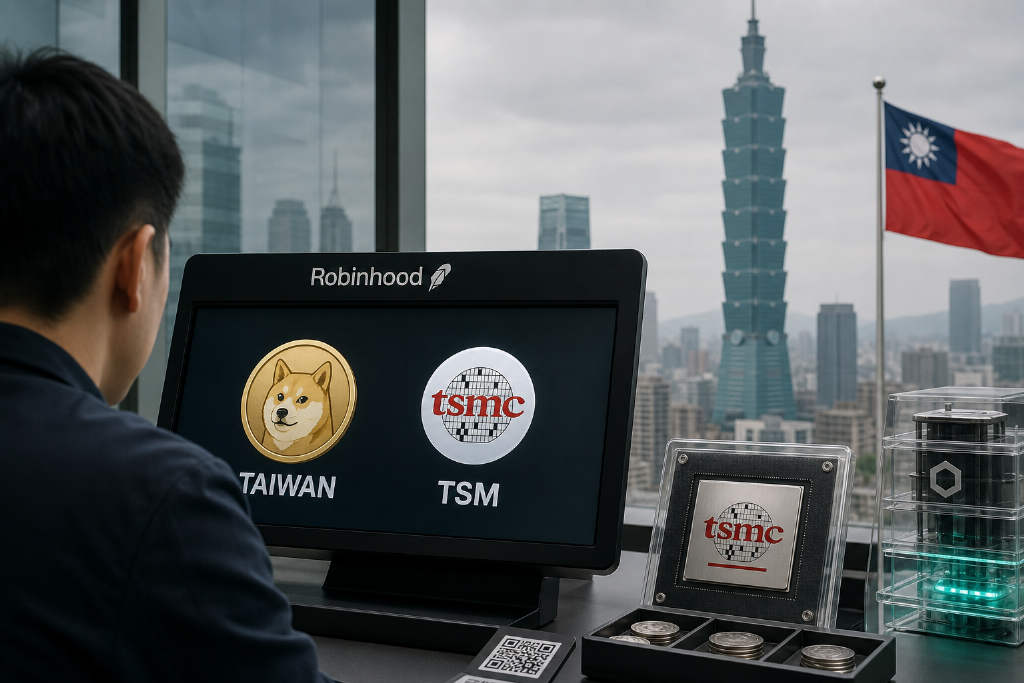
Jeffrey Huang, known as Machi Big Brother, has launched Taiwan Coin (TAIWAN) on Robinhood Chain. What drew the most attention was not the Taiwan theme itself, but the token’s main trading pair: instead of ETH or a stablecoin, TAIWAN trades primarily against TSM, a stock token on Robinhood Chain that provides economic exposure to Taiwan Semiconductor Manufacturing Co.
That means traders can buy and sell the meme token directly with a tokenized stock product. In turn, the TAIWAN/TSM pair has become a fresh test case for the idea that tokenization can make markets programmable.
TAIWAN surged after launch, then gave back most of the move
According to on-chain data, Huang minted TAIWAN through machibigbrother.eth at 1:46 a.m. Taipei time on Sept. 1. Trading started quickly after the token went live.
Because charting tools calculate last traded price, circulating supply, and liquidity pool pricing in different ways, market data showed a range for the early peak. About five minutes after launch, TAIWAN’s market value was estimated at roughly $1.07 million to $1.59 million. By the morning of Sept. 1, that figure had dropped to around $180,000. Using the $1.59 million high as the reference point, the decline was close to 88%.
On Robinhood Chain, stock tokens can serve as quote assets
Robinhood Chain is a permissionless Layer 2 built with Arbitrum technology for financial services and real-world assets, or RWA. Robinhood launched the public mainnet on July 1, 2026, and Uniswap, Rialto, and Arcus now provide stock-token markets on the chain.
Those stock tokens do more than support 24/7 on-chain trading. They can also be placed into lending pools, used as collateral, or paired directly with other ERC-20 tokens.
Most meme tokens are quoted against USDC, USDT, or ETH. TAIWAN/TSM takes a different route by making a stock token part of the quote and liquidity structure itself. Traders buying TAIWAN through that pool pay in TSM, while liquidity providers hold both TAIWAN and TSM and collect trading fees.
That also means TAIWAN’s dollar price is influenced not only by supply and demand for the meme token, but also by moves in TSM’s own dollar price.
Robinhood has said its new generation of stock tokens are tokenized debt securities issued by Robinhood Assets (Jersey) Limited. They provide economic exposure to the reference securities, but holders do not obtain legal or beneficial ownership rights in the underlying company shares.
From NVDA/SPY to TSM, markets do not always need to route back through dollars
Uniswap founder Hayden Adams recently argued that the deepest effect of tokenization is not simply putting stocks on-chain, but making the market itself programmable. If assets share the same settlement layer, they can form direct markets with one another instead of requiring every trade to pass through dollars first.
His example was that an NVIDIA stock token could trade directly against SPY, changing the path from NVDA/USD to NVDA/SPY, with only a smaller number of SPY/USD markets handling the dollar bridge.
According to the report, Robinhood Chain already has 10 stock tokens paired directly with SPY. In the first 12 days after launch, those markets generated $33 million in cumulative trading volume and drew more than 11,000 traders. Trades swapping one stock token directly for another have also appeared.
Adams said pairing two highly correlated assets could reduce inventory risk for liquidity providers. He also noted that TAIWAN/TSM is closer to what he jokingly called a "Vibes correlation": linked by name, culture, and narrative, but not necessarily by any stable statistical price relationship.
That is why the pair matters. It shows the composability available on Robinhood Chain. In this setup, stock tokens are no longer just passive on-chain representations tracking equity prices. They can also act as the pricing unit and liquidity base for a meme token market.