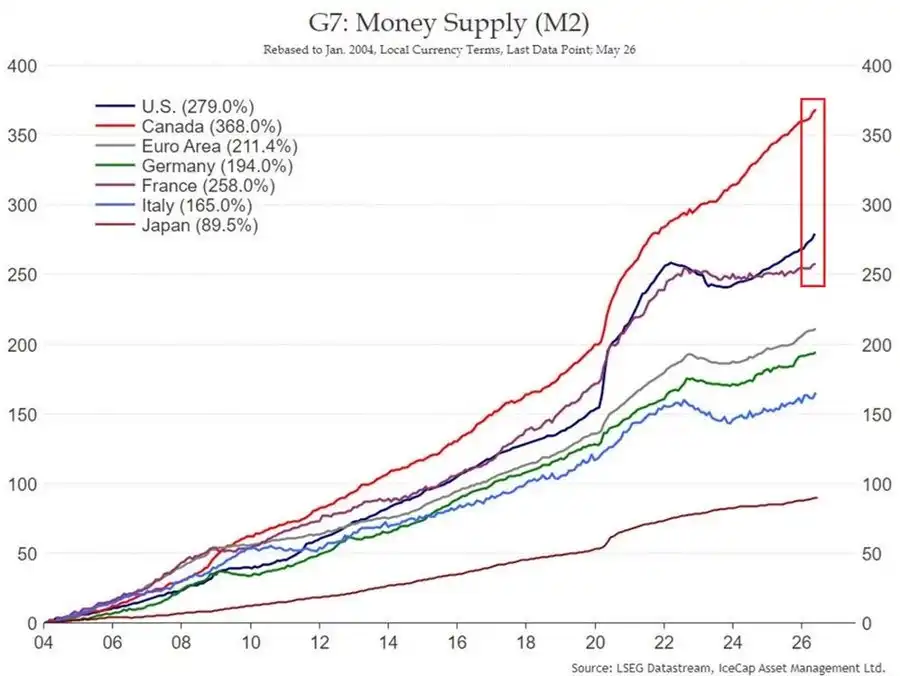
Data cited by BlockBeats on July 25 showed that broad money supply growth has significantly exceeded nominal GDP growth across several major developed economies since January 2004. Canada’s M2 rose 368% versus 159% for nominal GDP, while the United States posted 279% money growth against 171% GDP growth. France, the euro area, and Japan showed similar gaps, with M2 growth of 258%, 211%, and 90%, compared with GDP growth of 84%, 102%, and 25%, respectively.
The analysis said two decades of low interest rates, quantitative easing, and large-scale fiscal stimulus in 2020 and 2021 helped drive a sustained expansion in global liquidity. Central bank money creation, wider fiscal deficits, and bank credit growth together produced a long-running environment of excess money supply.
Some economists argue that because money velocity has fallen and a large share of liquidity has flowed into financial assets, the excess has shown up more in asset prices than in consumer prices. Over a longer horizon, the report said, money growth that continues to outpace economic output may create pressure through asset inflation, currency debasement, or future consumer inflation. Japan and Canada were presented as contrasting cases within that trend.
Data cited by BlockBeats on July 25 showed that broad money supply growth, measured by M2, has outpaced nominal GDP growth across major developed economies since January 2004.
Money growth versus nominal output
Canada recorded 368% M2 growth against 159% nominal GDP growth. In the United States, M2 rose 279% while GDP increased 171%. France posted 258% M2 growth versus 84% GDP growth, and the euro area showed 211% money supply growth against 102% GDP growth. Japan’s M2 rose 90%, compared with 25% GDP growth.
Two decades of expanding liquidity
The analysis said low interest rates over the past 20 years, along with quantitative easing and large-scale fiscal stimulus in 2020 and 2021, drove continued expansion in global liquidity. Central banks increased money supply, governments widened deficits, and bank lending expanded, together creating a long-term environment of excess money.
Some economists said the drop in money velocity, combined with the fact that large amounts of capital flowed into financial asset markets, meant surplus liquidity was reflected more in rising asset prices than in direct increases in consumer prices.
Long-term risks highlighted
Over time, money growth that keeps running ahead of economic output may lead to asset inflation, currency debasement, or pressure for future consumer inflation.
Japan was described as an extreme case, with money supply rising sharply while GDP growth remained weak over the long term and inflation stayed relatively low. Canada was presented as the other end of the spectrum, where monetary expansion has been closely linked to a housing boom and rising household leverage.
This article was originally published by Bit.Fan. For more cryptocurrency news and market insights, visit www.bit.fan. Disclaimer:
The market information, project data, and third-party content displayed on this platform are for industry information sharing only and do not constitute any form of investment advice or return commitment.
Cryptocurrency trading carries high risks. Users should fully assess their risk tolerance and make independent decisions. All profits, losses, and legal responsibilities are borne by the users themselves.