
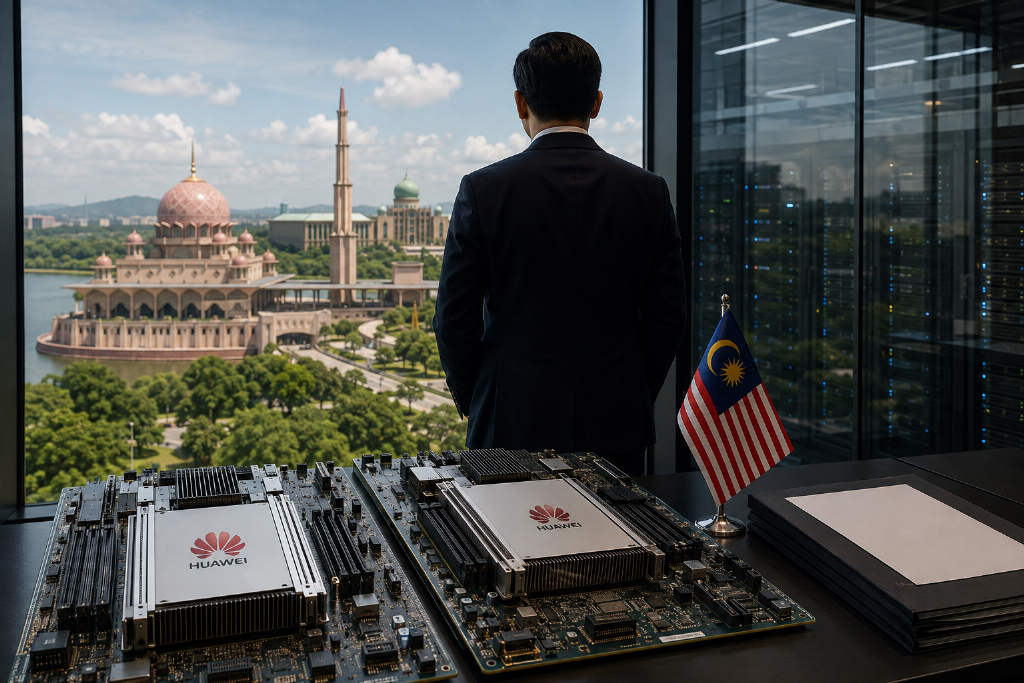
Malaysia is evaluating whether to use Huawei chips for its sovereign AI project, a plan that has been reported at up to 2 billion ringgit, or about $494 million. Bloomberg said that, if approved, the move would become the first known case of a government formally choosing Chinese chips over U.S. ones for a project of this kind.
The chip under consideration is Huawei’s Ascend 910C. U.S. officials have already flagged that model. The Trump administration warned last year that using the Ascend 910C could breach U.S. export rules, meaning a Malaysian purchase would put Kuala Lumpur directly against a line Washington has already drawn.
Data sovereignty is at the center of the project
Prime Minister Anwar Ibrahim has repeatedly said Malaysia does not want to remain just a buyer of foreign technology. According to a digital funding notice tied to the 2026 budget and led by the Malaysian Communications and Multimedia Commission, the sovereign AI project requires data to stay inside Malaysia.
That data is described as highly sensitive, covering government records as well as military and intelligence material. The project is part of Anwar’s broader AI Nation 2030 agenda.
A key source of concern for the government is the U.S. Cloud Act. As described in the report, data handled by U.S. technology companies can still be subject to U.S. court demands even if the servers are physically located in Malaysia. The law was signed during Trump’s first term. In April this year, Anwar told university students that he did not agree with the law, but said it was difficult to argue with President Trump.
Malaysia has assigned the lead operating role to Telekom Malaysia, the state-linked telecom company, which won the position through an open tender.
Telekom Malaysia has long ties with Huawei but currently uses Nvidia chips
Telekom Malaysia signed a cloud and AI infrastructure cooperation deal with Huawei in 2020. It is now carrying the sovereign AI initiative, yet its existing AI compute services run on Nvidia chips.
Its relationship with Huawei also goes back further than its work with Nvidia. If the project shifts to Huawei, the hardware being replaced would in practice be Nvidia chips already in service. Telekom Malaysia did not respond to Bloomberg’s request for comment.
Washington has already singled out the Ascend line
The model being assessed is Huawei’s Ascend 910C, not the supply-constrained Ascend 950 series. On May 13 last year, the U.S. Commerce Department’s Bureau of Industry and Security issued global guidance naming the Ascend 910B, 910C and 910D, treating them as products that lacked authorization.
In practical terms, the report said, use, resale, servicing or financing involving those chips could be viewed by the U.S. as violating export rules, regardless of where those activities take place. That gives the policy an extraterritorial reach.
The State Department has been more restrained in public. It said secure technology is the foundation of economic prosperity and argued that untrusted vendors can be manipulated, disrupted or controlled by authoritarian regimes, creating risks for infrastructure, personal data, intellectual property and national security. It did not publicly name China or Huawei.
Private messages were clearer. U.S. officials have raised concerns with Malaysian counterparts over the possibility that Huawei hardware could handle intelligence material. Officials from Malaysia’s National Security Council are expected to travel to Washington later this month for talks.
Malaysia has tested this line before
This is not the first time Malaysia has explored the use of Huawei’s Ascend chips. In May 2025, the deputy communications minister said publicly that Malaysia would use 3,000 Ascend chips to build a national AI system. That statement was later withdrawn by the minister’s office.
Malaysia’s Ministry of Investment, Trade and Industry then said the country would fully comply with export-control laws, while also stressing that it had the right to make policy in line with its own interests.
In July that same year, the White House signed an executive order bundling U.S. AI hardware, software and applications with government financing for export to countries across the Global South.
U.S. concerns extend beyond a single procurement
Bloomberg said Washington is trying to prevent China from gaining the same kind of influence in AI data centers that it once built in telecom equipment.
Huawei is also pursuing a government tender in Egypt, prompting the Trump team to prepare a response plan. That makes Malaysia’s position a test case for how the U.S. handles countries that do not fully align with Washington but still want American investment.
Lower price is the main draw despite weaker performance
Huawei’s accelerators still lag Nvidia on performance. A TrendForce teardown report said the Ascend 910C delivers about 800 TFLOPS of FP16 performance per card, roughly 60% to 80% of the level of Nvidia’s H100, which was introduced in 2022. Its logic die area is about 60% larger than the H100’s.
Price is where Huawei becomes hard to ignore. The Ascend 910C is priced at around 180,000 to 200,000 yuan per unit, while the H100 sells for about $25,000 to $30,000. On that basis, an integrated Huawei system can cost 60% to 70% less overall than an H100-based setup.
The gap has widened this year. About 70% of global memory output has been absorbed by AI data centers, and SK Hynix’s chief executive warned in July that shortages could continue beyond 2030.
The tender process is still in flux
The report said Telekom Malaysia was selected through an open tender, but some members of the Trump team were unhappy that U.S. companies had too little opportunity to compete. Nvidia and Advanced Micro Devices, or AMD, did not respond to Bloomberg’s requests for comment. One U.S. official said American technology remains unmatched globally and expanding exports is a top priority.
Washington is not treating the matter as settled. Anwar’s government is discussing another tender round that would allow U.S. suppliers such as Nvidia to compete more directly.
Malaysia is also an important market for Nvidia, Microsoft and Oracle, and it hosts one of the world’s fastest-growing AI data center ecosystems. The Malaysian government has kept its public line consistent, describing the matter as a commercial decision. The Prime Minister’s Office, the Digital Ministry and Huawei did not respond to Bloomberg’s requests for comment.