
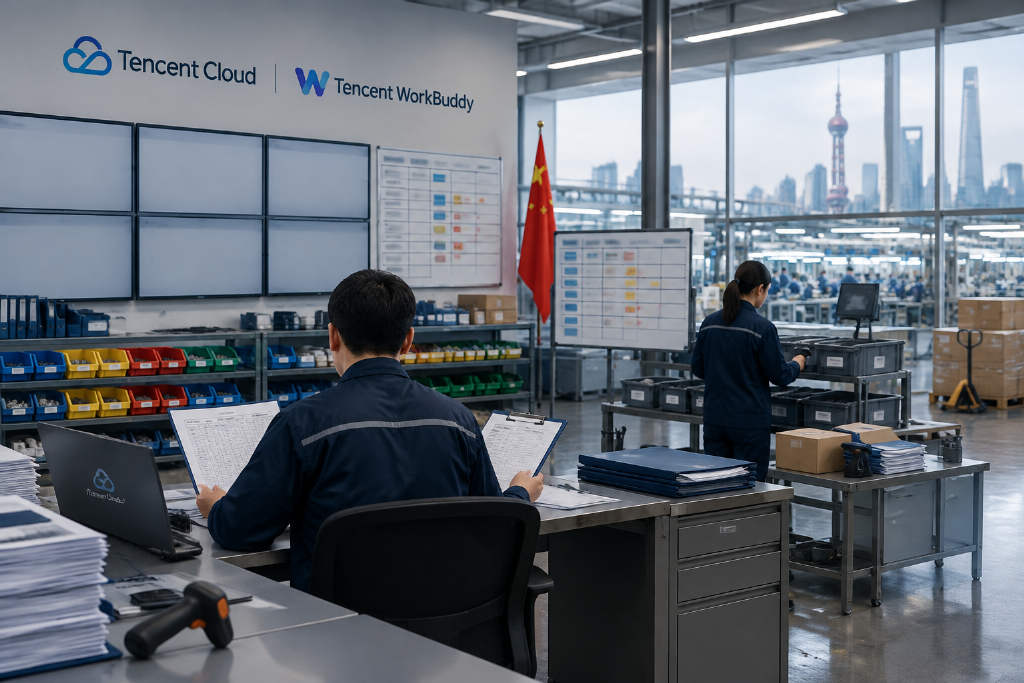
Manufacturers bringing AI into operations are often starting far from direct production control. The earliest wins, according to a new white paper from Tencent Research Institute, Tencent Cloud and Tencent WorkBuddy, tend to come from the repetitive coordination work that sits between orders, materials, processes and people.
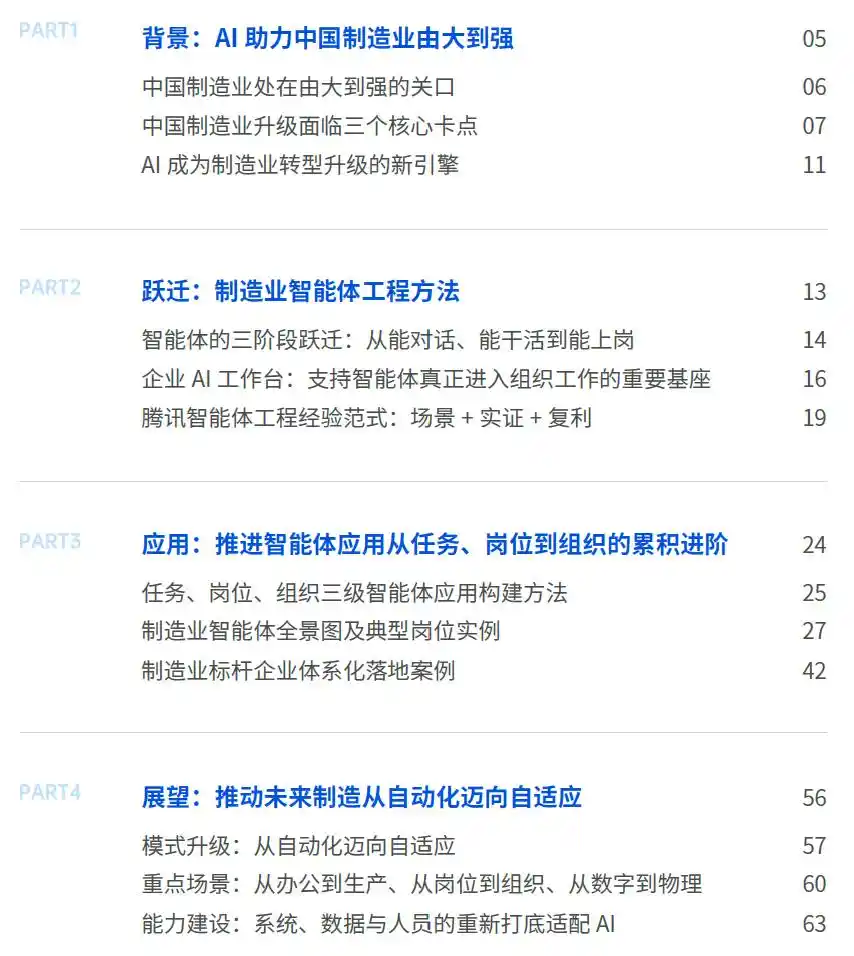
The paper, titled Toward Adaptive Manufacturing: A Practical White Paper on AI Agents in Manufacturing, draws on frontline experiments and lays out practical scenarios, methods and lessons for companies trying to deploy AI agents in manufacturing settings.
Where the friction shows up in manufacturing
For make-to-order manufacturers, a single order inserted into the plan at the last minute, or a change in product configuration, can ripple through a long chain of coordination. Planners need to rebalance delivery schedules and capacity. Procurement teams need to check whether materials are ready. Warehouses need to confirm whether inventory can actually be used. Process teams and workshops then need updated work orders.
If a bill of materials revision changes and one department continues using the old data, procurement, production and delivery can all be affected. Customers only see whether the product arrives on time. Inside the company, the harder task is managing constantly shifting relationships among orders, materials, processes and staffing. A small information mismatch can eventually turn into delayed lead times, cost swings or even quality risk.
The white paper says manufacturers this year have been actively opening WorkBuddy accounts. In the rollouts described in the report, one pattern kept repeating: many companies were not trying to assign AI a grand, all-encompassing role from day one. They began with small, concrete tasks that are tedious, error-prone and easier to validate.
Seven findings from the white paper
The first finding is that manufacturing AI agents are moving from systems that can talk, to systems that can help with work, and then to systems that can actually hold a job. Those three stages map to different capability boundaries: answering questions, assisting with tasks, and receiving assignments under role-based rules before delivering results. The paper defines "being on the job" as the point where AI output can be accepted by downstream teams, verified and traced within a company’s accountability chain.
The second finding is that an AI agent’s first stop in manufacturing is usually not the production line, but the breaks between systems and datasets. Tasks with scattered data, inconsistent definitions and cross-system handoffs that still depend on manual work are common coordination weak spots. Because their rules are relatively clear and their results can be checked, they are suitable entry points.
The third finding centers on engineering method. The report says agents need a repeatable path to deployment: choose a task that has business value and realistic implementation conditions; validate it with real data and live workflows; then turn the rules, templates and examples into reusable assets for the next task. The paper groups that path into three layers: scenario, evidence and compounding.
The fourth finding is that manufacturing agents should accumulate capabilities like building blocks. A company should solve one concrete task first, then connect several tasks into role capability, and only then link those roles into cross-functional coordination. Each completed capability should become the base for the next one.
The fifth finding focuses on system connectivity. An agent can only move from adviser to executor if it can access real data, interact with business systems and leave an audit trail. That is what makes it possible, within defined authorization, to complete work-order adjustments, material shortage checks or quotation preparation.
The sixth finding is that AI lowers the cost of information handling and rule execution, which makes human judgment more important, not less. Whether a company can clearly explain its experience, write down its rules and separate out exceptions determines whether an agent can create stable value.
The seventh finding points to what the report calls controlled adaptiveness. Agents are expected to move deeper into production systems, cross-role collaboration and physical environments. The closer they get to control and execution, the more clearly companies need to define authority boundaries, safety loops and human oversight.
BOM baseline checks as an entry point
The report says many manufacturers already have a range of digital systems, but the hard part often lies between them. A change notice may be scattered across spreadsheets, emails and business pages. Employees then need to check, supplement and confirm the information repeatedly before the next step can continue. Material changes, completeness checks, drawing-based quotations and invoicing reconciliation all fall into that category. They do not directly make the product, but they often sit at critical choke points for procurement, production and delivery.
BOM baseline verification is presented as a representative case. Once a product revision is issued, engineers need to identify differences across multiple files and judge which ones will affect procurement and production. An agent can handle multi-format parsing, data inspection, difference extraction and impact mapping first, then produce a list that marks risks and pending confirmations. Product engineers can use that list to confirm the baseline and decide how to handle it.
Based on the expected effect measured for this task level, the report says manual effort for one BOM revision can fall from 3-5 hours to 0.5 hours, while the cycle time can be shortened from 1-2 days to getting a list on the same day. The bigger change, in the paper’s view, is that a verification process once dependent mainly on individual proficiency begins to turn into a work standard that others can inspect, review and continue.
What it means for an agent to be "on the job"
The report argues that the real test is not whether AI can generate a result by itself, but whether it can fit into a chain of work where someone receives the task, someone confirms it, someone takes the output, and someone is accountable if anything goes wrong.
It uses short-term scheduling and urgent order insertion in production and material control, or PMC, as an example. The chain has roughly four links. Upstream teams provide due dates, material completeness and equipment capacity as the basis for scheduling. AI takes the middle segment: it generates a scheduling plan under priority rules, adjusts work orders after the plan is confirmed, sends notices to departments and leaves a record of what was handled. Humans remain at key control points. PMC staff review whether the plan is feasible, and people still decide urgent order trade-offs and exceptions outside the rules. Downstream processes then arrange production according to the notifications.
In other words, AI is not doing the whole job from start to finish. It is taking over a middle segment that can be checked and traced. The paper says this division of work can reduce manual input from 3-4 hours to 0.5 hours and cut end-to-end response time for urgent orders to 15 minutes, with expected significant gains.
From one task to role capability
One of the easiest mistakes for companies, the report says, is expecting AI to cover an entire department or even a full workflow from the outset. A more reliable route is to start with one task that has clear boundaries and then extend into adjacent work.
Material shortage review illustrates that approach. Material Requirements Planning, or MRP, can calculate a book shortfall, but it cannot answer several more important questions on its own: can warehouse stock actually be used, are substitute materials qualified, when is the material truly needed, and is the order worth an emergency purchase. In the past, procurement, planning, warehouse and process staff often had to confirm these issues back and forth, and some problems would not surface until just before production began.
An agent can place inventory, required timing, substitute material conditions and in-transit orders into the same decision sheet, then divide the results into three categories: "can start as planned," "can start under conditions," and "requires escalated decision." It does not make commercial commitments for buyers, and it does not decide delivery trade-offs for planners. Its role is to surface the real gap, the paths that can resolve it, and the issues that genuinely need judgment.
Once that task is stable, the data definitions and exception-handling methods captured there can extend into neighboring work such as completeness warnings, procurement follow-up and slow-moving material disposal. Capability grows step by step: first one task, then one category of role work, and eventually cross-department coordination.
Turning experience into executable rules
The white paper says AI is good at pulling data, calculating and checking against rules, but those rules do not appear on their own. The core job for manufacturers is to turn the know-how in senior employees’ heads into rules that AI can execute consistently: when to stock, how much to stock, and under what circumstances a case should be escalated.
Guangzhou Vision is cited as a supply-chain example. Faced with material price swings and longer procurement cycles, the company combined market prices, inventory levels, in-transit orders and historical consumption into one process and converted years of procurement management experience into risk grading and decision rules. AI then organizes the information and generates order suggestions under those rules, while business staff keep final approval authority.
According to the practice metrics cited in the paper, this joint decision process for dynamic inventory and pricing can be reduced from 3 days of manual work to 2 hours with AI assistance, while also supporting automatic monthly refreshes.
A vice general manager and director at Guangzhou Vision said: "We turned management experience into executable decision rules. After handing those judgment logics to AI, it can automatically refresh and make rolling decisions every month under fixed rules, and the results have been good."
The paper adds that the hard part is not merely explaining experience, but expressing previously hard-to-articulate experience as executable rules. The clearer the rules, the more stable AI execution becomes. When market conditions change, people then recalibrate the rules, add knowledge and handle exceptions. Once experience enters the rule system, it no longer moves with individuals and can instead become an organizational capability that is reused and continuously revised.
System connectivity determines whether agents can execute
To move from offering suggestions to actually getting work done, the paper says agents must connect to the company’s existing operating systems. They need to read real data, carry out necessary actions within authorization, and leave a record of the process. If any of those pieces is missing, it becomes difficult for AI to take on a role task.
The challenge is not limited to plugging in interfaces. An agent also needs to understand what a work order or a material code means in business terms. It must know which actions it can complete on its own, which ones require human confirmation, and who should handle conflicts when they arise. The deeper the system integration goes, the more important it becomes to define permissions, audit mechanisms and rollback mechanisms in advance.
For that reason, the report says system connectivity should assign a clear data scope, execution authority and responsibility owner to each action. Companies can then expand AI’s operating range step by step while preserving both speed and control.
From one scenario to organizational capability
Showing results in one scenario only proves that one task can be handed to an agent. If a company wants sustained returns, the report says the people who know the business best still need to define tasks, refine rules, inspect outputs and share proven methods with other roles.
Zhuhai Tonly Foma is described as using a model of "business-led, technology-supported" implementation. Business staff build efficiency-improvement flows themselves, while IT teams provide technical support. Once a solution is validated, it enters a case library and is then copied into cross-functional settings. Based on the practice data cited in the paper, the company has accumulated more than 50 application scenarios across six functions.
The CIO of Zhuhai Tonly Foma said: "Real AI means agents can automatically collaborate with one another. In the future, I’ll be able to coordinate the work directly inside WorkBuddy."
The value of that mechanism, the paper says, is that experience no longer stays with one person or one department. The earlier framework of scenario, evidence and compounding addresses whether a single task can land reliably. Business participation, case libraries and role reuse address how those small capabilities connect into a broader collaborative network.
Adaptive manufacturing starts with hard boundaries
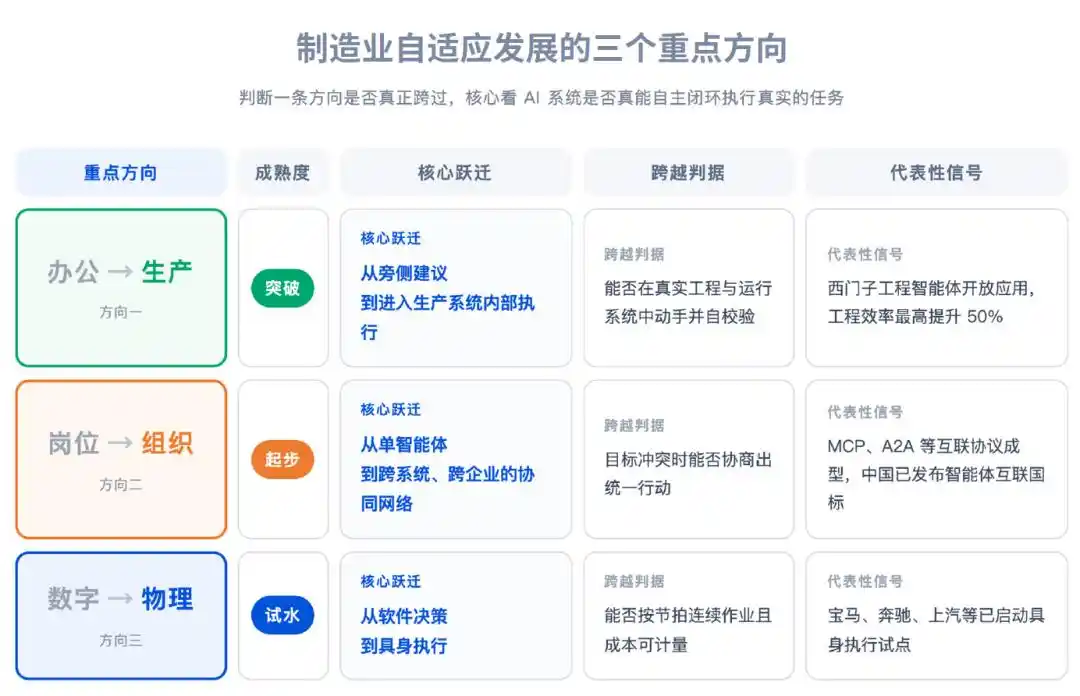
The paper contrasts past automation in manufacturing with what it calls adaptiveness. Traditional automation writes human actions into fixed programs, and when changes fall outside those programs, operations stop and people intervene. Adaptive systems are meant to judge and act on their own within predefined boundaries. The key to autonomy inside a boundary is the boundary itself.
One example is service dispatch. When a customer says a device has alarmed or shut down, an agent can first complete the equipment information, identify safety red lines such as smoke, odor or abnormal discharge sounds, and then suggest remote handling or an on-site visit. That turns a vague description into a work order a supervisor can assess. Fault diagnosis, dispatch decisions and fee commitments still require human confirmation. Once the boundary is clear, AI can confidently take over the intake stage first.
Closer to production, the division of labor becomes finer. The paper says shop-floor operations require millisecond-level certainty, which means probabilistic models should not directly take control. High-frequency data collection, anomaly detection and safety loops should first be handled by edge devices and deterministic systems. Agents then call those results when needed for analysis and coordination, while critical actions still pass through simulation checks, human review or safety circuits.
Only after boundaries are made concrete can autonomy gradually expand inside them. The paper says manufacturing agents are likely to move forward from easier to harder tasks: deepen digital tasks first, then connect to production systems, then move toward multi-agent collaboration, and finally extend into the physical world. The clearer the boundary, the more room there is for autonomy.
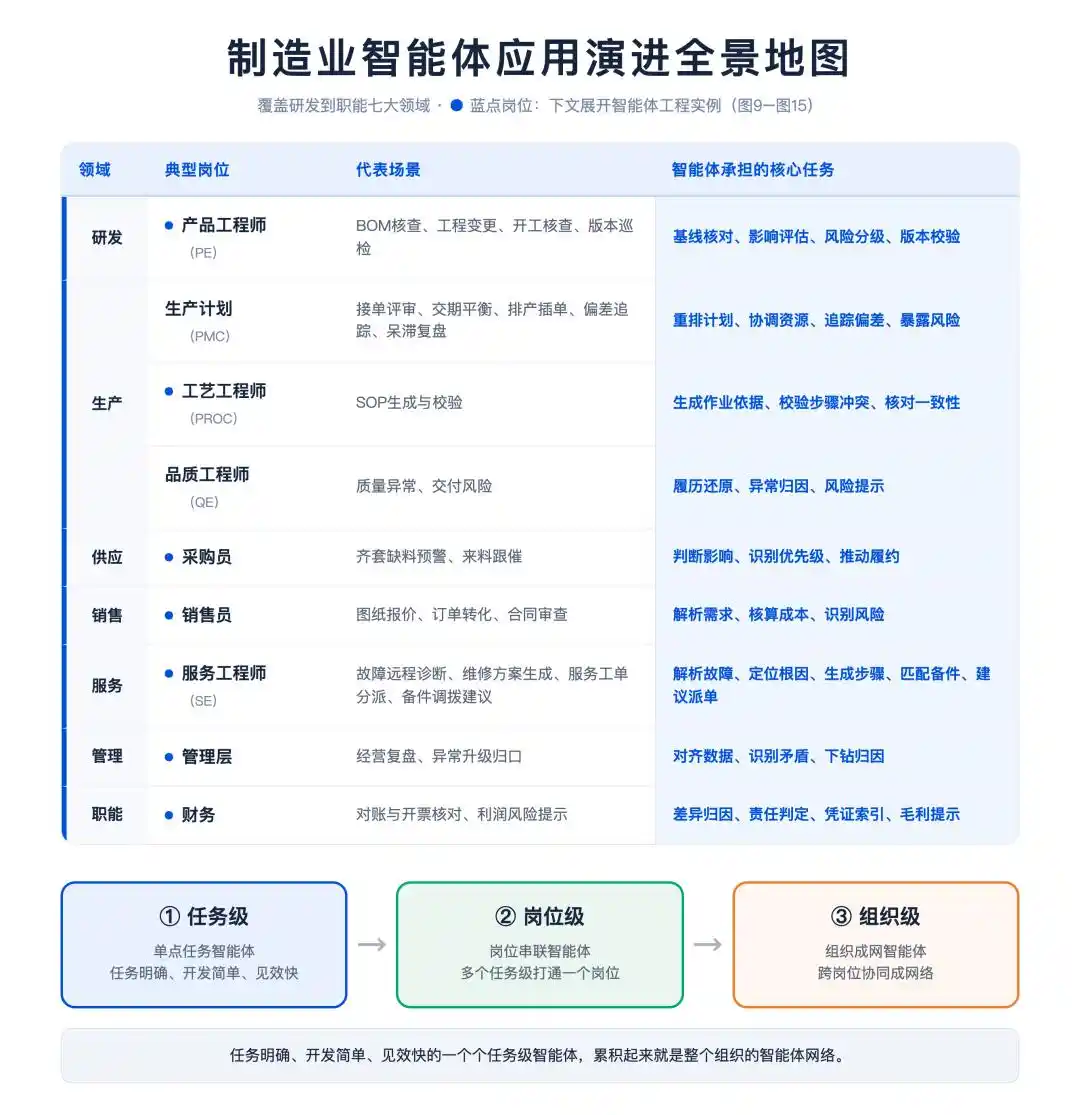
The paper covers seven roles and three companies
The report closes by arguing that the difficulty in manufacturing AI lies not only in model capability. It also depends on whether a company can break real pain points into specific tasks, connect data, rules and systems, turn experience into verifiable working methods, and draw a workable line between efficiency and accountability.
A scheduling adjustment sheet, a material shortage review and a drawing-based quotation may each look like small tasks. But once those tasks can be executed accurately, validated repeatedly and reused across more roles, a new layer of organizational capability begins to form.
That is the path described in Toward Adaptive Manufacturing: A Practical White Paper on AI Agents in Manufacturing: start from a real scenario and let AI run the first leg, then keep people and AI working together inside clear rules, data structures and responsibility boundaries, moving toward a manufacturing organization that is more resilient and better able to adapt to change.
The white paper, according to the article, maps typical task scenarios across seven roles and presents system-level implementation experience from three representative companies. The article was first published by the WeChat public account Tencent Research Institute (ID: cyberlawrc) and authored by Wu Pengyang.