
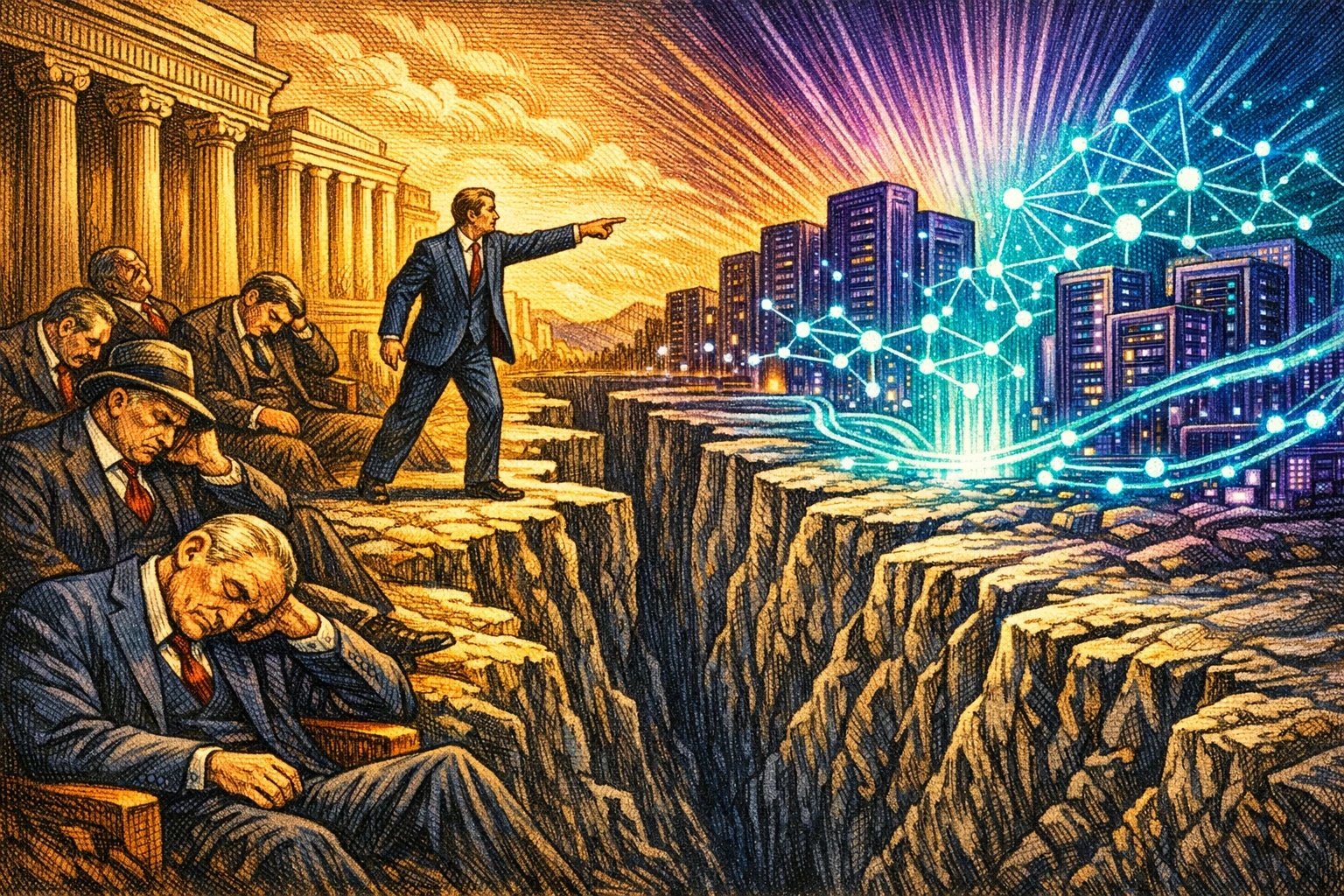
U.S. stocks wiped out $800 billion in market cap as the narrative "AI will take everything" became consensus. Shares of IBM, Adobe, and CrowdStrike plunged sharply after Anthropic released new Claude tools, fueling widespread panic over white-collar job displacement. But The Kobeissi Letter argues the doomsday script rests on three flawed assumptions: fixed demand, productivity gains not expanding markets, and system adaptation lagging behind disruption.
Anthropic's tools trigger instant sell-offs
On February 20, Claude launched "Claude Code Security," and CrowdStrike lost $20 billion in two trading days. IBM suffered its worst single-day drop since 2000 after Claude simplified COBOL code; Adobe is down 30% year-to-date. The market is rationally pricing in immediate profit compression. When AI can replicate a worker's output, pricing power shifts from seller to buyer. That's first-order impact — real and brutal.
Commoditization of cognition ≠ economic collapse
Commoditization is not collapse, says Kobeissi. PCs commoditized computing, the internet commoditized distribution, cloud commoditized infrastructure, and AI is commoditizing cognition. When the cost of producing something drops sharply, demand rarely stays flat — it expands. A PC today costs 99.9% less than in 1980, yet people consume orders of magnitude more computing power and built entire new industries on top of it.
The bearish vicious-cycle model is too simplistic: AI stronger → firms fire workers → spending drops → firms reinvest in AI. This assumes a static economy. History shows that when the price of a service falls, purchasing power rises even if wages don't. AI is effectively an invisible tax cut for households and small businesses.
Ghost GDP vs. Abundance GDP
Bears rely on "Ghost GDP" — growth on paper that doesn't improve lives. Bulls point to "Abundance GDP" — output growth paired with falling living costs. If AI lowers costs in medical administration, legal paperwork, customer service, and coding, small businesses survive more easily and more families can participate in the economy. Services account for nearly 80% of U.S. GDP; cost compression there unlocks enormous real purchasing power.
White-collar impact: valid concern, not a certainty
The fear that AI will disproportionately hit white-collar jobs is reasonable, especially amid existing inequality. But AI still struggles with physical dexterity and identity-based roles — tradespeople, hands-on healthcare, advanced manufacturing retain structural demand. Moreover, AI lowers the barrier to entrepreneurship: one person can now automate accounting, marketing, customer service, and coding, making small-scale businesses far easier to launch. The internet killed some job categories but created entirely new ones. AI will likely follow a similar trajectory.
SaaS transforms, not dies
AI pressures traditional SaaS business models, but SaaS is a delivery mechanism, not the end of value creation. The next generation of software will be adaptive, agent-driven, and outcome-oriented. Profit compression in one layer doesn't mean the digital economy collapses — it signals a shift.
Productivity and geopolitical upside
U.S. labor productivity hit its fastest pace in two years during Q3 2025. Even a sustained 1-2% productivity gain produces enormous compounding over a decade. Less discussed is the geopolitical angle: AI-driven abundance could reduce resource-driven conflicts. When growth is no longer zero-sum, protectionism becomes economically inefficient. The post-WWII industrial expansion already proved that technology accelerations tend to reduce global conflict over the long run.
Kobeissi Letter concludes: the Anthropic-driven "slaughter" is a signal that workflows are being repriced, but transformation is not collapse. The world always finds a way to adapt.