
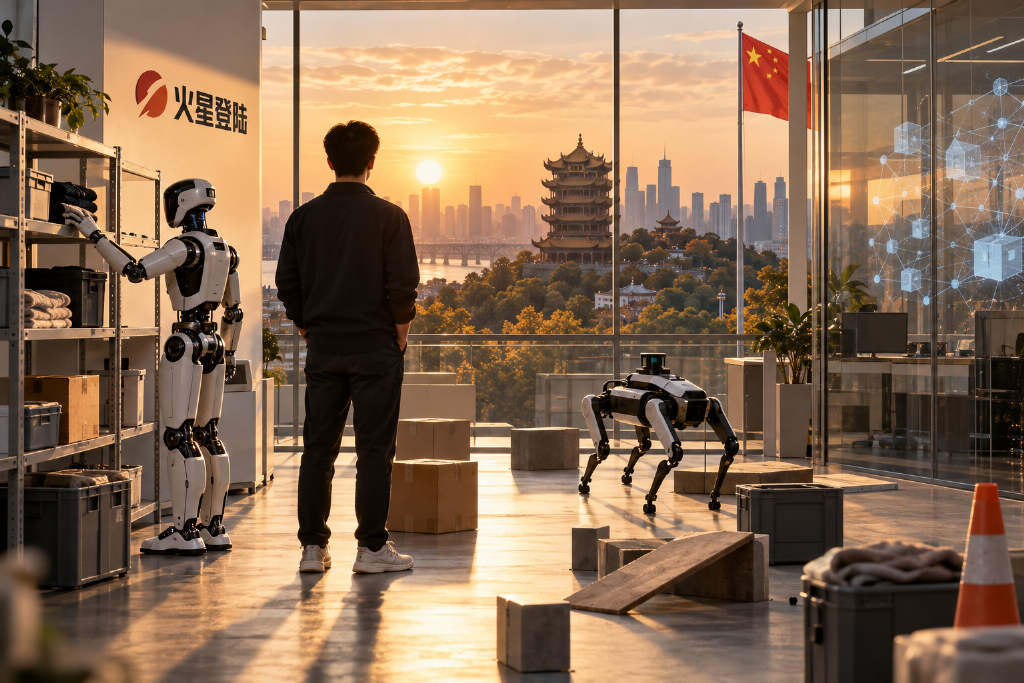
Mars Landing, formally Wuhan Qizhi Mars Landing Technology Co., has completed two consecutive funding rounds worth tens of millions of yuan, according to the article. The rounds were backed by Leaguer Venture Capital, Optics Valley Financial Holding, Ruijiang Investment and Wuhan Hi-Tech Group, with existing investor MiraclePlus increasing its stake.

The company was founded in April 2025. Its founder, Zhu Yuhan, is from the post-2000 generation. Instead of training a larger embodied foundation model, the startup has chosen another route: building a brain-like intelligence architecture for the physical world on top of spatial intelligence.
A model is not the same as a brain
Zhu’s starting point is a view that the industry may have equated “model” with “robot brain” too early. As he put it, “A model essentially provides one capability or a set of capabilities. No matter how strong those capabilities are, they do not equal a complete brain.”
He argues that the gap becomes especially clear in long-horizon tasks. Robots today can already perform well in single tasks and in some cross-task or cross-scene settings, including grasping, sorting, folding clothes, opening doors, carrying objects and mobile manipulation. But being able to do many things is different from being able to autonomously finish one complex job over a long period of time.
Once a task stretches from minutes to hours, and a robot is expected to keep operating across scenes and tasks, the problem becomes much harder. The machine has to decide what to do next, remember where it is, track what it has already done, and know what stage the task has reached. If the environment changes or execution fails, it also has to adjust and continue.
In Mars Landing’s view, those issues are difficult to solve simply by making a model stronger. Long-duration autonomy depends on persistent spatial memory, task-state management, coordination across capabilities, and feedback-based error correction. The question is no longer only whether the model is powerful enough, but how those capabilities are organized over time.
Zhu said, “Models solve capabilities. A brain solves how to organize capabilities into intelligence.” For the company, “brain-like” does not mean imitating neurons. It means building an organizational layer outside the model so that memory, tasks, skills, action and feedback form a continuous loop.
The path has not converged, and experience matters more
Large-model scaling has been validated over the past few years, and that has led many in the industry to try to copy the same path into embodied intelligence. Mars Landing’s position is that if a model is not the same thing as a brain, then scaling models alone may not scale into a true machine brain.
Language models already have a relatively clear scaling path. Embodied intelligence does not. The industry still has no settled answer on what data is truly valuable, how it should be collected, how it should be organized, or how it should be used for training.
Embodied data is also tightly tied to the robot body, sensors, action space and model architecture. If the technical paradigm changes, the value of past data may need to be reassessed.
That is why Zhu said it is too early to judge moats simply by asking who has more data. “The industry likes to talk about data scale in terms of millions or tens of millions of hours. But if the data paradigm itself has not converged, then having 1 million hours or 10 million hours of data today does not directly show how deep the moat is.”
He added that in a period of rapid technical change, more data does not always mean a stronger moat. It can also mean higher migration costs. Data assets accumulated today could even become historical baggage later.
This view is reflected in the company’s technical route. Rather than focusing only on data volume, Mars Landing is paying closer attention to whether machines can keep forming experience through interaction with the real world. Data records what happened. Experience also includes action, outcome, failure and correction.
In the company’s framing, if token scaling is a key foundation for language models, embodied intelligence may need something closer to “experience scaling” — whether a machine can keep accumulating useful experience through action, feedback and correction.
Why it is looking at open environments instead of only factories
Zhu also offered a different take on the popular theme of putting robots into factories. In his view, factory deployment is a real demand, but it is not the same thing as embodied intelligence reaching practical adoption. A meaningful share of those needs are still automation problems at their core.
For a factory, he said, what is being purchased is not the robot’s “level of intelligence” but productivity. Companies care about whether the system is cheaper, faster and more stable, and how long it takes to pay back the investment. If traditional automation, machine vision and a moderate amount of AI can already solve the problem reliably, replacing that setup with a more “intelligent” robot does not automatically create extra value.
That said, more general robotic capabilities are showing value in flexible manufacturing, complex assembly, non-standard operations and existing environments that are difficult to fully retrofit.
Zhu drew a distinction between two questions: where robots can be deployed more easily, and where machine intelligence can evolve more easily. He does not see those as the same thing.
Industrial production tries to reduce uncertainty through standardization. General machine intelligence, by contrast, has to deal with uncertainty. The more completely a problem can be standardized, the closer it is to an automation problem. The less it can be standardized, the more valuable intelligence itself becomes.
That logic has led Mars Landing to focus on underground spaces, tunnels, forests and emergency-response settings, as well as future home, eldercare and commercial-service scenarios. What these environments share is that the world will not be fully standardized for robots.
In those settings, networks can drop, positioning can be lost, and both tasks and environments can change. Machines have to handle a large number of problems that were not fully defined in advance. Zhu said these complex, open-ended and long-tail environments are closer to the real world that machine intelligence will ultimately have to face.
The real world is not just a test set
Looking further out, Zhu said true embodied RSI, or Recursive Self-Improvement, cannot happen without sustained interaction between machines and the real world. Simulation, synthetic data and world models can lower training costs and improve learning efficiency, but machines still need real-world feedback. In his description, they must form a loop of perception, memory, decision, action, feedback, error correction and relearning while carrying out tasks.
One failed attempt should not end as a log entry alone. It should change how the machine behaves the next time it faces a similar problem. Zhu said, “The real world should not be only the final test set for embodied intelligence. It should itself become part of the machine’s continuous learning.”
That is another layer of what Mars Landing means by “brain-like”: not only how intelligence is organized, but also how it is formed through ongoing interaction with the world.
Building a product stack around spatial intelligence
Based on those judgments, Mars Landing did not choose to train another embodied foundation model. It chose to enter from spatial intelligence and build the underlying architecture for machine intelligence.
To operate in the physical world, a machine needs to keep understanding where it is, what is around it, where it has been, how the environment has changed, and how tasks relate to space.
Around that direction, the company has built a technical system that spans spatial understanding and memory, task organization and coordination, and on-device skill execution. It has also formed a product matrix consisting of Xingqing M1, Xingqun M2 and Xingmang M3.
Zhu said this is not meant to replace VLA, world models or stronger foundation models that may emerge later. His view is the opposite: models will keep getting stronger. But as models become stronger and machines gain more capabilities, the question of how intelligence is organized becomes more important, not less.
As AI moves into the physical world, the next-stage problem may no longer be only how much a machine can do. It may be whether the machine can maintain memory in a changing environment, organize complex tasks, accumulate experience from real feedback, and ultimately achieve long-duration autonomy. That is the direction Mars Landing is betting on.