
Citi said in an Aug. 28 research note that Marvell is evolving from an AI connectivity chip company into a custom computing platform company. The firm said Marvell raised its full-year revenue outlook for a second consecutive quarter, lifting its FY2027 revenue forecast from $11.5 billion to about $12 billion and its FY2028 forecast from $16.5 billion to about $18 billion.
Management expects data center revenue to grow by more than 60% in both FY2027 and FY2028. Citi kept its Buy rating and its $275 price target, based on 28x CY2028 expected earnings.
Second straight increase in guidance puts data center at the center of growth
Marvell reported July-quarter revenue of $2.74 billion, roughly in line with expectations. Non-GAAP earnings per share came in at $0.94, slightly above the $0.93 market consensus, but below the company’s prior guidance of $0.95 and Citi’s $0.96 estimate.
The October-quarter outlook was stronger. Marvell guided to midpoint revenue of $3.15 billion, up 15% from the prior quarter and 52% from a year earlier, above the $3.0 billion consensus. Citi said data center is the main growth contributor, with about 18% sequential growth.
Gross margin guidance was 58.25%, down about 50 basis points sequentially. Citi attributed that to a higher mix of custom ASIC revenue and dilution from acquisitions, though strong optical sales partly offset the pressure. Non-GAAP EPS guidance was $1.10, above the $1.07 market consensus.
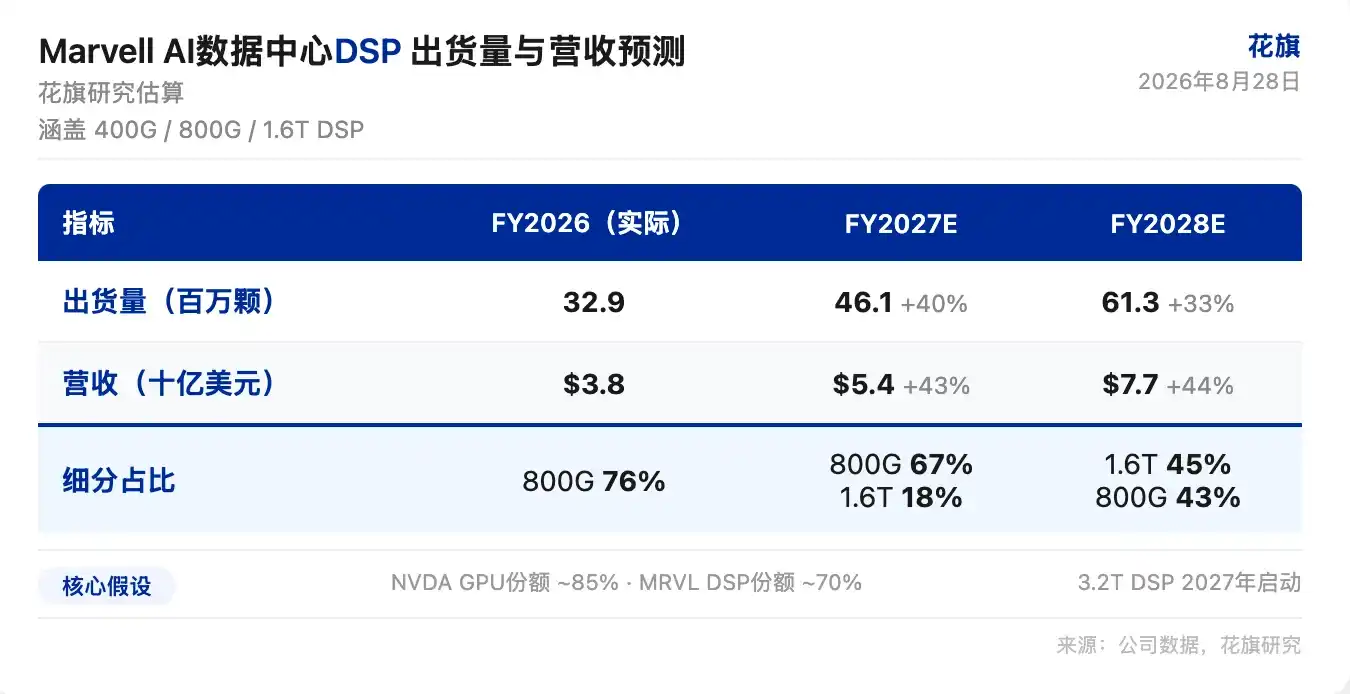
Citi estimates Marvell’s AI data center interconnect DSP sales will reach $5.3 billion in FY2027 and $7.7 billion in FY2028, with year-over-year growth of about 44% in both years. Its assumptions include Nvidia holding about 85% share of the AI GPU market, AI GPUs accounting for about 52% of all AI accelerators, Marvell maintaining about 70% share of the AI data center DSP market, strong volume ramp for 1.6T DSP in the second half of 2026, and 3.2T DSP shipments beginning in 2027.
Google agreement spans the full XPU-attach category
The note said Marvell signed an expanded commercial agreement with Google in late July. Citi said the deal covers multiple categories, including AI inference accelerators, storage controllers, NICs, memory interface controllers, and near-memory compute. In Citi’s reading, that scope matches the XPU-attach category Marvell defined several years ago, rather than a single program.
Citi said the distinction matters. The market had previously worried that Marvell might take share from Broadcom in the core compute die inside Google TPU systems. Citi’s interpretation, which it said is consistent with Bank of America’s view, is that Marvell’s role is focused on surrounding XPU-attach chips, while Broadcom still holds the core compute silicon.
The XPU-attach market is fragmented, with many product categories and lower value per individual program. Taken together, Citi said, the market can still become meaningful in size.
Management also reaffirmed its long-term target of $10 billion to $11 billion in custom chip revenue for FY2029, and said several larger projects tied to the new Google agreement will contribute later. Marvell also stated that “custom business will accelerate significantly in the second half of FY2027,” and set a specific internal timeline ahead of its Oct. 6 investor day.
CPO and NPO optics emerge as another major focus
Beyond custom silicon, Citi pointed to scale-up optics as another long-term pillar for Marvell. On the earnings call, management described scale-up optics as “one of the most exciting areas for Marvell” and said the company has won additional CPO and NPO design slots over the past several quarters.
Citi estimated that Celestial AI’s CPO/photonic fabric program is worth about $150 million, while the broader scale-up optics category, including NPO, is worth about $300 million. Both figures were first disclosed on the prior quarter’s earnings call.
Management described the opportunity as “huge” and said it will provide a full update on the technology roadmap and revenue framework at the Oct. 6 investor day. Citi said Marvell’s strategy is to participate across multiple scale-up photonics architectures, including both CPO and NPO, while continuing to grow its scale-up interconnect business.
Valuation and risk factors in Citi’s report
Citi maintained its $275 target price based on 28x CY2028 expected earnings, in line with the stock’s average valuation over the past three years. The firm said it shifted its valuation base year from 2027 to 2028 to reflect better visibility from Marvell’s two-year revenue outlook.
Citi expects Marvell’s total data center revenue to reach $9.8 billion in FY2027 and $16.5 billion in FY2028. Of that, XPU/XPU-attach-related revenue is projected to account for about 20%, or roughly $2.0 billion, in FY2027 and about 28%, or roughly $4.7 billion, in FY2028.
The bank expects FY2028 non-GAAP operating expense growth to run at about half the pace of revenue growth, which would support more margin expansion. It also expects non-GAAP operating margin to reach the company’s long-term 38% to 40% range in the fourth quarter of FY2027, then move toward the high end of that band in FY2028.
Upside and downside scenarios cited by Citi
Citi listed downside risks that include weaker storage demand, slower-than-expected network growth, and share losses in storage and networking.
Upside risks include stronger-than-expected M&A synergies and faster share gains in storage and networking.
The original article said it was a整理与解读 of a third-party brokerage report from Citi dated Aug. 28, 2026, combined with public market information. It also said the ratings, target price, earnings forecasts, and related views cited in the piece reflect the analyst’s opinions and represent only the brokerage’s position, not the view of Chaoxiang Research, and do not constitute investment advice.
The original article also said that markets carry risk, decisions should be made independently, and the piece should not be used as a basis for buying or selling any security.