


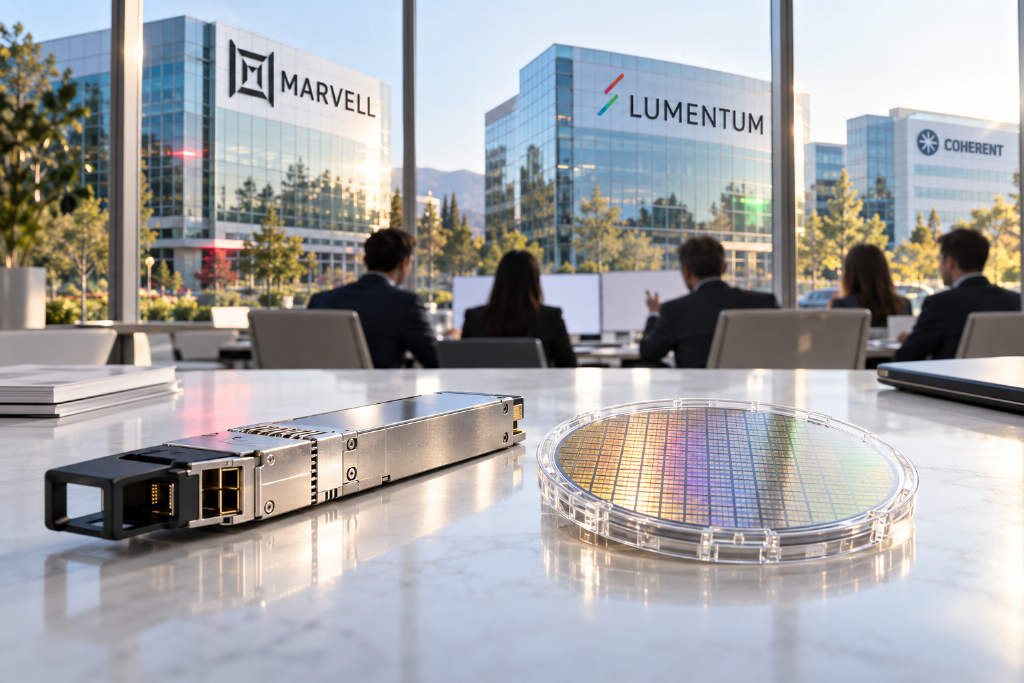
Marvell Technology (NASDAQ: MRVL) is in advanced talks to acquire data-center optical components maker Lumentum Holdings (NASDAQ: LITE), according to Bloomberg and The Information, both citing people familiar with the matter. Those people said a formal agreement could be announced as soon as next week, in early November, if negotiations stay on track. They also said the terms and timing could still be delayed, and the deal could still collapse before a final signing.

So far, outside reports have not disclosed a per-share offer or the payment structure, including the split between cash and stock. Given Lumentum’s size, the market expects any transaction to include a large stock component.
A deal that could approach $90 billion to $100 billion
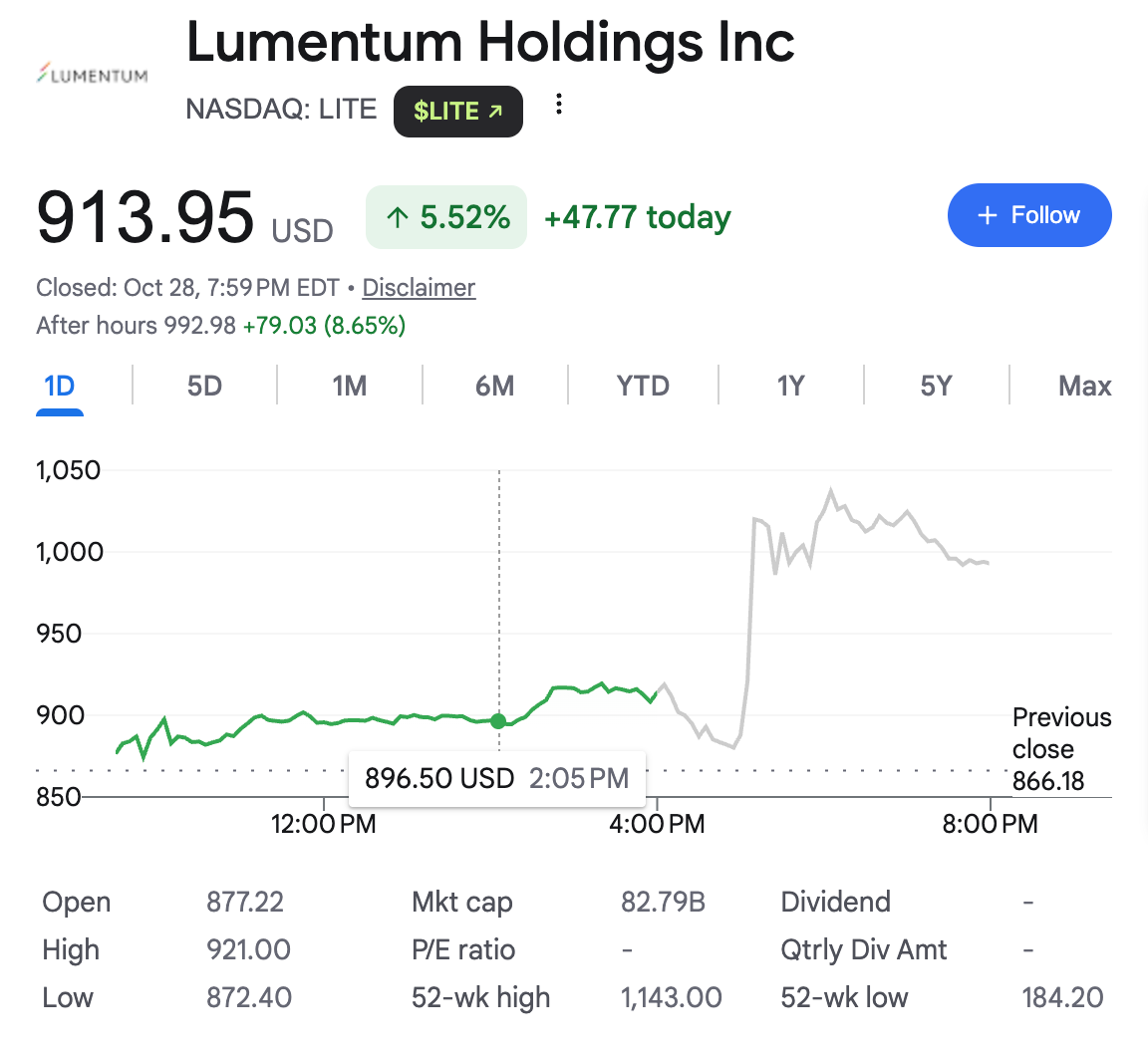
Before the takeover report surfaced, Lumentum had already been one of the biggest beneficiaries of rising demand for AI data-center optical interconnects. Its stock had climbed more than 360% over the past year, lifting its market capitalization to about $83 billion. Marvell, the prospective buyer, is valued at about $221 billion. Add a standard control premium, and the potential transaction could come close to $90 billion to $100 billion.
If completed, the acquisition would not only rank as the largest deal the optical communications industry has seen, it would also stand as one of the most expensive bets in the global semiconductor sector this year.
Why Marvell is looking at Lumentum now
The report ties Marvell’s interest to a basic constraint in AI infrastructure. As AI clusters scale from tens of thousands of accelerators toward hundreds of thousands and even millions, traditional copper links inside servers and between racks are running into limits in signal loss, heat, power consumption, and transmission distance. In that setting, the shift from copper to optics is no longer a distant idea. It is becoming a hard requirement as data-center networks move toward 1.6T, 3.2T, and co-packaged optics, or CPO.

For Marvell, the first strategic objective is to build a tighter stack that combines electrical chips with optical devices. In 2021, Marvell used a $10 billion acquisition of Inphi to secure a leading position in PAM4 DSPs, the digital signal processors at the core of optical modules. As the industry moves deeper into ultra-high-speed optical interconnects, the report argues that DSPs alone are no longer enough for the tighter electro-optical integration required in silicon photonics and CPO.
Lumentum brings a different set of assets. It has leading technology in EMLs, or electro-absorption modulated lasers, and high-power CW, or continuous-wave, lasers. Marvell is already a major customer for Lumentum laser components. Bringing Lumentum in-house would give Marvell a way to align computing interconnects, DSPs, and upstream laser sources inside one development and supply chain.
InP wafer capacity is another central issue
The report says Marvell’s second strategic target is control over indium phosphide, or InP, wafer lines. In optical communications, the bottleneck is not demand. It is the shortage of upstream InP laser wafer capacity.
Lumentum CEO Michael Hurlston told Bloomberg in early October that the company’s optical device capacity had effectively sold out through early 2029, and that some customers had already started locking in orders for 2030. He also said that in 2027, customer demand for some core products would exceed available supply by as much as 70%, while the supply gap in 2028 would still be about 30%.
That matters directly to Marvell’s growth logic. In high-speed optical modules, electrical chips and optical chips are paired products. If one laser set is missing upstream, one high-margin DSP or silicon photonics solution may not be sold downstream. As the industry moves toward CPO, the bundled delivery of external high-power light sources and compute chips is becoming more important.
Building a new InP wafer fab usually takes three to five years to ramp, according to the report. That means an acquisition of Lumentum would give Marvell a way to bring one of the industry’s scarcest optical manufacturing assets under its own control for the next several years.
After-hours trading showed a sharp split
Once the takeover report hit the market, the two stocks moved in opposite directions after the close. Marvell fell more than 10% at one point, traded around $230 in late trading, and remained down more than 8%. Lumentum jumped more than 17% at one stage, traded around $993 in late trading, and was still up 8.65% after hours.
For Lumentum, the move reflected a straightforward combination of tight capacity and expectations for a control premium. For Marvell, Wall Street focused on the financial burden behind a deal of this size.
The report notes that Lumentum is not a cheap cyclical asset at the bottom of a downturn. Its shares have multiplied over the past year on the AI optical interconnect theme, and some Wall Street firms have recently set a $1,200 target price. Buying a company worth more than one-third of Marvell’s own market value near peak levels, while also paying a control premium, would likely force Marvell to issue a large amount of new stock or take on substantial debt. Existing shareholders could face a painful period of EPS dilution after closing.
A shift away from the fabless model
The disagreement runs deeper than financing. The deal could alter Marvell’s business model. For years, Marvell has been viewed as a classic fabless chip designer, outsourcing wafer manufacturing to Taiwan Semiconductor Manufacturing Co., or TSMC, and benefiting from a light-asset, high-margin profile.
Lumentum is different. It operates as an IDM, or integrated device manufacturer, with multiple self-built InP wafer fabs and packaging and testing sites around the world. If Marvell acquires it, the company would move beyond light-asset chip design into heavy manufacturing. Depreciation on Lumentum’s fixed assets and capital expenditure for line expansion could weigh on Marvell’s overall gross margin.
That is why investors are balancing two very different timelines: the longer-term case for a tighter electro-optical stack, and the near-term pressure from dilution and margin compression.
Why Coherent is also in focus
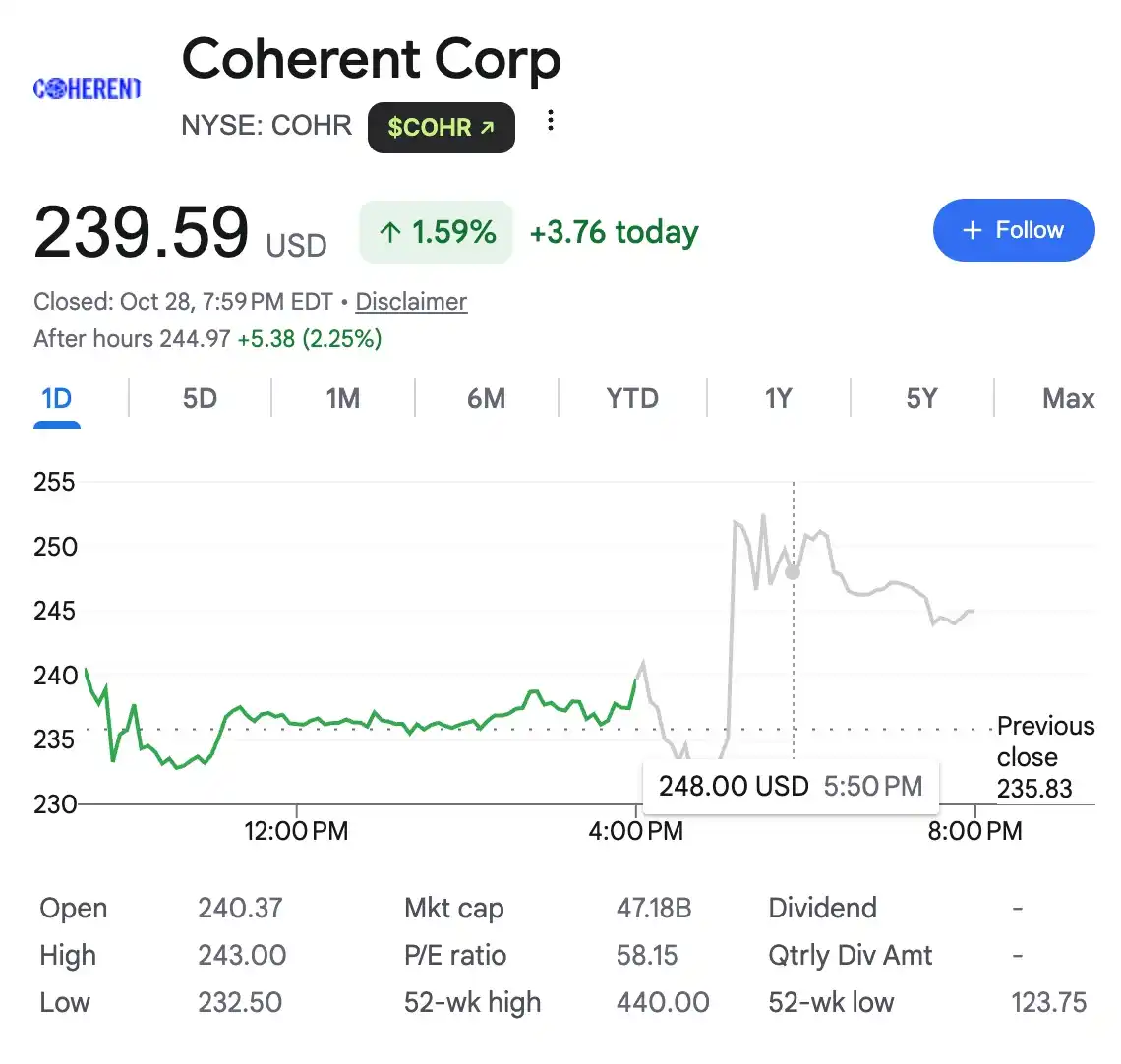
As the market reacted to the Marvell-Lumentum talks, shares of Coherent (NASDAQ: COHR), another major photonics and optical communications components company, also moved higher after hours and briefly traded above $250.
The report links that move to supply-chain neutrality. Before this potential acquisition, Lumentum served as an independent supplier across the industry. Its customers included cloud companies, optical module makers, and chip groups such as Broadcom, NVIDIA, and AMD. If Marvell were to buy the company outright, Lumentum would no longer be a neutral supplier. It would become an asset controlled by a direct competitor.
For Broadcom and large cloud operators, handing control of a critical laser supply chain to Marvell, a rival in custom chips and switching, could be hard to accept. To preserve a second-source strategy and reduce supply risk, customers waiting for Lumentum capacity in 2027 and 2028 could redirect incremental orders, capacity prepayments, and multi-year contracts to Coherent. If the deal goes through, Coherent’s position as an independent third-party supplier could become more valuable.

Marvell’s larger ambition
The report also points to a public discussion in June between NVIDIA founder Jensen Huang and Marvell CEO Matt Murphy on the evolution of AI infrastructure. On that stage, they argued that the first bottleneck in AI was compute, which helped create a $5 trillion NVIDIA; the second was memory, which could produce three trillion-dollar memory companies; and the next major bottleneck would be connectivity.
Huang then pointed to Marvell and told the audience, 「Ladies and gentlemen, this is the next trillion-dollar company!」
From that perspective, the report argues that Marvell may see limits in relying only on DSP sales or custom ASIC work for cloud customers if it wants to move beyond its current roughly $220 billion valuation. Bringing Lumentum’s laser capacity together with Marvell’s silicon photonics, DSP, switching, and custom XPU capabilities would create a much tighter system position in AI optical interconnects.
According to the people cited in the reports, the market may get a clearer answer on this near-$100 billion transaction as soon as early next week.