
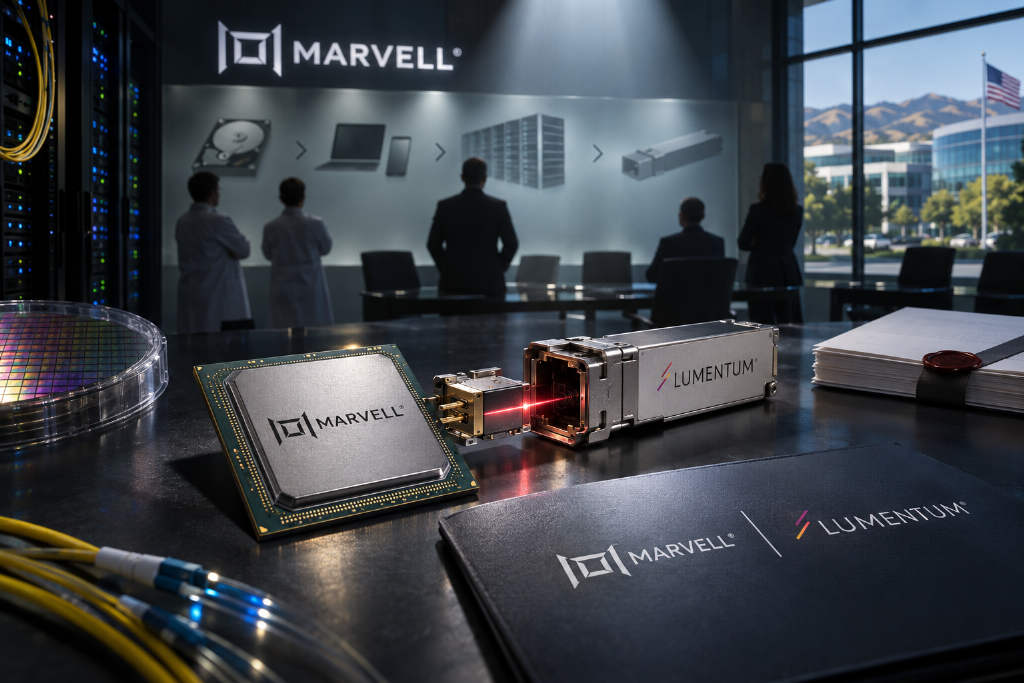
Marvell announced on Nov. 2, 2026 that it will acquire laser company Lumentum in an all-stock transaction valued at $115 billion, bringing the light source itself into the company’s portfolio. The deal is Marvell’s largest acquisition in 30 years and, in the source article’s framing, the latest step in the company’s fourth identity change.
From a hard-drive read-channel chip startup in 1995, to a consumer electronics supplier, then a data center infrastructure company, and now a business pushing toward integrated optical connectivity, Marvell did not change in one move. The source describes a company rebuilt deal by deal over three decades. Its product catalog, customer list, revenue mix, gross margin profile and competitive set all changed along the way.
Marvell’s first version began with hard-drive chips
Marvell was founded in 1995 in Sunnyvale, California by Sehat Sutardja, Weili Dai and Pantas Sutardja. The company started with about $350,000 in family savings. All three founders came out of Berkeley, and the initial target was narrow: read-channel chips for hard drives.
At the time, Texas Instruments dominated that market with bipolar process technology. Sehat Sutardja believed CMOS, widely seen as too slow, could be made faster, lower power and cheaper if designed well enough. Marvell built the technology, but early customers would not adopt it. Samsung declined. Western Digital declined as well. The issue was not chip quality. The company was too small, and customers were unwilling to replace an existing supply chain with an unproven vendor.
The turning point came after Weili Dai made a cold call to Seagate scientist Kenneth Boone. Seagate was struggling because a next-generation chip from Texas Instruments was missing speed targets. Seagate gave Marvell a nearly impossible specification. Marvell delivered in three months. Seagate not only placed an order, it replaced Texas Instruments entirely. In 1998, Seagate became Marvell’s first major customer, and the company nearly doubled year after year for several years after that.
On June 27, 2000, Marvell went public on Nasdaq at $15 a share. The stock closed near $56 on its first day, up nearly threefold, and the company raised $90 million. Hundreds of employees became millionaires overnight, and the two founders appeared on Fortune’s list of wealthy people under 40 that year.
After the IPO, Marvell bought its way into more markets
Once public, Marvell began expanding through acquisitions.
- In October 2000, it used about $2.7 billion in stock to acquire Israeli networking chip company Galileo and enter Ethernet switching.
- In 2002, it acquired SysKonnect.
- In 2003, it bought Radlan for $49.7 million to add networking software.
- In 2005, it paid $180 million in cash plus $45 million in stock for QLogic’s hard-drive controller business, and $24 million for UTStarcom’s SoC business.
- In 2006, it acquired Avago’s printer ASIC business for $240 million.
The most important deal in that stretch came in July 2006, when Marvell paid $600 million in cash to buy Intel’s XScale mobile and handheld chip business. At the time, XScale’s PXA application processors were used in devices such as BlackBerry and Palm Treo. Marvell already had WiFi, Bluetooth and storage controllers. In theory, it could supply almost every supporting chip a phone maker needed. When the first iPhone launched in 2007, its WiFi chip came from Marvell.
That was the closest Marvell came to the center of consumer electronics. It was also one of its hardest falls. XScale had application processors but no baseband. Qualcomm integrated baseband and application processing into a single chip. MediaTek turned the full stack into a turnkey solution for handset makers. Marvell was stuck in the middle. It could not beat Qualcomm at the high end, and it could not beat MediaTek at the low end. In 2015, Marvell exited the mobile chip business and cut about 1,200 jobs. Less than a decade passed between the $600 million purchase and the full retreat.
Looking back, the source reduces Marvell’s logic in that era to one line: use stock to buy revenue. Wall Street wanted growth. Internal development was too slow. So Marvell bought. By 2010, it had become the world’s 18th-largest semiconductor company, with more than 10,000 patents and thousands of product SKUs across hard drives, Ethernet, WiFi, mobile, printers and set-top boxes.
Growth then stalled. Revenue spent four years in a range of a little over $3 billion to $3.7 billion, then dropped back to $2.65 billion in a single year. The stock slid from the teens to below $10. In every product line, Marvell faced a larger and more focused rival: LSI in hard-drive controllers, Broadcom in Ethernet switching, Qualcomm in mobile, and Broadcom and Atheros in WiFi. The source compares the company to a supermarket at a busy intersection, full shelves everywhere, but a more specialized store on every street.
The 2016 crisis and the decision to sell before buying again
According to the source, 2016 was the darkest year in Marvell’s history. The board’s audit committee opened an internal investigation. The U.S. Securities and Exchange Commission became involved. Nasdaq issued a delisting warning because Marvell delayed filing its fiscal 2016 10-K. In the same year, the company reached a $750 million patent settlement with Carnegie Mellon University.
The audit committee did not conclude that fraud had occurred. It did say management had put “significant pressure” on the sales team to hit revenue targets, and that revenue recognition for some transactions did not comply with company policy. In April 2016, founders Sehat Sutardja and Weili Dai resigned as CEO and president. Activist hedge fund Starboard Value, which held about 7% of the company, pushed a management overhaul. In July, former Maxim Integrated executive Matt Murphy became president and CEO.
When Murphy took over, Marvell’s market value was below $5 billion and the stock traded around $10. Customers were questioning whether the company could remain stable. Murphy later described Marvell at his first analyst day as “a company without a rudder.” R&D spending had been spread across more than 20 product lines, with none ranking in the industry’s top three.
His first move was not to buy. It was to sell. In 2019, Marvell sold its WiFi and Bluetooth business to NXP for $1.76 billion. In 2025, it sold its automotive Ethernet business to Infineon for $2.5 billion. Those two divestitures brought back $4.3 billion and removed the company from consumer electronics.
Then came the rebuild around data centers:
- In 2018, Marvell acquired Cavium for $6 billion in cash and stock, adding Arm server CPUs, DPUs and security chips.
- In 2019, it bought Aquantia for $452 million to add multi-gig Ethernet.
- Also in 2019, it acquired GlobalFoundries unit Avera Semi for $650 million to add custom ASIC capability.
- In 2021, it bought Inphi for about $10 billion to add optical DSP.
- Also in 2021, it acquired Innovium for $1.1 billion to add data center switching chips.
Murphy was not just looking for orders. The source says he wanted “multi-year visible revenue.” Marvell signed a multi-generation agreement with Amazon Web Services lasting more than five years, covering custom AI chips, optical DSP, AEC DSP, PCIe retimers, DCI optical modules and Ethernet switching. Some capacity reservation agreements disclosed in the company’s 10-K run for four to 10 years.
The numbers changed with the strategy. Revenue rose from $2.65 billion in fiscal 2016 to $8.195 billion in fiscal 2026. Data center revenue reached 74% of total sales, then climbed to 79% in fiscal 2027 second quarter. A decade earlier, data centers accounted for less than 10% of Marvell’s revenue. Now they made up nearly four-fifths.
By then, Marvell had become a data center infrastructure company. Cavium brought compute. Aquantia brought Ethernet. Avera brought custom ASICs. Innovium brought switching.
Inphi pushed Marvell from chips toward optics
In October 2020, Marvell announced a cash-and-stock acquisition of Inphi worth about $10 billion. Wall Street broadly viewed the price as expensive at the time. Marvell’s annual revenue was still below $3 billion, yet it was paying roughly three times that figure for a company focused on PAM4 DSP.
But Inphi gave Marvell more than a product line. It gave the company a new position. If Cavium changed Marvell’s customer base, Inphi changed its identity.
In an 800G optical module, the two highest-cost components are DSPs and lasers. DSPs clean up and process the signal on the electrical side, making them a first checkpoint in each speed upgrade. Lasers convert electricity into light, the physical starting point of transmission. Inphi was a global leader in optical DSP. By buying it, Marvell moved to the boundary between electricity and light.
More than that, Inphi showed Marvell how much depended on the laser side. The source says DSP performance is constrained by laser wavelength, linewidth, power and yield. Optical component capacity determines how many modules can be shipped. Module delivery determines how quickly cloud operators can bring clusters online. In that chain, an electrical chip company may look important, but it is still a supporting player.
From 2021 onward, Marvell kept moving upstream along what the source calls the “connection” line:
- In 2021, it bought Innovium for $1.1 billion to add data center switching.
- In December 2025, it acquired Celestial AI for $3.25 billion, gaining Photonic Fabric and pushing optical interconnect into the package.
- In early 2026, it bought XConn for $540 million to add PCIe/CXL switching.
- In April 2026, it acquired Polariton to add plasmonic modulators.
Placed in order by distance, the source sees a clear route: inside the package at the millimeter scale, chip-to-chip at the centimeter scale, board-level over tens of centimeters, rack-to-rack over meters, and data center to data center over kilometers. Marvell was extending “connection” from electrical to optical, and from outside the rack into the package itself.
At that point, the company was no longer just selling chips. It was selling connectivity: from one chip to another, from one rack to another, from one data center to another. Chips were simply the delivery mechanism.
One piece was still missing: the light source. Marvell had DSPs, switches, custom ASICs, retimers and photonic fabric, but not lasers. The source calls lasers the scarcest, most rigid and hardest-to-expand part of the chain.
Lumentum fills the laser gap
Lumentum traces its roots to Uniphase, founded in 1979, and JDS Fitel, founded in 1981. The two merged into JDSU in 1999. After a 2015 breakup, the communications optics business became Lumentum. Through several acquisitions, the company built capabilities in indium phosphide laser chips and data center optical modules. By 2026, its 200G EML laser chips held more than 90% global market share, and its capacity was fully sold out through early 2029, according to the source.
After Nvidia invested in Lumentum and locked in capacity in March 2026, Marvell was left with two choices in the source’s telling: stay in line, or buy the whole company. It chose the second option. The Lumentum acquisition is structured as an all-stock deal, Matt Murphy will remain in charge, and the transaction is expected to close in the first half of 2028.
With Lumentum, Marvell would no longer control only chips and components around the optical chain. It would also control the source of light itself. From hard drives to networking, from mobile to data centers, and then to optics, each major acquisition rewrote the company again. Lumentum turns Marvell into a company that owns the light source.
The source also highlights the timing. Optical module stocks have pulled back sharply in recent months and market sentiment has cooled, yet Marvell chose this moment to buy upstream laser supply.
Three industry pivots, four corporate identities
The source lays out Marvell’s 30-year history as three pivots and four identities.
The first ran from 2000 to 2015, when Marvell moved from hard-drive chips into a broad semiconductor “general store” spanning Ethernet, WiFi, mobile, printers and set-top boxes. It bought access to more markets, but failed to dominate any of them. The 2016 crisis became the bill for that strategy.
The second ran from 2016 to 2021. Marvell sold WiFi, Bluetooth and automotive Ethernet assets, then bought Cavium, Aquantia, Avera, Inphi and Innovium. That shift, from generalist supplier to data center company, worked. Revenue rose from $2.65 billion to $8.2 billion, and market value climbed from below $5 billion to $172.2 billion.
The third runs from 2021 to 2026. Marvell is moving from data center infrastructure into optics, from Inphi to Celestial AI, from XConn to Polariton, and now to Lumentum. The source says that shift is still underway, and its endpoint is not yet known.
Across all three pivots, the method stayed the same: use acquisitions to buy time. The source argues that this is not unique to Marvell. Semiconductor technology moves fast, R&D costs are high, and market windows are short. Building an InP production line takes three to five years. Building an optical DSP ecosystem takes five years. Building a major customer relationship takes 10 years. The AI window, by contrast, is only two to three years. If a company relies only on internal development, the market may have moved by the time the product is ready.
The article says Broadcom, Intel, AMD and Marvell all grew through acquisitions. Marvell’s distinction, in that telling, is that it bought not only technology but identity. Galileo made it a networking company. XScale nearly made it a mobile company. Cavium made it a data center company. Inphi made it an optical connectivity company. Lumentum makes it a company with the light source itself.
Sehat Sutardja died in September 2024 at the age of 63. The source says the company he founded had already become something very different by then, with a new product mix, customer base and revenue structure. The one thing that did not change was the method: using acquisitions to buy time.
The source also cites Jensen Huang as saying Marvell is the next trillion-dollar company. In the article’s closing view, the central point in the $115 billion Lumentum deal is not just the price. It is that Marvell has once again decided not to remain what it used to be.
Selected Marvell acquisitions over 30 years
| Year | Target | Value | What Marvell gained |
|---|---|---|---|
| 2000 | Galileo Technology | About $2.7 billion in stock | Ethernet switching |
| 2006 | Intel XScale | $600 million | Mobile application processors |
| 2018 | Cavium | About $6 billion | Arm server CPU, DPU, security |
| 2019 | Aquantia | $452 million | Multi-gig Ethernet |
| 2019 | Avera Semi | $650 million | Custom ASIC |
| 2021 | Inphi | About $10 billion | Optical DSP |
| 2021 | Innovium | $1.1 billion | Data center switching |
| 2025 | Celestial AI | $3.25 billion | Photonic Fabric, optical interconnect inside the package |
| 2026 | XConn | $540 million | PCIe/CXL switching |
| 2026 | Lumentum | $115 billion | Lasers, optical components, OCS |
The source article was credited to the WeChat public account Dag Kan Keji, written by Dag Kan Keji.



