
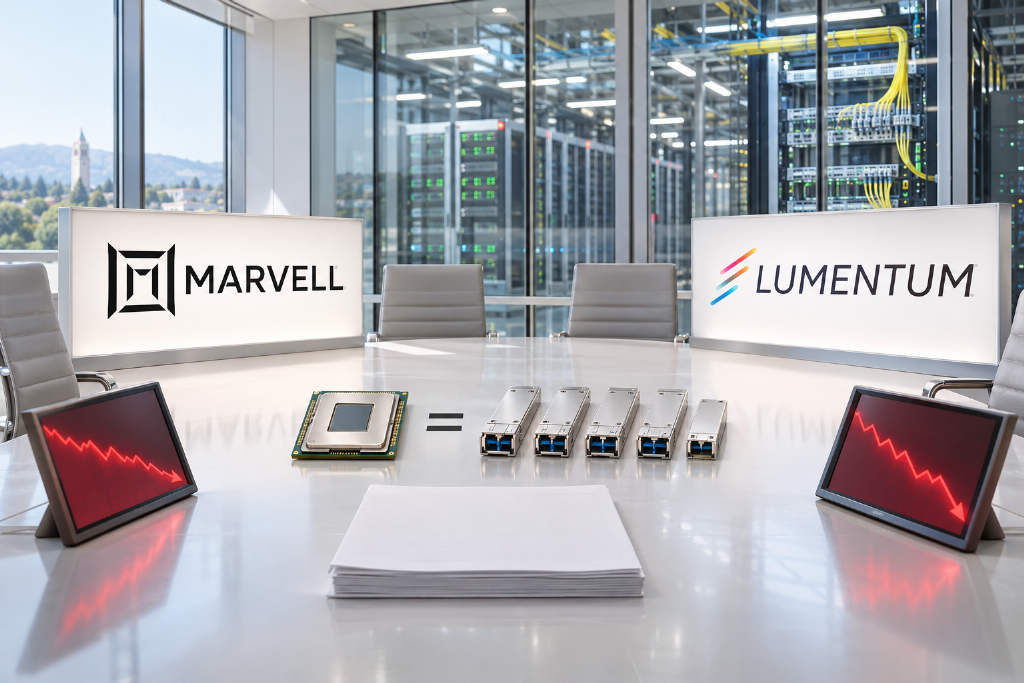
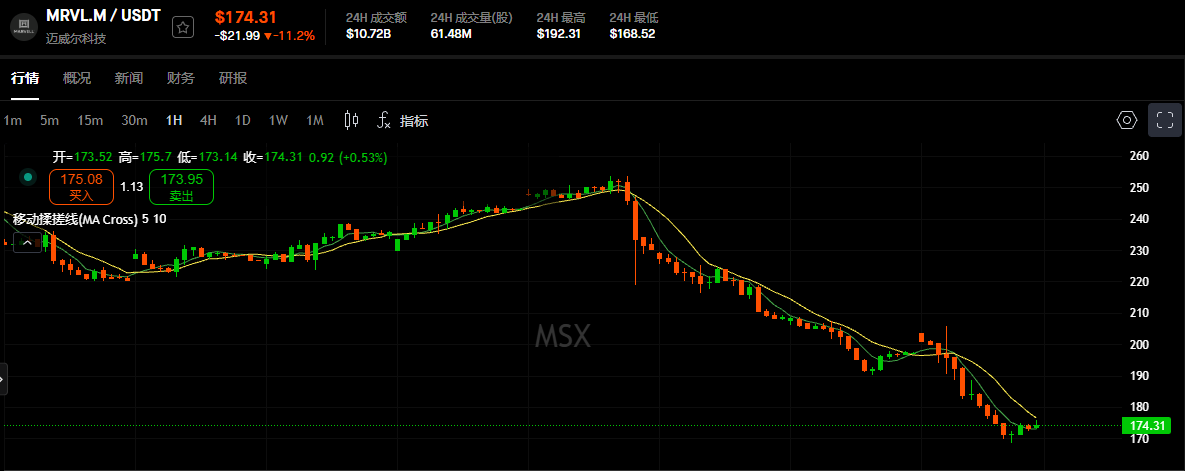
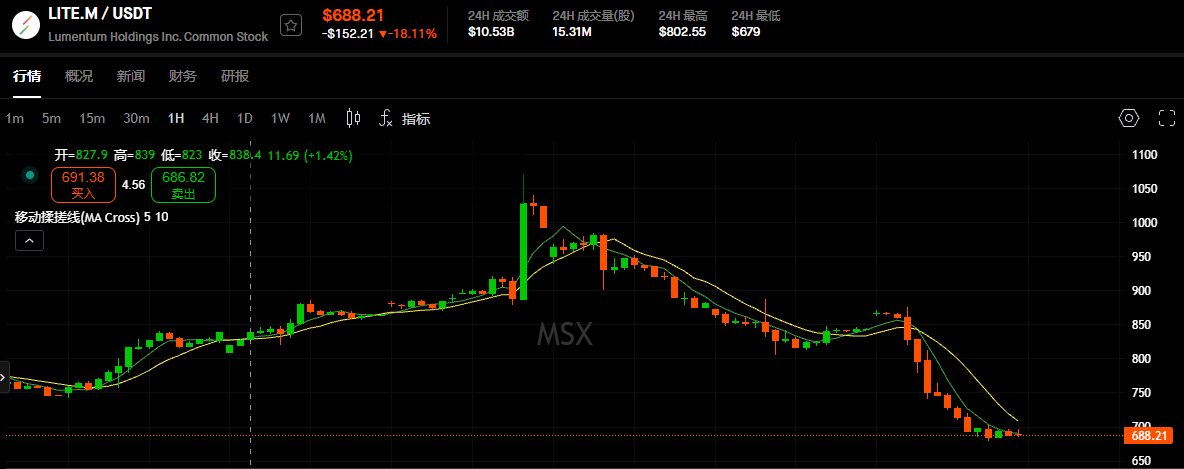
Marvell said it plans to acquire Lumentum in an all-stock transaction, assigning the target an implied enterprise value of about $115 billion. Based on the Oct. 28 closing prices used in the companies’ announcement, the offer carried a premium of roughly 23.9% to Lumentum’s stock. Investors still sold both names. According to MSX.COM data, Marvell closed down 11.2% in U.S. trading, while Lumentum fell 18.11%.
Under the terms of the deal, each Lumentum share will be exchanged for 4.5 shares of Marvell common stock. Marvell is trying to combine the two companies’ strengths in semiconductors and optical communications to build faster, lower-power data-transfer systems for AI data centers, a segment it sees as a major source of future demand.
Why Lumentum also fell despite the takeover premium
Lumentum shareholders are not receiving cash. They are receiving Marvell stock, and that matters. The exchange ratio is fixed at 4.5 Marvell shares for each Lumentum share, but the value of those shares is not fixed. If Marvell trades lower, the value of what Lumentum investors will eventually receive also declines. That leaves Lumentum exposed to weakness in Marvell even after a takeover announcement.
The near-24% premium cited in the announcement was also based on a specific reference point rather than a guaranteed gain after the news broke. The companies used their Oct. 28 closing prices, before the market had heard about the transaction. At those prices, 4.5 Marvell shares were worth about $1,132, or around 23.9% more than one Lumentum share. Once both stocks started moving, the real value of the stock-for-stock consideration moved with them. The headline premium did not lock in a profit.
Marvell investors are focused on dilution and deal economics
For Marvell shareholders, the main question is whether the acquisition price makes sense. After new shares are issued, existing shareholders are expected to own about 67% of the combined company. Marvell will gain Lumentum’s business, but if the added profit does not keep pace with the increase in share count, existing holders may see little benefit on a per-share basis.
Reuters reported that investors are watching the transaction price, financing risk and the rising level of AI infrastructure spending. A larger company does not automatically mean better returns per share. What matters to shareholders is how much profit each share can claim after the merger is complete.
Marvell is betting on rising connectivity demand inside AI systems
Marvell’s willingness to pay a premium is tied to growing data-transfer needs inside AI data centers. As more chips work together, the amount of data moving between them rises as well. If transmission speeds cannot keep up, added computing capacity becomes harder to use efficiently.
In their announcement, the companies said rising bandwidth demand and the physical limits of copper interconnects are pushing AI infrastructure toward greater use of optical links. Faster and lower-power data movement has become a key requirement for customers building next-generation systems, and both companies see that as a commercial opening.
They bring different pieces of the stack. Marvell supplies chips, high-speed interconnect and networking switch technology. Lumentum specializes in lasers and optical communication components. Combined, the two companies could align chip and optical component design earlier in the development process, reducing the integration work customers face when assembling products from different vendors. Lumentum’s laser manufacturing capability could also be paired with Marvell’s chip design and packaging technology to support new product development.
By acquiring Lumentum, Marvell wants to offer AI data center customers a broader product set and get involved earlier in the design of next-generation systems. If the combined offering can deliver faster, lower-power and easier-to-deploy data transfer, Marvell could improve its chances of winning more orders.
A large growth target, but the payoff is still some distance away
The companies said the combined business could address a market worth $550 billion by 2030. That figure includes their existing businesses as well as new areas they may enter after combining technologies. Still, market size is not the same as profit. Products, customer orders and competition will determine whether the acquisition creates the return investors want.
Marvell’s more concrete promises are tied to cost and earnings. The company said it expects more than $1 billion in annual cost savings after the merger and expects the transaction to be accretive to adjusted earnings per share in the first year after closing. If that happens, Marvell would be increasing profit per share even after issuing new stock.
That outcome will take time to test. Research, manufacturing and product integration will all bring costs of their own, and the final result will depend on operating performance after the deal closes. The companies expect the transaction to close in the first half of 2028, subject to shareholder approval and regulatory clearance. Over that period, AI demand, market sentiment and Marvell’s share price could all change.
For Lumentum shareholders who do not want to wait, and who do not want to end up holding Marvell stock, selling after the announcement may look more attractive. Marvell is willing to pay a premium for future growth. The market, judging by the immediate share-price reaction, is less willing to carry the risk tied to a long wait for that payoff.



