
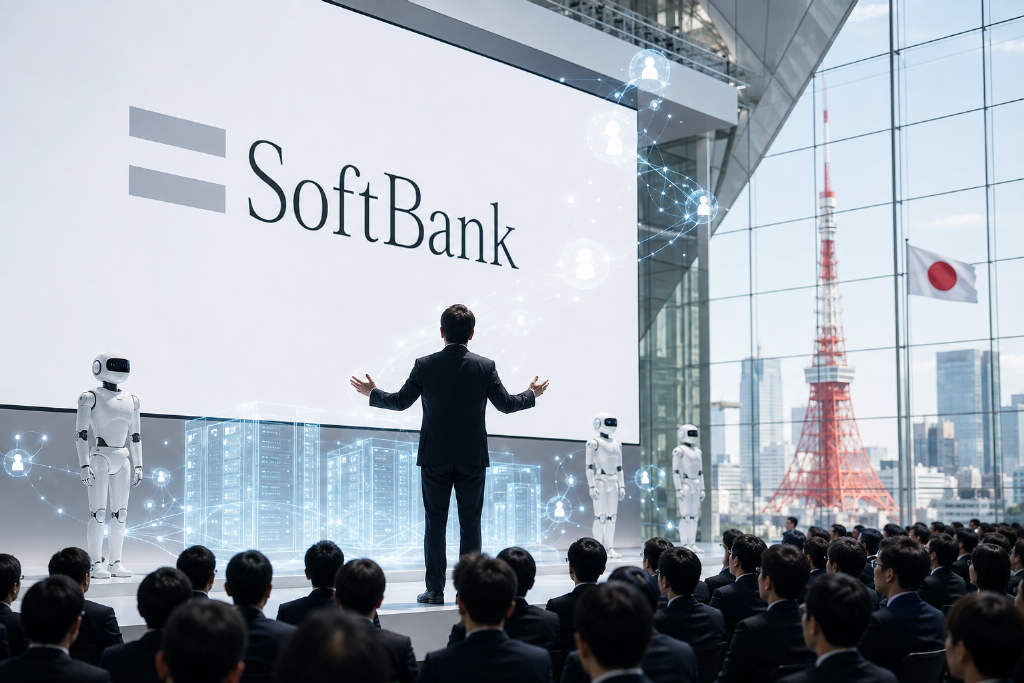
SoftBank founder Masayoshi Son said at SoftBank World 2026 that companies should adopt Return on AI, or ROA, as an operating metric and use a structured transition process to become AI-native enterprises.
In his keynote, Son said industries worldwide are heading toward broad AI adoption. He projected a future in which 100 trillion AI agents and 1 billion humanoid robots are in use, pushing companies to prepare for a different operating model.
ASI could account for 20% of global GDP by 2040
Son said Artificial Superintelligence, or ASI, is projected to make up 20% of global GDP by 2040, with annual output reaching 7,000 trillion yen. He described a labor market that gradually shifts toward 100 trillion AI agents and 1 billion humanoid robots. According to his remarks, those systems will be able to operate independently, communicate, and keep learning, making them a primary source of labor on production lines.
To support that level of computing demand, global AI data center capacity would need to reach 3 terawatts. Son said average annual investment is expected to reach about $5 trillion, driving compute power to the quetta level, or 10^30.
Son says people will need to integrate with AI and become “superhuman”
Son also said related data shows AI can quickly uncover thousands of potential vulnerabilities inside a system. In response to that trend, he said both individuals and companies need to integrate AI into daily life and work, extending the limits of the human brain and preparing people to become “Superhuman.”
He added that companies need to upgrade systems and adjust their architecture to defend against new forms of attack and avoid disruption caused by automated vulnerabilities.
ROA presented as a new way to measure business performance
During the speech, Son introduced Return on AI as a metric he said will replace the traditional Return on Assets. He described ROA as a way to measure how spending on AI and supporting infrastructure turns into actual productivity gains and revenue growth.
Son said executives should assess the metric with a three-year horizon. In that framework, management can review whether capital committed to AI agents or humanoid robots is generating matching real-world value and long-term competitive advantage.
As presented in the keynote, ROA is meant to evaluate the practical effect of technology spending on productivity and revenue growth. Business leaders, Son said, can use a three-year cycle to judge whether the value created by AI agents and humanoid robots is enough to justify earlier spending on infrastructure, software, and hardware.
How Son says companies can become AI-native
Son outlined four steps for companies seeking to become AI-native enterprises:
- Maintain a firm vision: leadership should keep advocating for AI and make clear across the organization that the company is committed to becoming AI-driven.
- Use existing strengths: apply the company’s existing data, industry knowledge, and experience to deploy AI more effectively in specific fields.
- Automate operations: use AI agents to automate all business tasks so that internal processes can execute on their own.
- Adopt ROA: track Return on AI to measure how AI investment converts into productivity and revenue growth over three years.