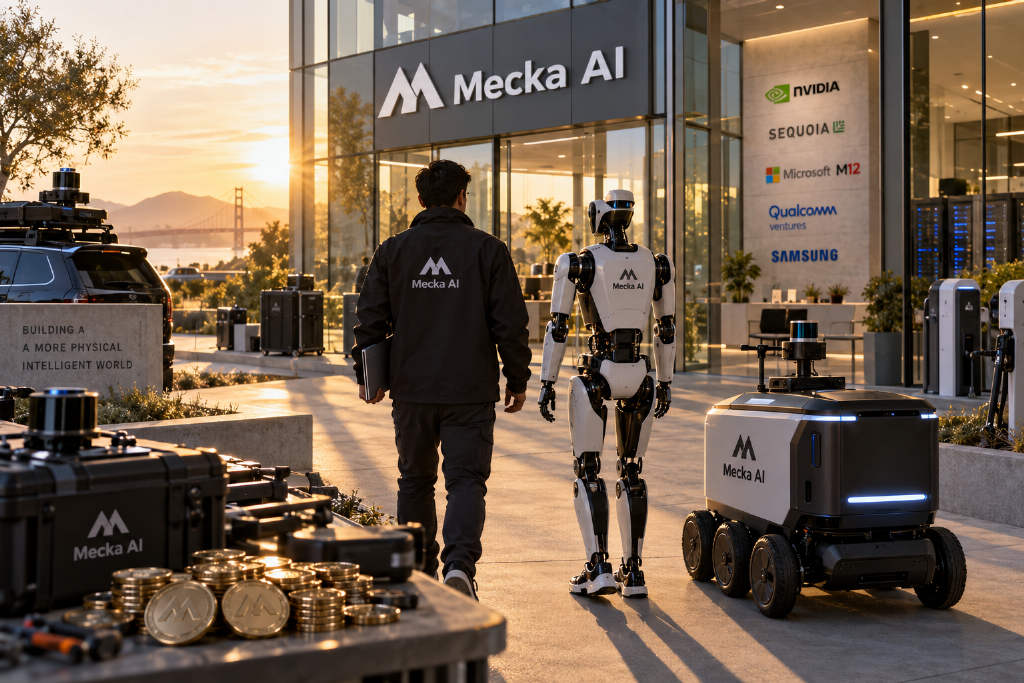
Mecka AI, a robotics data company that once used a crypto-style points system to attract contributors, is now backed by Sequoia Capital, Nvidia, Microsoft and other major investors.

On Oct. 7, Mecka AI said it had raised a $60 million Series B. Sequoia led the round, with new participation from Nvidia, Microsoft’s M12, Qualcomm Ventures and Samsung. Framework Ventures, Kindred Ventures and startup incubator and venture firm Neo also continued to back the company.
The company also said its annualized revenue run rate had exceeded $100 million in June 2026 and is expected to reach $300 million by the end of the year. Mecka noted a run rate, not full-year revenue already booked.
From crypto-adjacent project to Physical AI infrastructure company
Mecka is not entirely new to the crypto industry. The company has crypto-linked investors, and its founding team also has ties to that sector. In its earlier phase, Mecka launched a points program with a clear crypto flavor, which led to speculation from users about whether a token might eventually follow.
That emphasis has largely disappeared from its website and financing announcements. Mecka now describes itself as a Physical AI data infrastructure company.
The shift marks a visible change in how the company presents itself: away from points-based community growth and toward robotics training data and enterprise deployment.
Founders came from outside robotics, with one well-known crypto background
Mecka’s four main co-founders are Josh Gao, chief executive officer; Jason Chong, chief technology officer; Duy Nguyen, chief operating officer; and Mogen Cheng, chief product officer.
None of the four originally came from a professional robotics research background. Gao and Cheng had previously co-founded a restaurant software startup and sold that business in 2023.
Chong is a familiar name in crypto. He founded crypto payments startup Utopia Labs, which was later acquired by Coinbase. Fortune reported that Nguyen, who oversees operations, also had a sneaker resale background and had made millions of dollars through that business.
In an interview with Fortune, Gao said the team did not come from the robotics industry. By reading research papers, visiting robotics labs and speaking with researchers, the founders came to see a gap: robotics had increasingly capable hardware and models, but lacked large-scale, real-world and sufficiently rich human action data. That led the team to focus not on building robots themselves, but on supplying the data robots need to learn from the physical world.
Public reports differ on when Mecka was founded
There is some variation in public reporting on the company’s timeline. TechCrunch traced Mecka’s founding back to 2024, while Fortune said the four founders formally decided to launch Mecka AI in 2025 after accumulating a large amount of data in an earlier phase.
On that basis, 2024 can be read as an exploration period, while 2025 was the stage when the company was formally launched in those reports.
Funding path widened from crypto investors to large tech names
On financing, Mecka publicly completed an $8 million seed round in August 2025, led by Neo.
In June 2026, the company announced a combined $60 million financing package made up of a $25 million Series A and $35 million in follow-on investment. Framework Ventures led that financing, with Menlo Ventures, SV Angel and Kindred Ventures among the participants.
Four months later, Mecka raised another $60 million in its Series B, adding Sequoia, Nvidia and Microsoft’s M12 to the investor roster.
From Framework Ventures to Sequoia, then Nvidia and Microsoft as strategic investors, Mecka’s cap table has moved beyond the crypto circle.
What Mecka sells: turning everyday human activity into robotics training data
AI can write text and generate code. Teaching a robot to carry coffee, fold clothes or repair a car still requires large amounts of training data.
The gap is straightforward. Language models can draw from massive amounts of internet text. Robots need to understand motion, force, contact and spatial relationships in the real world. That information does not come directly from web pages.
Mecka’s business is built around converting daily human activity into training data that robots can use.
Its process has three main parts:
- Data collection. Mecka organizes people to use smartphones or the company’s self-developed multi-sensor devices to record tasks such as cooking, organizing items and repairing cars.
- Data processing. The company uses computer vision and multimodal models to process raw video and sensor inputs, extracting motion trajectories, hand poses and 3D spatial information.
- Data delivery. Mecka then provides processed datasets to robotics labs, AI model teams and enterprises for model training, evaluation and real-world robot deployment.
Its core business model is B2B data and related services.
Customers and business scope now extend beyond datasets
According to Upstarts, Mecka said in August 2025 that it had signed paid contracts with some Fortune 100 companies and identified robotics company 1X Technologies as an early partner.
The company now says it serves multiple frontier robotics labs and several companies among the U.S. tech “Magnificent Seven,” though it has not published a full customer list or specific contract values.
Still, Mecka is no longer presenting itself as only a data seller.
In its latest financing announcement, the company highlighted robotics commercial deployment work, including hardware integration, on-site data collection, model post-training, system integration and ongoing operations and maintenance.
That points to a broader ambition: moving from a training data supplier to a service provider that helps enterprises deploy robots.
The appeal of that model is that Mecka may be able to sell not only one-off datasets, but also build longer-term customer relationships through deployment and ongoing operations.
Web3 references have been dialed down
Compared with its current Physical AI positioning, Mecka’s early branding carried much stronger crypto references.
In 2024, the company launched a points program inspired by the crypto industry. In its early form, the program also included social tasks and served as a user growth tool.
Upstarts reported that chief executive Josh Gao said the model helped the project gain early attention, but also created trust issues, especially when dealing with large enterprises. CTO Jason Chong said a token model might make sense if a company needed to gather millions of hours of video data of uneven quality, but could become a distraction if that scale of collection was not required.
Mecka later shifted toward gamified everyday tasks, allowing users to contribute data through activities such as making the bed. For enterprise-specific assignments, the company provided dedicated devices to screened contributors in order to obtain higher-quality data.
Whether users still receive points is unclear
It is not yet clear whether Mecka still issues points to users.
In February 2026, Mecka released a new iOS app on Apple’s App Store. The company described it as a first-person data recording tool for internal robotics research labs, mainly used for recording, uploading and task management. The public description did not mention points, tokens or an airdrop mechanism.
The original author said the app required an access code after download, which meant the internal tasks and reward rules could not be reviewed. As a result, it remains unclear whether contributors currently receive points, cash or some other form of payment.
If the data business works, is a token still necessary?
Looking back at Mecka’s path, the central issue is not only whether it may ever launch a token. The more important question is how its data collection model has become tied to enterprise demand.
The early points program addressed a cold-start problem: how to attract more ordinary users to contribute real-world data for robotics.
Enterprise customers ask for something more complex. For robotics labs, volume alone is not the only metric. Accuracy, completeness of actions, fitness for a specific training task and consistency of collection quality also matter.
That means open points incentives and specialized paid collection are not the same business model. The first can bring in large numbers of participants. The second can make it easier to manage collection around concrete client needs. The two models can also coexist, and the source material does not claim one is always superior.
Mecka’s path from early crypto-style points to enterprise-specific data work and commercial deployment can be read as a narrowing of business focus.
The company’s disclosed annualized revenue run rate of more than $100 million suggests it says the business has already reached meaningful scale. At the same time, without fuller financial disclosure, outsiders still cannot assess gross margin, profitability or how sustainable that growth may be.
Mecka also leaves the crypto industry with a harder question: if a project can ultimately rely on conventional business revenue, keep paying data contributors and satisfy enterprise procurement needs, is a token still necessary?
For Mecka, that question does not yet have a final answer.
What is clear is that the points program that once drew crypto users has stopped being the center of its public message. Robotics training data, enterprise clients, commercial deployment and rising revenue have taken its place.