
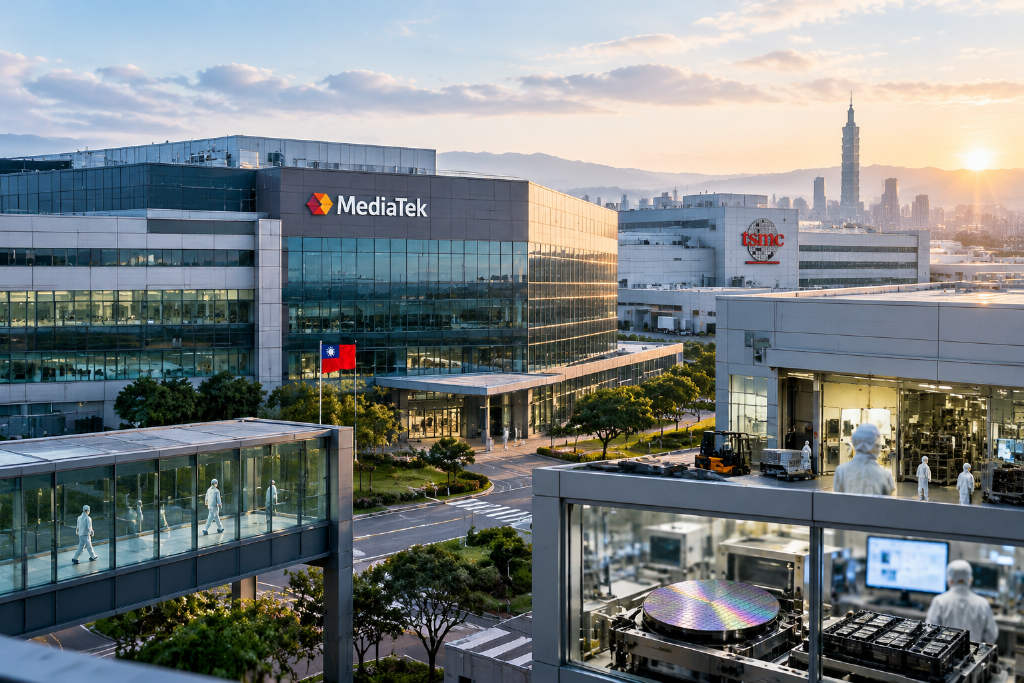
MediaTek shares opened 3% higher on Sept. 30 after falling nearly 7% the previous day, with institutional investors keeping a positive view and pointing to Taiwan Semiconductor Manufacturing Co. (TSMC) support on advanced packaging as a factor easing supply concerns. ABMedia reported that TSMC has stepped in with CoWoS-L backup packaging capacity, a move seen as reducing the market’s biggest worry around advanced substrate supply.
Rumors focused on tape-out, performance and EMIB yield
ABMedia said MediaTek has been trying to break Broadcom’s long-held position in Google’s TPU supply chain and has secured Google TPU v8t and v9 ASIC design orders this year, making the program a key bet in the company’s ASIC transition.
On Sept. 29, however, the market was hit by a string of negative claims. On the technical side, the rumors said MediaTek had suffered repeated tape-out failures, that chip performance in testing did not meet Google’s requirements, that the company lacked authorization for 448G SerDes IP and had to develop a 336G specification on its own, and that debugging cycles for multi-die voltage issues had been extended. On the packaging side, the market claims said low yield rates for Intel EMIB advanced packaging substrates were slowing mass production.
Those claims also included schedule concerns. According to the report, rumors suggested Google TPU v8 samples may not be delivered within this year and could slip to the second quarter of 2027 at the earliest. A TPU v9 version originally tied to HBM4e was also said to face partial order shifts to Marvell because Google-side customers preferred suppliers with proven mass-production records.
MediaTek denied the claims and said ASIC plans remain on track
After those rumors circulated, MediaTek stock fell nearly 7% on Sept. 29. The company said the claims were false rumors and reaffirmed that its ASIC business is progressing on schedule. MediaTek said its first AI accelerator ASIC is expected to enter mass production in the fourth quarter of this year, that data center-related revenue is targeted to exceed $2 billion this year, and that next year is expected to mark a period of rapid growth.
The report also said MediaTek completed a $3.9 billion overseas convertible bond issuance last month. NVIDIA subscribed $3.5 billion, accounting for nearly 90% of the total, and Google also participated. The transaction was seen by the market as practical backing from strategic allies.
TSMC enters with CoWoS-L as a second source
Institutional commentary cited by Mirror Media said the constructive view on Sept. 30 was tied to TSMC’s involvement, which has broadly eased concerns over concentrated supply risk in advanced packaging substrates.
The market’s core concern was Google’s 2nm TPUv9, code-named Humufish, which the report said is expected to ramp in 2028. That product had been seen as highly dependent on Intel EMIB-T advanced packaging substrates. If EMIB-T supply or yield ran into trouble, the production schedule could be affected across the board.
TSMC is now said to be entering with CoWoS-L as a second source. According to the report, TSMC is expected to support about 500,000 units of 2nm TPU packaging in 2028. Combined with roughly 2.5 million units from Intel EMIB-T, total capacity would reach about 3 million units, close to MediaTek’s annual shipment target.
The report also framed the move in strategic terms. Intel is expanding EMIB-T capacity and is targeting 40,000 to 45,000 12-inch-equivalent wafers per month by 2028, with the aim of capturing about 10% to 15% of the global 2.5D advanced packaging market. TSMC’s decision to support MediaTek and Google at this stage was described as a way to reinforce its own packaging position while checking a rival’s expansion.
Institutions stay positive and watch three next steps
On cost, the report said CoWoS-L requires three additional mask processes in the redistribution layer, making it more expensive than Intel EMIB-T. Still, institutional investors said end customers are willing to absorb that premium as Google seeks a more diversified supply chain. They also said chips using the CoWoS version carry a higher average selling price than EMIB-based versions, which would be positive for MediaTek’s overall gross margin and revenue mix.
Morgan Stanley and UBS both maintained positive ratings, according to the report, and said MediaTek’s progress with a second cloud service provider customer supports a target price of NT$7,300.
ABMedia said the Sept. 30 rebound showed the market had quickly repaired the selling pressure triggered by the previous day’s rumors. The next things to watch are whether TPU v8 samples stay on schedule, whether Intel EMIB-T yield improves, and when TSMC’s CoWoS-L backup capacity is actually brought online.