
1. Research Framework and Core Question
Mega-funds with over $10 billion in assets under management (AUM) are pouring into seed rounds at an unprecedented pace. Murph Capital leveraged Harmonic data to dissect the early-stage investment behavior of 20 top mega-funds across three distinct eras: the SaaS era (2015–2019), the Zero-Interest era (2020–2022), and the AI era (2023–2026). The core question: should emerging managers (EMs) be concerned about the structural advantages of these giant funds?
The data provides a clear answer: mega-funds do deliver seed-to-Series B conversion rates 3.7–4.2 times the market average, but when they scale up deployment aggressively, this advantage rapidly dilutes. For emerging managers, room to survive remains, but they must choose their sectors wisely and understand the logic of a two-tier market.
2. Deal Volume Across Three Eras: A Structural Strategic Shift
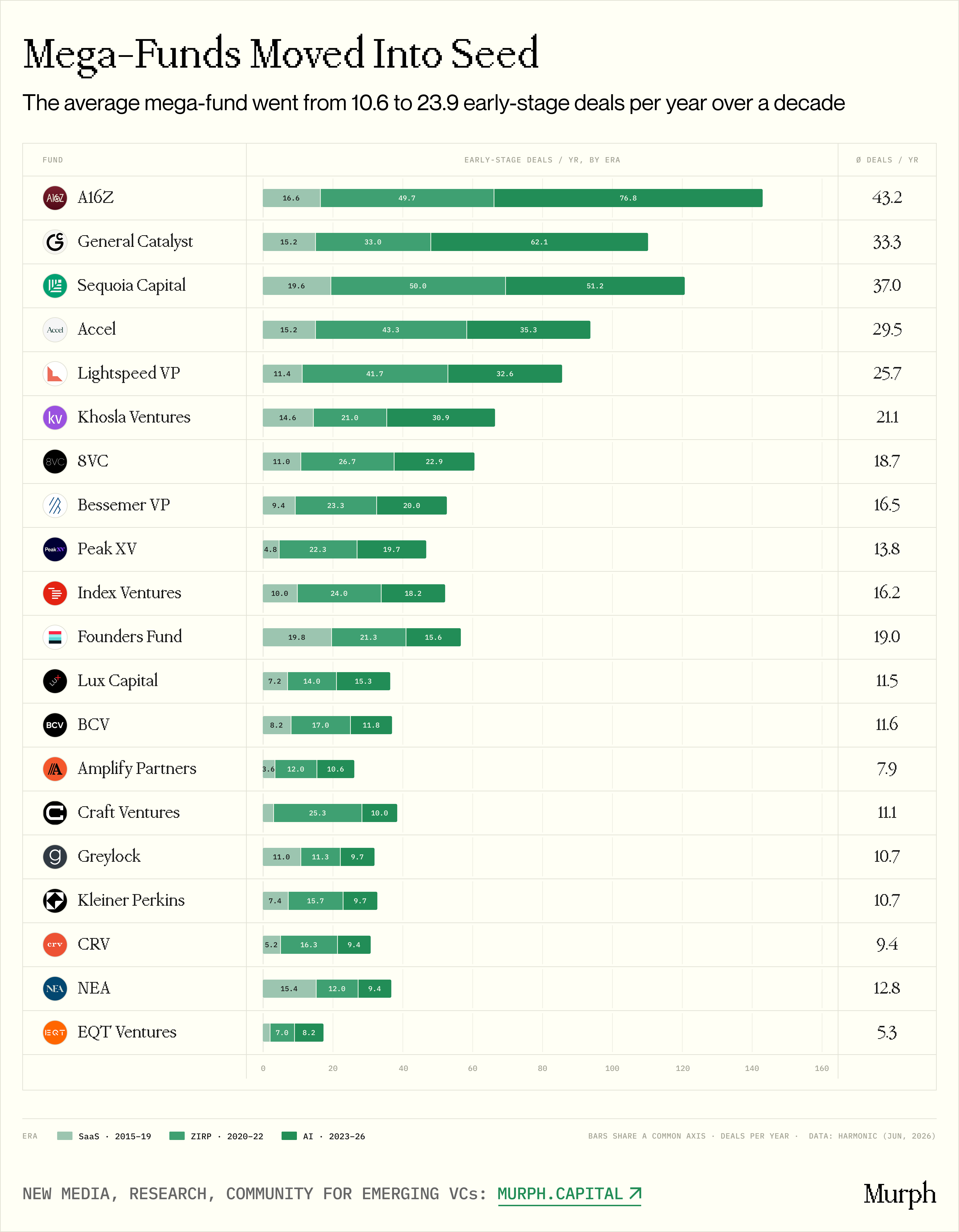
On average, a typical mega-fund completed 10.6 early-stage deals per year in the SaaS era. By the AI era, that number jumped to 23.9—a 2.37x increase across the entire cohort. Interestingly, what happened after the zero-interest period ended reveals the structural nature of this shift: the average annual deal count in the AI era (23.9) is almost identical to the Zero-Interest era (24.3). Only three funds reduced their early-stage investment pace. This is not a byproduct of cheap money; it is a permanent reorientation.
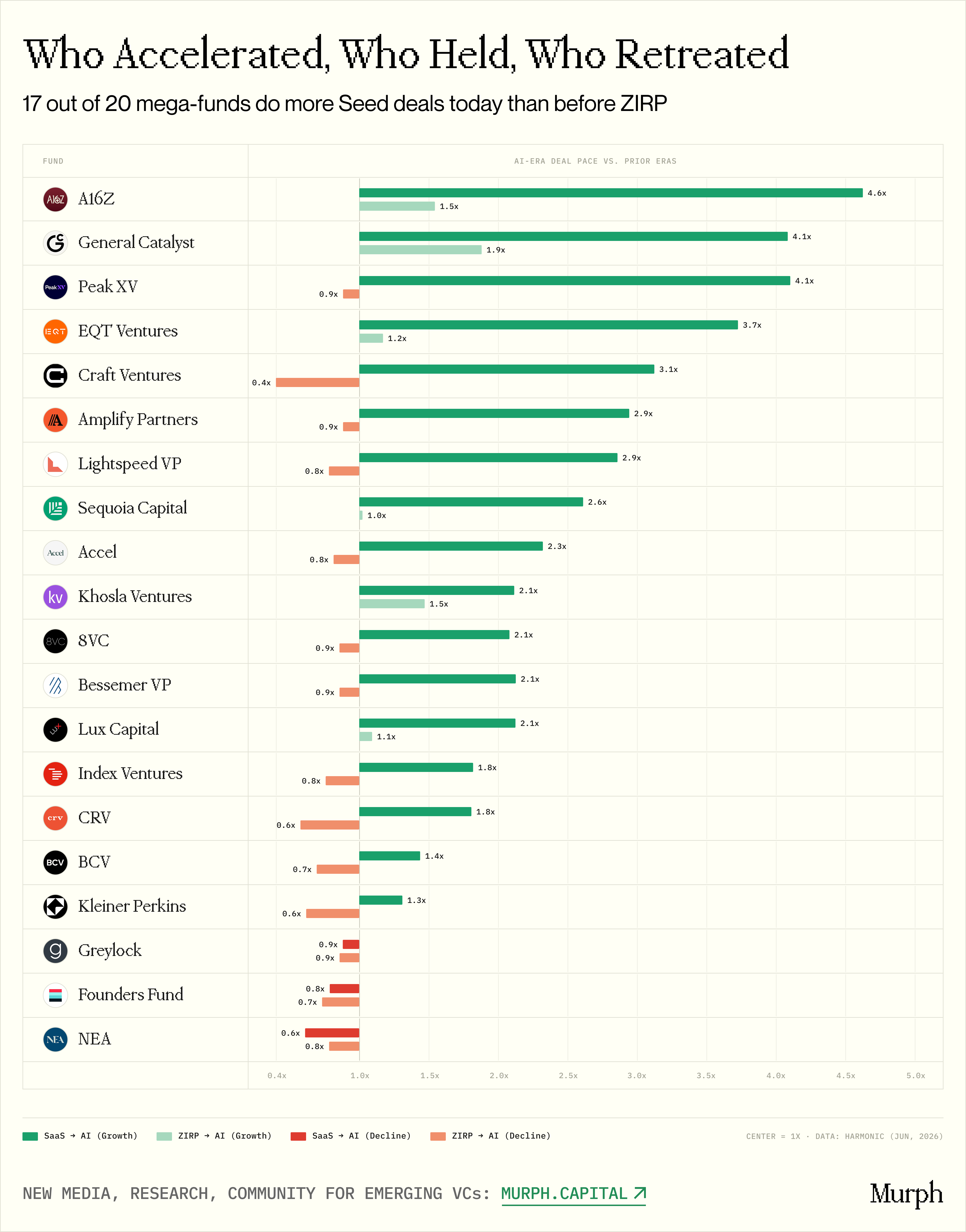
Three underlying drivers explain this shift. First, AI-era companies are intrinsically more capital-intensive: GPU infrastructure, data pipelines, and research scientists earning $300,000–$500,000 annually create a fundamentally higher baseline cost. The median seed round has jumped from roughly $500,000 in the SaaS era to $2–5 million in the AI era. Second, the competition for top founders has shifted pricing power away from investors. The best AI founders can choose between a16z, Sequoia, and Lightspeed at the seed stage, forcing terms in their favor. Third, fund size math compels early engagement: the top five funds in our cohort grew their combined AUM from ~$34 billion to ~$249 billion over a decade (roughly 7x), while their seed deal counts only grew 2–4x. A $6 million seed check now represents just 0.01% of a $90 billion AUM, giving these funds ample room to bid aggressively without pricing discipline.
3. From Side Bet to Core Strategy: The Rise in Strategic Commitment
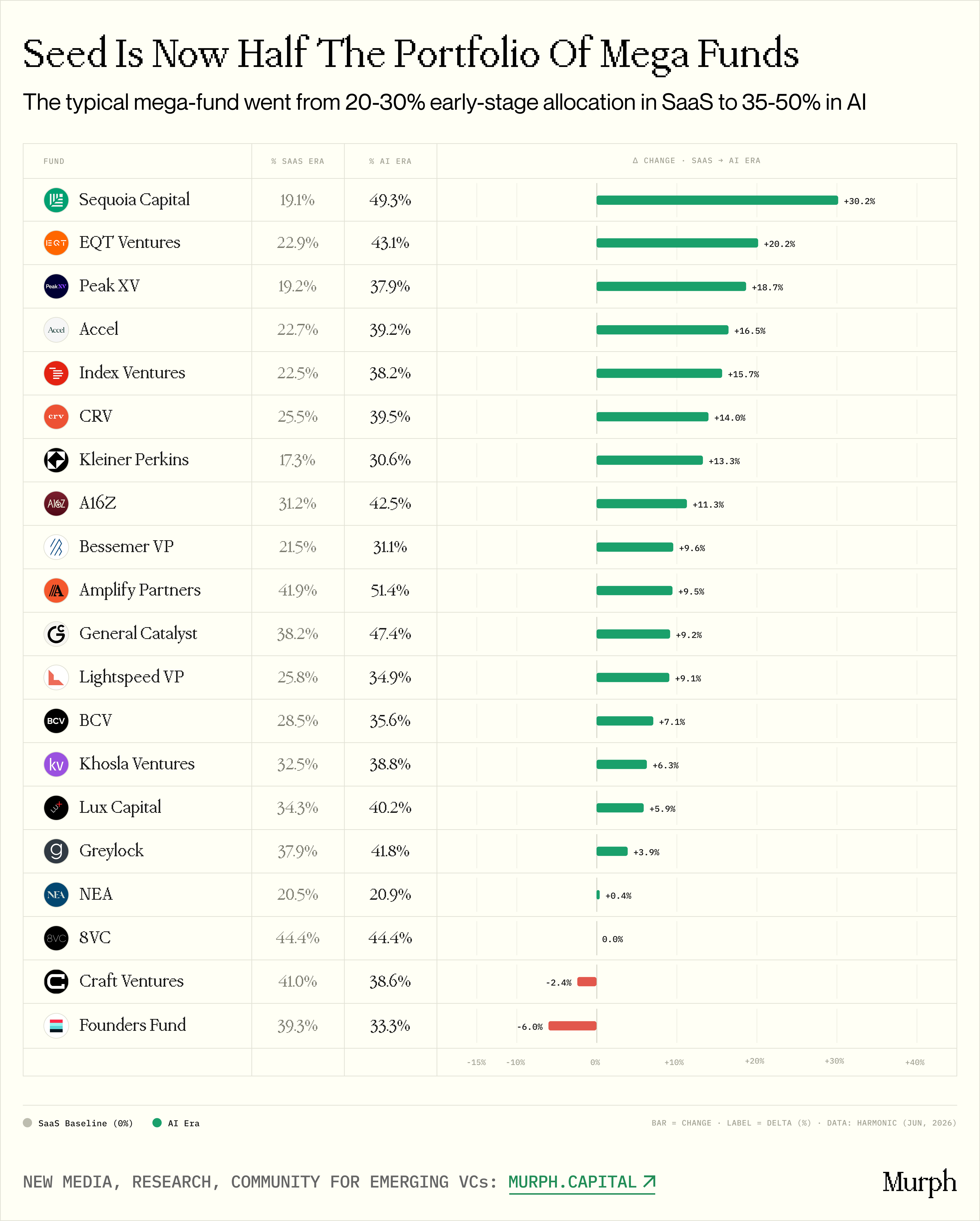
16 out of the 20 mega-funds set all-time highs for their early-stage allocation percentage in the AI era. In the SaaS era, a typical mega-fund directed 20–30% of its total deal flow to seed rounds. In the AI era, that baseline has surged to 35–50%. Three cases are particularly telling: Sequoia transformed radically, moving from less than one-fifth of deals in seed to nearly half (49%) in the AI era. General Catalyst followed a V-shaped curve—already heavy at 38% in SaaS, dipping to 30% during zero-interest, then rebounding sharply to 47% in the AI era. a16z held steady at 31.2% across both SaaS and zero-interest eras, then jumped to 42.5% in the AI era.
Mega-funds have abandoned the narrative of "occasionally writing a seed check when we meet an extraordinary founder." Instead, they have turned seed investing into a core strategy, weaponized through specialized teams, proprietary deal sourcing channels, and accelerator programs such as a16z Speedrun and Sequoia Arc. For emerging managers, this means that daily competition now extends beyond neighboring $50 million boutique funds. They are competing against $10–90 billion AUM behemoths that have aimed 40–50% of their institutional deal-making machine at the seed stage.
4. Price and Round Fragmentation: The Reality of a Two-Tier Market
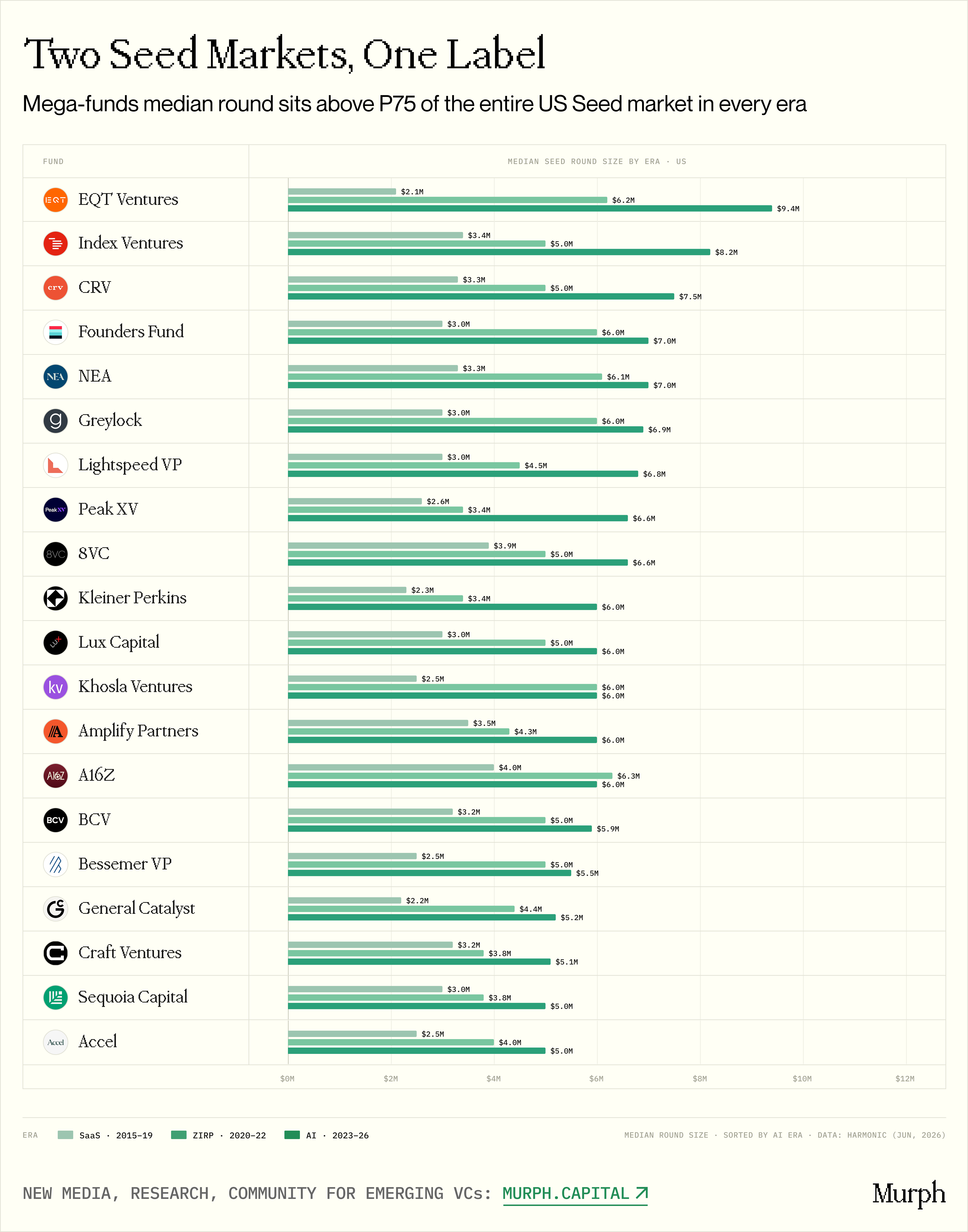
Mega-funds rarely participate in "average" seed rounds. They systematically operate in the top quartile of the market, with median round sizes 4.3–4.8 times larger than the overall U.S. seed median. The market's 75th percentile ($4 million) serves as their entry floor; their own median round ($6.2 million) sits comfortably above that threshold. When we compare median and average round sizes, funds split into two categories.
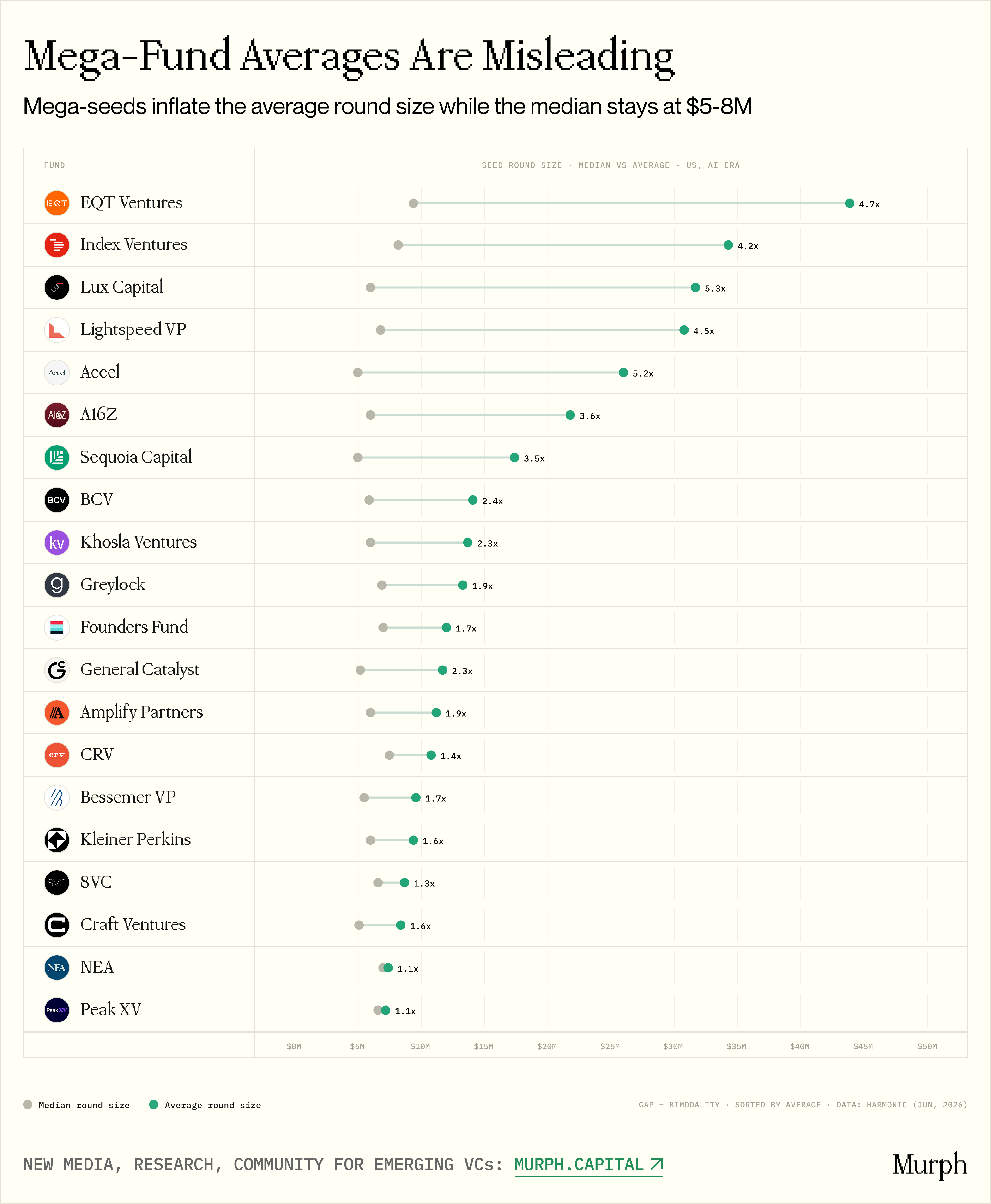
"Dual-track" funds (with a median-to-average spread of 3x or more—Index, Lux, Lightspeed, Accel, a16z, Sequoia) simultaneously play on two tables: high-volume classic seed rounds ($5–8 million) and highly selective super-seed rounds ($50 million to $500 million+). Their typical deal remains in the $5–8 million range, despite the eye-popping headlines about "$100 million seed rounds." "Homogeneous" funds (General Catalyst, Khosla, Bessemer, Greylock) have tight median-average alignment, deploying consistently in the $5–8 million band without large outliers. For EMs, homogeneous funds are the more immediate threat, as they operate directly in the core price range where most emerging funds deploy capital.
5. Lead Investor Analysis: Who Really Sets Pricing
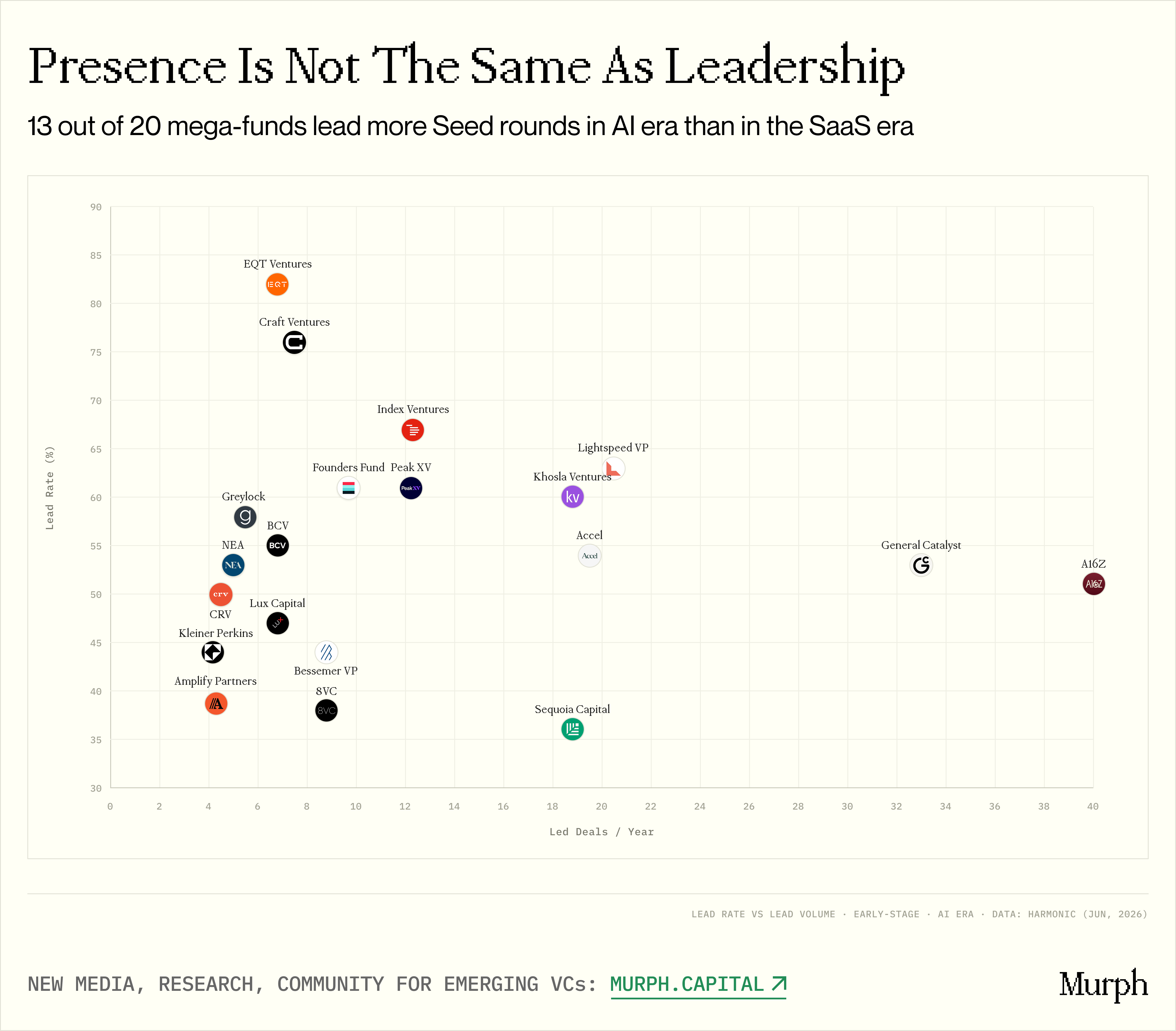
There is a fundamental difference between participating in a round and leading it. Among mega-funds, Khosla (60% lead rate, 19 leads/year), Lightspeed (63%, 21 leads/year), and Accel (54%, 20 leads/year) are "conviction leaders"—the most dangerous group for EMs because they both deploy aggressively and demand the driver's seat. a16z (51%) and Sequoia (36%) have lower lead percentages but still dominate in absolute numbers: a16z leads roughly 40 early-stage deals per year, exceeding the total early-stage deal count of half the funds on our list.
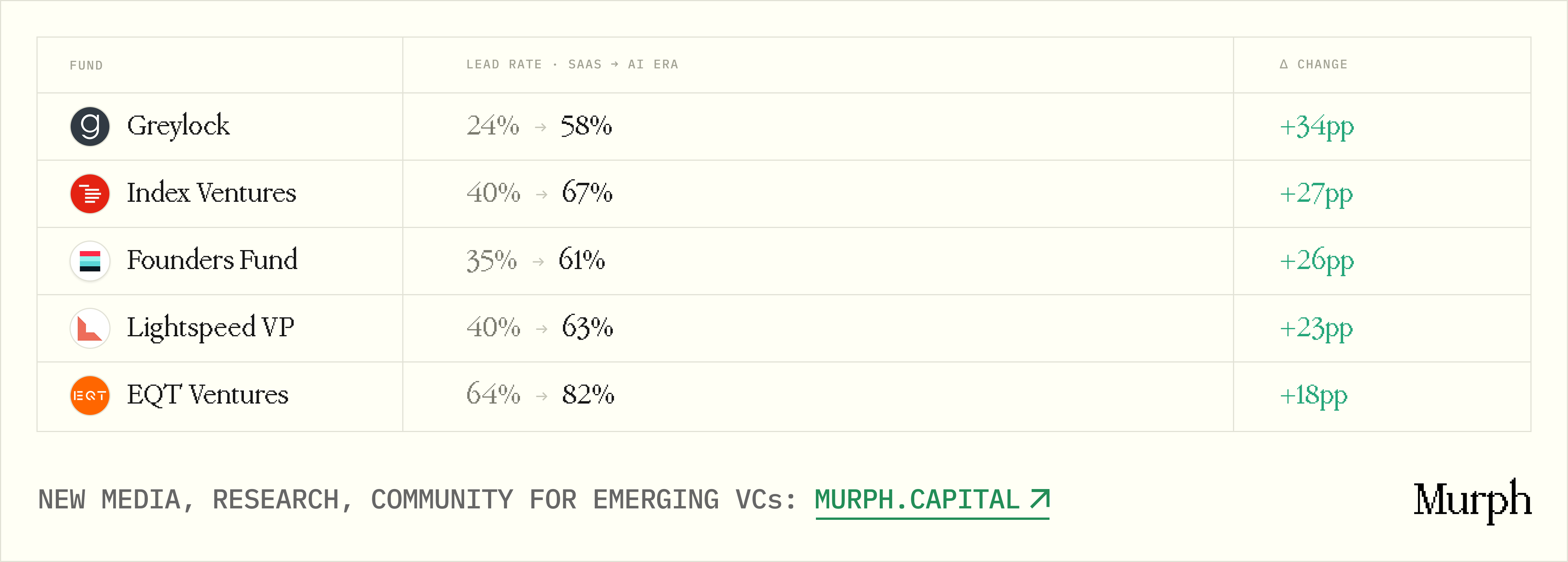
Importantly, the lead rate is trending upward for most mega-funds in the AI era. 13 of the 20 funds have higher lead rates than in the SaaS era. Greylock moved from leading only one in four seed deals in the SaaS era to leading more than half in the AI era. This signals that mega-funds are shifting from passive "invited guests" to proactive "we arrange this round."
6. Sector Distribution: Where You Compete Matters Most
Enterprise AI & Automation and AI Infrastructure & DevTools together account for 538 companies—42% of all early-stage activity in the dataset. All 20 mega-funds are active in both sectors. The drivers: enterprise AI spending exploded from $1.7 billion in 2023 to $37 billion in 2025; growth frameworks shifted from T2D3 to the faster Q2T3 paradigm; and outlier companies emerged at breathtaking speed—Lovable reached $100M ARR in 8 months, doubled to $200M in another 4 months, and was on track for $500M by mid-2026. Anthropic's annualized revenue accelerated from ~$1B at end-2024 to $47B by May 2026.
By contrast, Cybersecurity (76 companies, but 62% lead rate and $7M median round) and Defense & Aerospace (34 companies, 66% lead rate, but only 12 active funds) show that smaller deal flow does not equal low intensity. Sectors like Climate & Energy (26 companies, 12 active funds), Logistics (24, 13 active), and traditional verticals (PropTech, EdTech, Legal, HR) are structurally less crowded. EMs with deep domain expertise in these niches can compete on a different playing field—facing not 20 platforms, but 8–12 institutions that typically price only 2–3 deals per year.
7. Conversion Rates: Real Advantage with a Dark Side
Focusing on the SaaS and Zero-Interest eras (the AI era companies are still too young), we measured the share of seed-stage companies that later reached Series B. Mega-fund-backed companies had a 3.7–4.2x higher conversion rate than the market average, and this gap actually widened during the overheated zero-interest period when overall market conversion plummeted. Part of this premium comes from signaling effects: a mega-fund's brand attracts follow-on capital, talent, and customers. But part also stems from genuine platform resources—expert networks, customer introductions, strategic guidance.
The flip side is stark: among 15 funds with sufficient data, 14 saw their conversion rates drop by 10–25 percentage points from the SaaS to Zero-Interest era. The funds that expanded volume most aggressively suffered the biggest declines: Sequoia tripled its deal count (from ~20 to ~50 per year) and saw conversion crash from 46% to 14%; Lightspeed quadrupled deal count (12 to 42 per year) with conversion falling from 31% to 11%. The lone exception was Greylock, which held deal count nearly flat (11.0 to 11.3 per year) and actually improved conversion from 29% to 44%. Discipline in deal count is directly tied to portfolio quality.
This tells us that mega-funds have proven they can pick winners at low volume, but they have not yet proven they can do so at scale. In the AI era, mega-funds are now breaking all-time seed volume records. If the zero-interest pattern repeats, conversion erosion is inevitable. The open question is whether their platform effects and signaling advantages can offset the dilution from massive deployment.
8. The Danger Index: Who Are the Top Threats to Emerging Managers?
The research team built a Danger Index based on three pillars: deal volume (number of early-stage deals in the AI era), strategic commitment (percentage of early-stage deals as share of total investments), and price overlap (median round size). Each pillar scored 0–10, for a maximum of 30. The top tier: General Catalyst (26 points), a16z (25 points), Sequoia (22 points), and Accel (21 points). These four funds not only dominate in volume but also actively compete in the $4–6 million round range where most EMs deploy capital.
The Danger Index is not a death sentence—it is a minefield map. For an EM targeting AI software, facing GC and a16z doing a combined ~150 seed deals per year in their backyard, the LP pitch must clearly articulate what specific edge allows them to win repeatedly. For an EM writing $2–3 million checks in Climate Tech where no Tier 1 mega-fund is active, the conversation is entirely different—deep domain expertise itself becomes a defensible moat.
9. Conclusion: The Premium of Discipline Is the Ultimate Counter-Strategy
The mega-fund invasion of early-stage investing is not a temporary anomaly of a particular tech cycle. It is a permanent recalibration of how venture capital works at its foundation. As multi-stage giants continue to absorb the top quartile of the seed ecosystem with hundreds of billions of dollars, trying to beat them at their own high-speed, deep-pocket game is a mathematical dead end. But the data reveals a critical crack in their seemingly flawless armor: the inescapable tension between large-scale deployment and investment portfolio quality.
For emerging managers in the AI era, the real advantage no longer lies in trying to replicate the institutional deal machine or blindly chasing the hot categories where Tier 1 platforms set pricing rules. Instead, it lies in rigorous sector selection, patience to back complex future unit economics that mega-funds often overlook, and the courage to stay small, focused, and deeply founder-aligned before the multi-stage platforms even notice their existence. In a venture ecosystem increasingly glorifying pure scale, the ultimate counter-strategy for EMs is to master the premium of absolute discipline—not to match the volume of giants.