
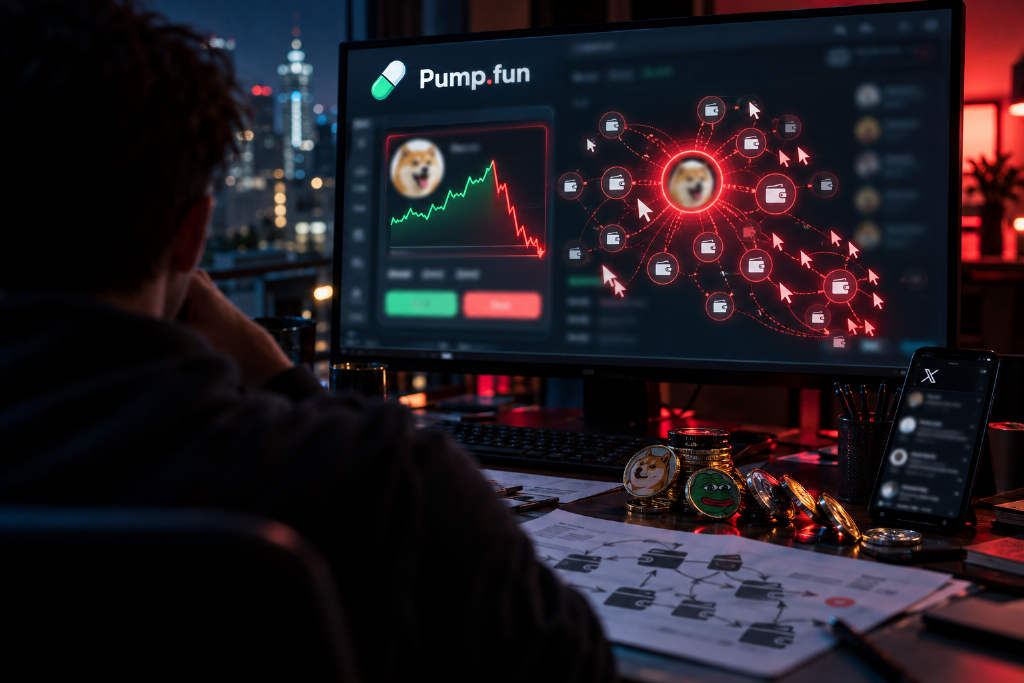
Crypto trader StarPlatinum said on Oct. 19 that real buying interest in the meme coin market is fading, with many tokens racing to a $50,000 market cap and then collapsing. In his view, the bids, holder counts and trading volume visible to retail traders can be manufactured through bots, bundled wallets and coordinated selling before outside buyers even arrive.
Bitquery data shows first-minute selling by developers is common
StarPlatinum, who said he has traded meme coins for three years, wrote that it has become much harder to tell whether demand in a newly launched token comes from real users or from a setup created by the project team. He described a familiar pattern on Pumpfun: a token launches, the holder count rises, volume looks active, a few recognizable accounts start talking about it, the market cap reaches $50,000, and then the token goes to zero. Some make it to $100,000 or $200,000, he said, but the ending is often the same.
He cited Bitquery research covering 8.2 million Pumpfun projects between October 2025 and October 2026. According to that analysis, 21% of projects involved developer-linked wallets participating in bundled issuance, with a median holding of 10% of supply. During the study period, developers and related bundled wallets made a combined $579 million in profit. The figure he highlighted most was this one: 65% of developers started selling within the first minute after launch.
An 18-minute trade that returned 11x
StarPlatinum also pointed to an extreme case recorded by Bitquery in June 2026. A developer launched a token with a very small initial buy, and four wallets in the same Jito bundle spent $6,000 to acquire 79% of the supply. The token almost immediately "graduated," and 1,138 wallets entered over the next 18 minutes.
By then, five early wallets had already sold their holdings for $121,000. Those wallets had spent only $11,000 in total, producing an 11x return in 18 minutes. StarPlatinum’s conclusion was blunt: someone has to fund that payout, and in his telling, that someone is retail. He said this is why so many tokens die around a $50,000 market cap. By the time a token looks active, early participants may already be exiting.
58% of Solana DEX volume was classified as non-organic
Volume used to be one of the first metrics he checked, StarPlatinum said, but he argued that even that signal can no longer be taken at face value. He cited another Bitquery study that examined a 30-day period and found that 58% of the $201.4 billion traded in Solana DEX pools was classified as non-organic, equal to about $117.7 billion.
A large share of that activity, he said, came from a simple tactic: coordinating buys and sells of the same token within the same transaction. Developers can also spread small amounts of tokens across dozens of wallets to create repeated trades and inflate holder counts, making a project appear far more active than it really is. Add Telegram groups discussing the token, X accounts posting charts and KOLs promoting it, and the market can look alive even if the same group is preparing to sell into that attention.
After the KOL post, who is selling?
StarPlatinum said not everyone promoting a token on crypto Twitter is necessarily part of a coordinated operation. Some may genuinely believe in their call, some may simply be wrong, and some may have been paid. From the perspective of users scrolling through posts, though, those three cases can look identical.
He argued that if someone starts selling right after publishing a recommendation, the people who buy because they trusted that recommendation are effectively providing the liquidity for that person’s exit. He said the pattern repeats across different tokens, different codebases and different narratives. For that reason, he believes a promoter’s trading history is becoming just as important as the token itself. A KOL with a profitable entry record may not be especially good at spotting opportunities; they may simply have entered earlier than the audience they later direct toward the trade.
He recommends checking supply ownership and wallet links on-chain
StarPlatinum did not argue that traders should avoid every token launched with bundles. He said not every bundle is malicious. Some teams use coordinated launches to manage sniping, and independent snipers can also buy in the first block without any connection to the developer. The key question, he said, is what those wallets do afterward.
He recommended spending more time identifying who owns the supply and named Bubblemaps, Trench Radar and Solscan as tools for checking early buyers, wallet relationships and token distribution. The questions he said traders should ask include:
- If a group of wallets bought a large share of supply in the launch block, are they still holding it?
- If several top holders received SOL from the same source, why?
- If liquidity is limited but volume suddenly spikes, are those trades actually independent?
- If someone is heavily promoting the token, is that wallet still accumulating or already distributing?
He also warned that operators adapt. They can use different funding sources, spread purchases across multiple blocks and recycle wallets to make coordinated behavior look natural. That means tools built to help retail traders identify manipulation will never be perfect. As he put it, traders still have to think for themselves.
Solidus Labs estimate puts the figure at 98.6%
At the end of the thread, StarPlatinum cited an estimate from Solidus Labs saying that 98.6% of Pumpfun tokens showed signs of pump-and-dump behavior during the study period. He said the business has become one of draining liquidity before a narrative fully forms. In his view, genuine communities are finding it harder to compete with groups whose business model is to manufacture the appearance of a community.
He added that he still believes opportunities exist in meme coins. What is disappearing, he said, is the old habit of blindly buying whatever starts to trend and expecting the market to reward that decision. If other participants already control half the supply when a buyer enters, being early is no longer enough. Traders need to understand the structure of the trade itself.



