

A MarsBit article by JamesX argues that many market participants still view Meme KOL extraction in its most basic form: a project pays a KOL in cash or tokens, the KOL posts on X, joins a Space, or calls the token in Telegram and WeChat groups, followers rush in, and the team exits at higher prices. The article says that pattern exists, but in the Meme market, the playbook has moved well beyond that.
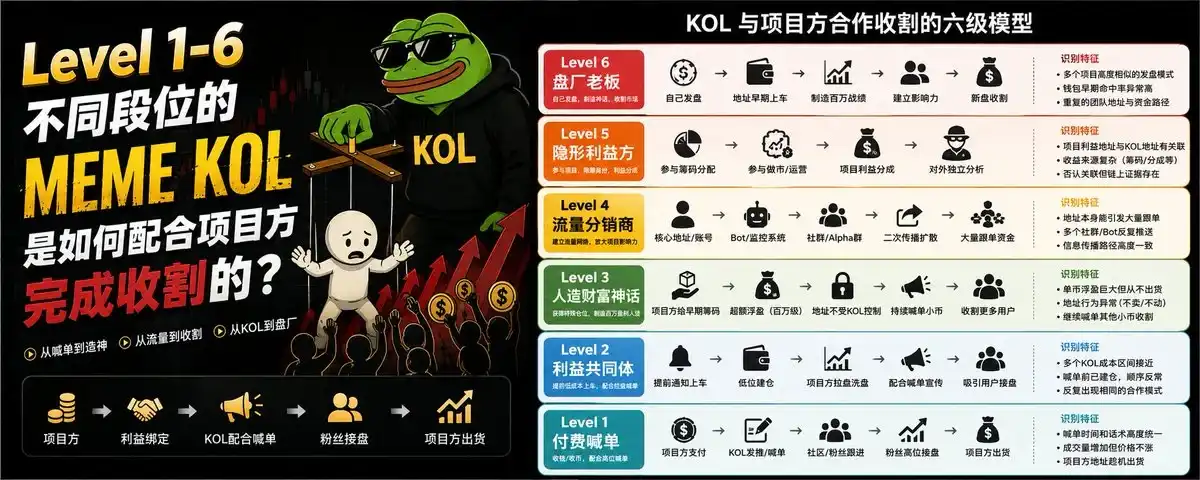
For a mature Meme operation, the piece says, a KOL is rarely just an ad slot. A KOL can serve as traffic intake, a distribution arm for tokens, a price starter, a profit-sharing partner, or even the front end for a full launch team. In some cases, the so-called million-dollar Meme trader may be part of the machine from the start.
The article starts with a basic question: what does a Meme project actually lack? Not tokens, because those can be issued in minutes. Not artwork, because AI can generate dozens of images in a minute. Often not even seed capital. The scarce resource, it says, is a steady supply of people willing to buy at higher prices — exit liquidity. In that framing, the core chain in the Meme market is chips, narrative, attention, buy pressure, liquidity, and exit. KOLs sit at the key point in that chain because their real asset is not research skill, but the ability to turn attention into buy orders.
Level 1: direct paid promotion
The first level is the oldest and simplest one. A project contacts a KOL, pays 5,000U, 10,000U, or 20,000U, or sends a block of tokens, then asks for posts, Spaces, group promotion, or a staged “discovery” of the project. The article says the issue is not marketing by itself. The issue is whether the economic relationship is disclosed.
What users see may be: “I’ve been looking into this project recently, and it seems interesting.” What may have happened behind the scenes is: “The team transferred me 20,000U yesterday.” The article argues those are not equivalent pieces of information for investors.
It then points to a warning sign seen often in Meme trading. A team already holds a large supply of low-cost tokens. A KOL starts promoting. A wave of followers enters. Volume rises quickly, but price does not move much, or briefly spikes and then stalls. The piece reduces that setup to a simple pattern: attention up, volume up, price roughly flat.
If a market sees a sudden increase in buying but the price shows little elasticity, the article says one question should be asked: who is taking the other side? Buying and selling happen at the same time. A sharp increase in turnover without corresponding price movement often suggests steady supply on the other side of the book. That alone does not prove team selling, the article adds, but if wallets tied to the project, early holders, or team wallets are also selling, the logic becomes harder to ignore. At this level, the KOL is still essentially an advertising channel.
Level 2: no ad fee, just a nearly risk-free win for the KOL
The second level becomes more interesting because teams stop buying promotion in the usual way and begin designing the KOL’s upside. The article says a team may realize that paying a KOL 20,000U might buy two posts, while helping that person make 200,000U on one trade may buy a month of voluntary promotion.
In the example given, the team accumulates early supply first. When the project sits at a 500K FDV, it tells a small group of favored KOLs that it is time to enter. Those accounts build positions around 500K, 600K, and 700K FDV. After that, the team pushes price, shakes out weak hands, works the community, manufactures volume, pushes for trending visibility, and brings in more KOLs. The project then runs from 500K to 2M, 5M, and 10M. At that point, the earliest KOLs may be sitting on gains of 10x, 20x, or more.
Those KOLs can now post statements that are factually correct: they found the project early, they are heavily positioned, and the token is already up many multiples. The hidden piece is why they were able to buy that early. The article draws a distinction between normal alpha — research, judgment, risk-taking, then buying — and relationship-based alpha, where the sequence may be early notice, buying, team-led price work, and only then public promotion.
The main signal to watch here, it says, is unusually tight clustering in cost basis across several KOLs. The article gives an example of a very obscure Meme token where A buys at 620K FDV, B at 670K, C at 710K, and D at 650K, then all four begin discussing the token only after it reaches 3M. Any one wallet may look fine in isolation. Repeated use of the same pattern by the same group is what matters.
Timing is central. Was the public research posted before the buys, or did the wallets buy first and the “discovery” narrative appear later? The article says users often assume the former, while the on-chain timeline may show the opposite: wallet buys first, price work starts, public promotion comes after.
It adds one more red flag. If a trader focused on Memes almost never seems to fail when sizing up heavily, and the true heavy bets always come at unusually low cost bases, it is fair to ask whether that person keeps finding alpha — or alpha keeps finding that person first.
Level 3: manufacturing a million-dollar-profit KOL
The next stage is more counterintuitive. According to the article, teams eventually realize that a KOL with enormous on-chain PnL is itself a marketing asset. A team may allocate early tokens directly to a KOL or help set up a wallet. That wallet receives a $20,000 position in a very early Meme. If the token later rises 100x, on-chain tools will show a PnL of +$2,000,000.
From there, the social loop begins. Communities take screenshots. Twitter spreads them. Smart Money bots flag the address. The public takeaway becomes simple: this trader made $2 million on one coin. Once that narrative sticks, the KOL’s standing in the market changes sharply. A future post saying “bought a little XXX” may be enough to attract immediate copytrading capital.
The article warns that this setup contains a major cognitive trap. Unrealized PnL is not the same as realized profit. A wallet showing a $2 million gain does not mean the person behind it can actually withdraw $2 million. Ownership is also not the same as control. The private key may still be held by the project. The KOL may only be allowed to display the address. There may be an agreement preventing discretionary selling. Or the market may simply believe the wallet belongs to the KOL.
That, the article says, helps explain a strange Meme market pattern: public wallets show unrealized gains of $500,000, $1 million, or $3 million on a single token, the token later falls 90% or nearly to zero, and the wallet still never seems to take visible profit. For an ordinary trader, that makes little sense. One possibility worth testing, the piece says, is that the position was never freely disposable in the first place.
In that case, the million-dollar PnL is valuable not as profit but as marketing spend. The team uses cheap early supply to create a “Meme genius” who appears to have made $2 million on one trade. That becomes a credibility asset capable of pulling real money into future projects. The article even frames the initial 2M unrealized gain as an influencer acquisition cost.
Level 4: the KOL as a full distribution network
At the fourth level, the article says, a KOL’s influence extends far beyond their own audience on Twitter. The on-chain ecosystem now includes automated copytrading and alert systems that can amplify a single wallet action through multiple layers. Once an influential wallet buys, the move may be picked up by wallet-monitoring bots, Smart Money alerts, Telegram alpha groups, tracking users on GMGN, Arkham, and DeBank, copytraders, smaller KOLs, and community screenshots.
The article lays out the sequence like this: core KOL buys, bots pick it up, alpha groups spread it, smaller KOLs repeat it, Twitter accelerates it, copytraders join, and more users buy in. At that stage, the KOL is no longer just a content creator. The wallet becomes a distribution node. The piece sums it up in one line: “Address becomes Media.”
If enough people track a wallet, a buy transaction alone can create attention. Attention creates volume. Volume attracts more people. The team is no longer asking only whether the KOL can post a tweet. It is asking whether the KOL’s entire traffic network can be activated.
Level 5: the KOL is part of the project
At the fifth level, the line between project team and KOL starts to disappear. Publicly, it still looks like an independent influencer reviewing a token. In reality, that person may have been involved in early token supply, token design, market making, fundraising, community work, marketing, or even fee-sharing arrangements.
In that setup, the KOL is no longer just someone being paid to promote. The article describes the role more as an invisible shareholder, invisible issuer, or direct participant in profit distribution. Yet the outward message may still be framed as an independent view: “I found an interesting project recently.”
The article says this is where users are most likely to misread what they are seeing. What the public thinks is independent opinion may actually be an undisclosed conflict of interest. It stresses that investing in a project, participating in a project, and making money from it are not the issue by themselves. The issue is presenting economically interested commentary as if it were independent judgment.
Level 6: the KOL runs the launch machine
The sixth level is the full loop. Here, the KOL no longer waits for teams to bring deals. The KOL either owns or deeply controls the team responsible for issuing tokens, managing supply, moving price, operating the community, handling promotion, and exiting. The public identity may still be Meme trader, alpha hunter, or Smart Money. The business model underneath has changed completely: create the market first, then profit by using the influence that market creation produced.
The article says the most effective first step is not immediate extraction. It is building the persona of a highly skilled Meme trader. The team does that by manufacturing strong public wallet PnL. Since the team controls the token launch, it knows when the token will go live, when LP will be added, where early supply sits, which wallets will not sell, when the price campaign begins, and when marketing starts. The public KOL wallet can buy at the earliest stage, for example at a 10K FDV. Then the team runs the token from 100K to 500K, 2M, and 10M. On-chain, the wallet now shows gains of +300K, +800K, and +1.5M. Repeat the process several times, and a so-called on-chain god is created.
The article puts the key point bluntly: the market may not be something the trader predicted. It may be something the trader created. For a normal Meme trader, the logic is straightforward — buy early because the token may rise. But if the token was launched by the same team, there is no forecasting problem to solve. The test-maker already knows the answer.
The second step is turning wallet performance into credibility. Crypto users place heavy trust in on-chain data because wallets seem harder to fake than posts. An address that repeatedly appears in 100x tokens is quickly tagged by tools as Smart Money, tracked by communities, and watched by a growing audience. Over time, the market forms a simple belief: this address is unusually accurate.
There is a quieter problem underneath that. Are observers seeing all of the relevant wallets? The article says a team can operate 20, 50, or 100 wallets. Different wallets buy different tokens. Most fail. Only the most successful wallet is made public. The public then sees an 80% win rate even if the actual team-wide rate is very different. The article describes that as survivorship bias turned into marketing.
The third step is when the wallet itself begins to move the market. Early on, Twitter shapes wallet reputation. Later, wallet reputation starts shaping price action. The article gives an example: the address suddenly buys a Meme at a 300K FDV. Bots immediately push alerts saying a Smart Money wallet just bought the token. Hundreds or thousands of users receive the notification. The first wave of copytrading capital enters. Price rises. That move draws attention from more scanners and more users. Then the KOL posts that they “just found something interesting,” and a second wave from Twitter arrives. At that point, the wallet itself has become a price starter.
The final step is using that “god-tier” address to direct liquidity into the team’s own next token. The process described is straightforward. The team prepares a new token, arranges issuance, token allocation, LP, wallet setup, and narrative. Then the KOL Smart Money wallet — the one with a visible history of hundreds of thousands or even millions in PnL — buys in. The first wave of bot-driven copytrading enters. Price rises. The KOL then posts. A second wave of followers enters. Other KOLs start talking about it. A third wave of capital arrives. The token reaches trending feeds. More people see it. Price continues to move up.
From the outside, the story looks organic: a Smart Money wallet spotted a Meme early, the market slowly recognized value, and the community formed around it. The article says the actual sequence may be the reverse. The team launched the token. The wallet bought deliberately. The first move came from copytraders. Twitter content amplified the process. New liquidity then became the exit path for early supply. That creates a self-reinforcing loop: launch token, buy with own wallet, attract followers, push up price, improve wallet PnL, strengthen the Meme-god persona, attract more wallet watchers, and give the next token a stronger starting engine. The article reduces that loop to: PnL, followers, liquidity, PnL.
Self-fulfilling alpha and what ordinary users should watch
The article says the real danger here is not alpha itself, but self-fulfilling alpha. In a normal setup, a trader buys because the token is likely to rise. In a self-fulfilling setup, the token rises because the trader bought. Once a wallet has enough followers, the act of buying creates demand. Then the loop reinforces itself: the wallet buys, others follow, price rises, the wallet’s PnL looks stronger, more people believe in the wallet, and the next trade attracts even more followers.
From the outside, the hit rate keeps improving. But the article says that hit rate may be coming less from forecasting ability and more from market influence. If the token being bought was also issued by the same team, the mechanism starts to resemble a near-complete liquidity machine.
The piece also cautions against jumping from suspicious patterns to accusations. One of the biggest mistakes in on-chain work, it says, is treating correlation as causation. Several wallets buying together does not automatically prove collusion. A token transfer from a project may have a legitimate explanation. An early buy may still come from real research ability. What matters is repeated behavior that forms a statistically meaningful pattern over time.
The article says four questions deserve the closest attention:
- WHEN: When did the buying happen? Did the wallet buy before the public call or after it? If the repeated pattern is wallet buys first, price rises, and only then the KOL starts talking publicly, that is worth tracking.
- WHERE: At what cost basis did they buy? Are several KOLs consistently entering at unusually tight ranges, especially in thin-liquidity tokens that almost nobody is discussing?
- WHO: Where did the tokens come from? Were they purchased through standard DEX swaps, or transferred directly from a project wallet? Who funded the purchases? Do several KOL wallets share the same funding source? Across projects, do the same deployer wallets, funding wallets, LP wallets, or counterparties keep appearing?
- EXIT: Who actually sold into the demand? The article calls this the most important question. Instead of only asking how much a KOL bought, users should watch who keeps selling once the KOL’s promotion brings in major turnover. If early addresses continue unloading supply during a surge in popularity, the destination of new buying pressure becomes much easier to identify.
The article’s bottom line: the Meme market trades attention
JamesX closes by arguing that many people think the Meme market trades tokens. His view is that what it really trades is attention. Teams create supply. Narrative gives that supply a story. KOLs turn the story into attention. Attention becomes buy pressure. Buy pressure becomes liquidity. Someone eventually converts that liquidity into real dollars.
The sequence is presented one more time in the article as: token, narrative, KOL, attention, buy pressure, liquidity, exit.
At the lowest level, teams buy traffic from KOLs. A level above that, they bind KOL incentives. Above that, they manufacture a “million-dollar Meme trader.” At the highest level, the KOL has the ability to launch and run the token machine directly, building the market and then using the track record it created to influence the next market. So when users see a KOL posting that they bought at a 100K FDV or made another $1 million on a trade, the article says the better questions may not be “Why is this person so good?” but rather: why do they always get in that early, why do these projects always seem to find them, and where exactly do they stand in the incentive chain?