
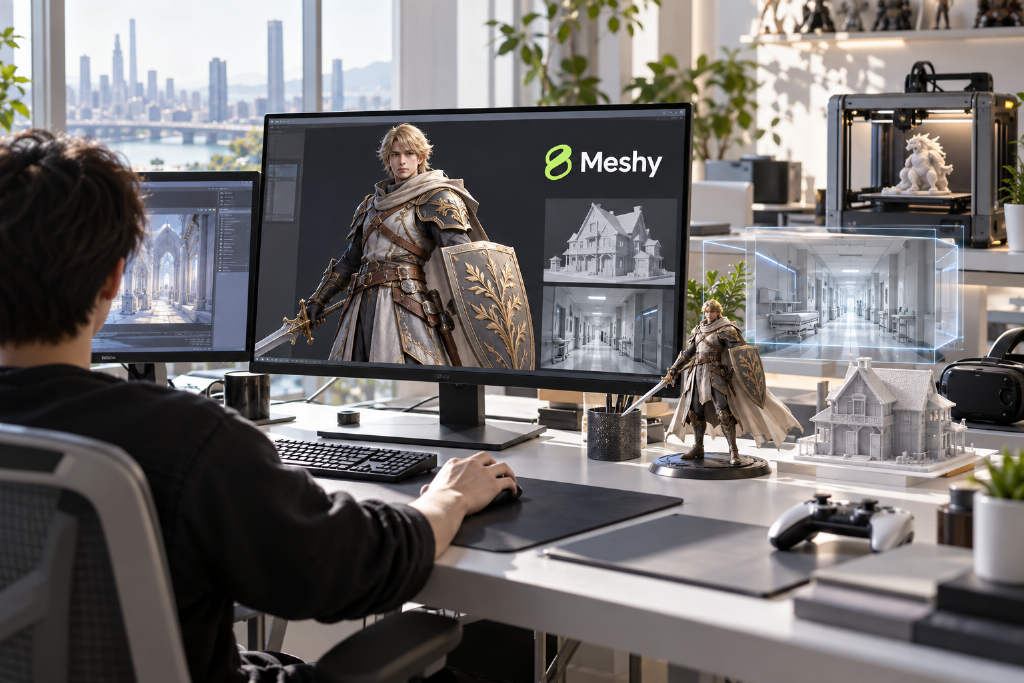
GPT-6 Astra has reignited a core question in the 3D world: if a general-purpose model can already build inside Blender, does the market still need dedicated AI 3D models?
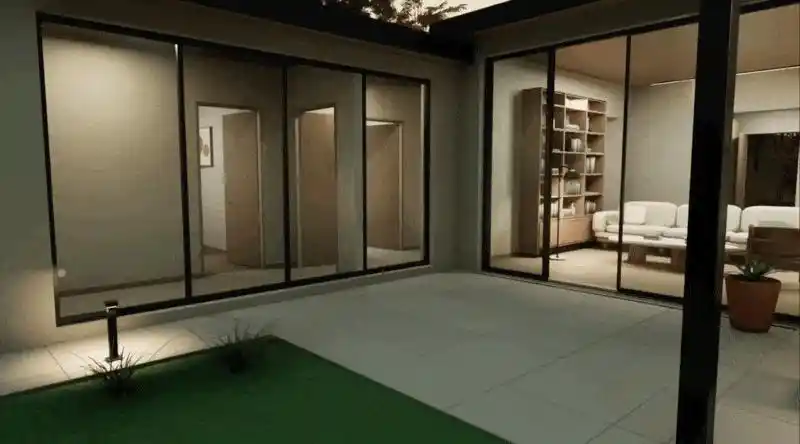
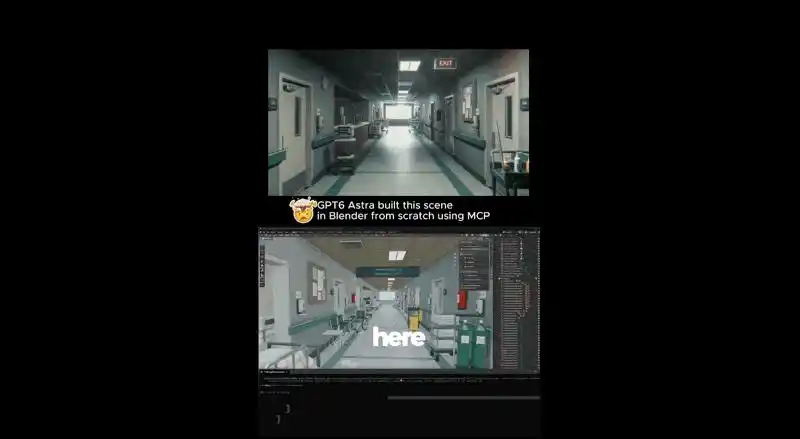
The article says that question became sharper after Astra demos spread across social media. Astra can build a house in Blender and then move it into Unreal Engine 5 as a walkable scene. Users also showed it generating an entire hospital corridor from scratch through Blender MCP using only text prompts.
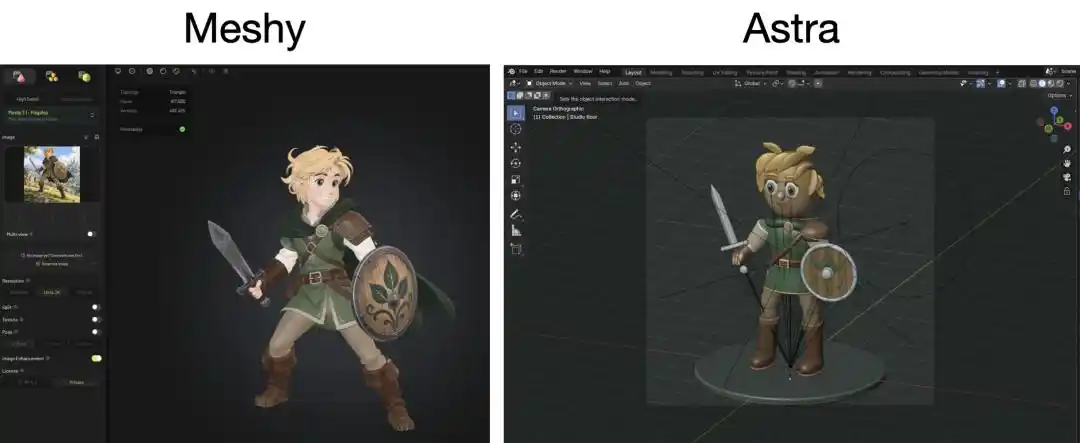
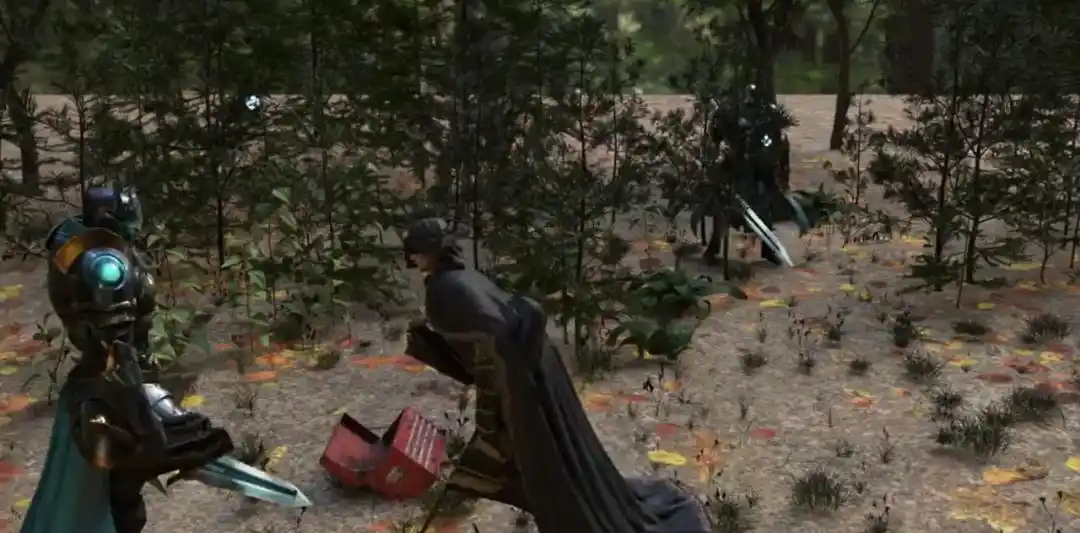
But the comparison changes once the task moves from broad scene construction to specific assets, especially characters and complex props. According to the article, when the same reference image was given to Astra and Meshy, Meshy produced a blond swordsman with clearer strands of hair, facial features, layered cloak, belt and armor details, plus the leaf pattern on the shield. Astra’s version looked much rougher, with hair rendered like a single helmet-shaped block and a body that resembled a set of geometric forms assembled in Blender.
That shifts the discussion from whether a model can build something in 3D to whether it can reliably generate assets that are ready to enter a production pipeline.
Meshy says ARR rose from $1 million to $100 million in under two years
Meshy disclosed that its annual recurring revenue, or ARR, increased from $1 million to $100 million in less than two years.
ARR measures recurring subscription or contract revenue on an annualized basis and usually excludes one-off income. The article frames it as a core SaaS metric because it reflects sustained paying demand rather than attention or demo traffic.
To put that pace in context, the piece cites Bessemer Venture Partners, a venture firm with roots dating back to 1911 and early investments in Shopify and LinkedIn. In The State of AI 2025, Bessemer grouped fast-growing AI companies into two categories: "rising stars," which take about four years on average to reach $100 million in ARR while maintaining roughly 60% gross margins, and the rarer "supernovas," which reach that mark in about 1.5 years on average.
On that timeline, Meshy’s move from $1 million to $100 million in under two years puts it close to the supernova range.
The article also compares Meshy with two well-known AI companies. ElevenLabs, the voice generation company valued at $11 billion, took about 20 months from product launch to reach $100 million in ARR. HeyGen, the AI video company built by a Chinese team, took 29 months to go from $1 million in ARR to $100 million. Meshy, the article says, did it faster than HeyGen.
That is notable because 3D is harder to commercialize than audio or video. Audio and video outputs are often usable right away. A 3D asset still has to clear checks around topology, textures and dimensions before it can be used in a game engine or sent to a 3D printer.
General models can plan and script, but specialist 3D models still handle the hardest assets
The article breaks Astra’s appeal into three parts. Computer Use lets it operate Blender. Coding turns a request into scripts. Spatial understanding helps it reason about structure and object placement.
That makes Astra well suited to tasks that can be decomposed into geometric relationships, such as CAD, parametric modeling and procedural generation. Walls, stairs, doors and windows can be built line by line through code.
Characters and complex props are different. Hair flow, cloak folds and shield ornamentation are not easy to reduce to a few geometric rules. They depend on a model learning what shapes and details should look like from large volumes of real assets.
That is where specialist 3D models such as Meshy come in. The article describes Meshy’s role as generating textured 3D assets directly from text or images.
The piece points to 3AGameFactory, an open-source framework from Peking University’s OpenDCAI team. It lets an AI coding agent break down game requirements and decide asset by asset whether something should be generated on the spot, built procedurally or pulled from an open-source asset library. Characters and key props were assigned to Meshy.
Even after generation, the work is not done. Assets still need mesh cleanup and scale checks. Characters also need rigging and motion processing before they can enter a game. Bohan Zeng, the project lead and a PhD student, summarized the biggest challenge this way: there is still a gap between something that "looks right" and something that is truly usable. Many problems only show up after an asset is placed inside a playable scene.

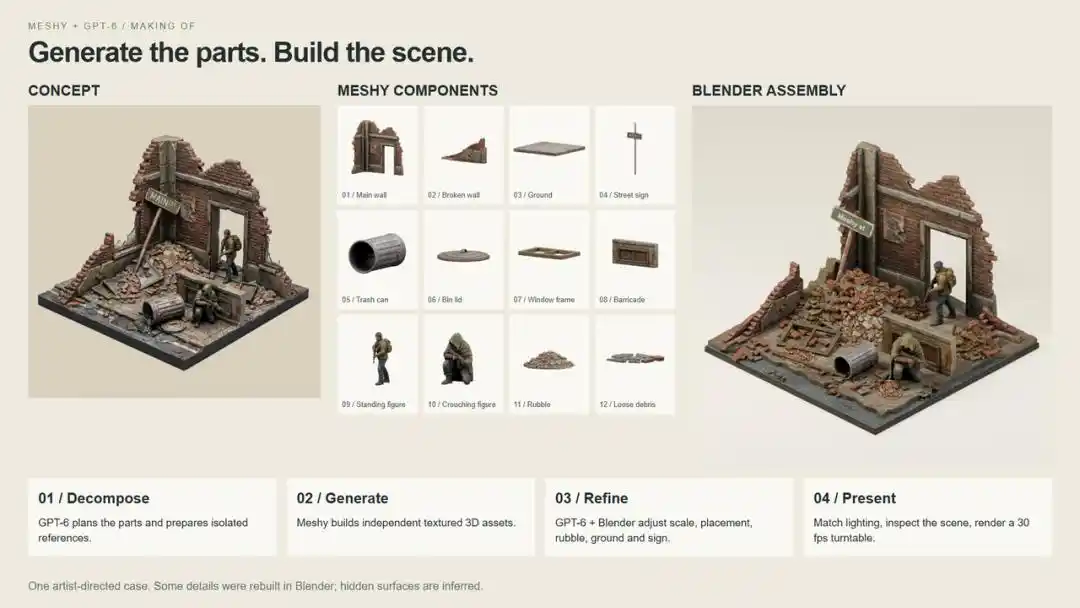
The article says a demo of Meshy and Astra building a ruins scene showed a similar division of labor. A general model handled scene decomposition and reference preparation, then called Meshy through an API to generate the required assets one by one. Those assets were then imported into Blender for placement, scaling and lighting.
In that setup, planning and orchestration can be handled by a general model. The assets that determine the final visual quality still come from Meshy.
The article’s view is that agents lower the barrier to starting a 3D project, but asset quality becomes the more important barrier. As more people can initiate projects, demand rises for characters and props that match the design and can move into production without breaking downstream workflows.
Where the moat sits: shape, detail, and color or pattern fidelity
The article says Meshy’s value in this workflow comes down to asset quality: whether the shape is right, whether the detail is sufficient, and whether colors and patterns are preserved.
Shape
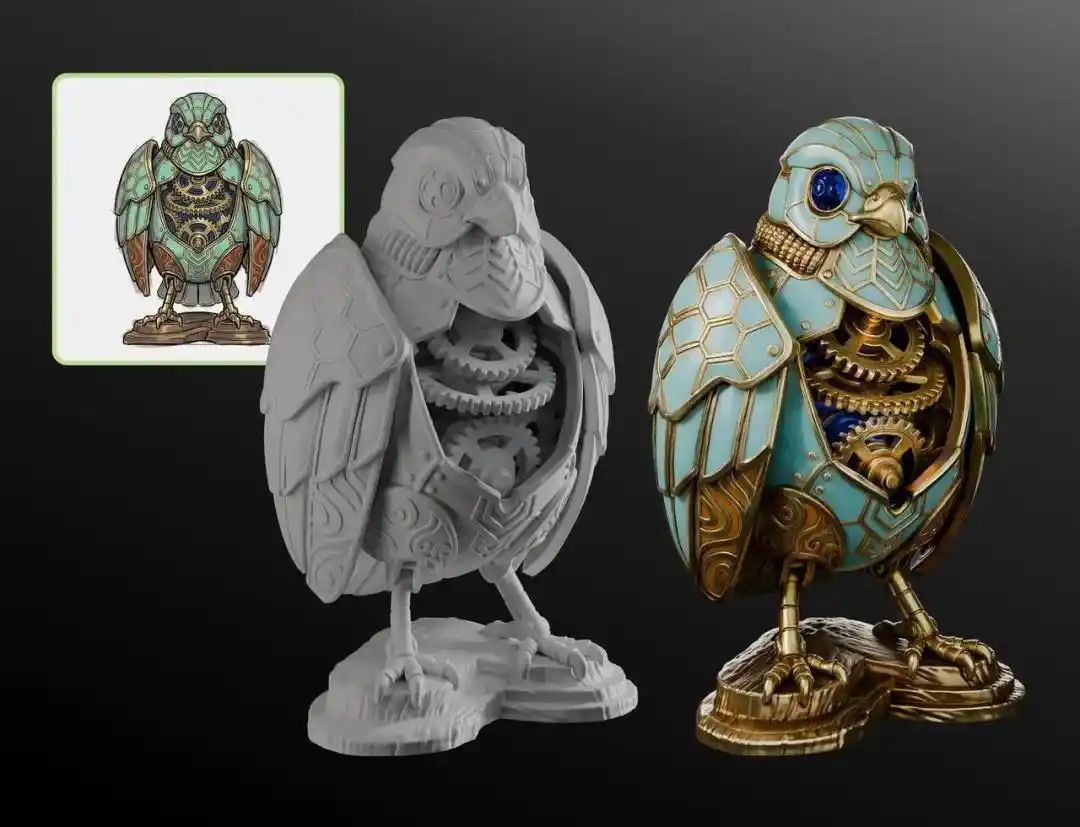
One example is a mechanical owl. The layered armor plates, chest gears and carved base in the reference image remained separate structures in the generated result instead of collapsing into a single bird-shaped silhouette. For artists, that means revisions can start from an asset that is structurally closer to the original design.
In Meshy’s self-built 3D geometry alignment benchmark, the article says Meshy 7 led other tested models on shape proportion, spatial distribution and surface detail under single-image input. Surface detail scored 59.8%, versus about 49% to 55% for other models, while the previous-generation Meshy 6 Lite scored 52.7%.
Detail
The article says an orc character generated by Meshy 7.1 showed clear relief in the armguard rope knots, while woven edges and wear marks were visible on the skirt. Those details existed in the geometry itself and could be seen even without texture rendering.
According to Meshy, version 7.1 increased geometry generation resolution from 2048³ to 4096³. Under 4K rendering conditions in its Detail Richness benchmark, it scored 23.1%, ahead of other tested models.
Higher resolution allows finer grooves, folds and surface textures to be expressed, but it also raises the bar for training, inference and mesh extraction.
Color and pattern
The article uses a vintage radio as another example. The hard part was not the boxy shell but the English text on the nameplates, the numbered scale next to the knobs and the material variation across the panel. After conversion into a 3D model through Meshy, the article says the two nameplates remained legible and the scale markings kept both segmentation and numbers.
In Meshy’s end-to-end texture alignment test, Meshy 7 posted a composite score of 66.2%, above the other tested approaches.
The article attributes those gains to continued optimization around 3D assets. Meshy 7 improved the image encoder and training data so that input images align more accurately with target geometry. Meshy 7.1 expanded geometry generation scale and improved mesh extraction so finer structures could survive in deliverable meshes.
The team is also exploring direct mesh generation. Meshy T2, which uses a Flow Matching approach, can generate vertices and connectivity while controlling mesh complexity within a budget, balancing speed and asset structure.
Who is paying for AI 3D
The article says benchmark scores alone are not enough. The commercial question is who will pay for this capability on a recurring basis. It identifies at least two clear use cases.
Game development
3D assets are already a major cost center in game production. Based on pricing ranges published by game art outsourcing company Juego Studios, a stylized 3D prop costs about $300 to more than $2,000, while a AAA-quality character can cost more than $5,000.
Time is another pressure point. Once the number of characters and props rises, 3D art quickly becomes a bottleneck for project schedules.
The article says 37 Interactive Entertainment has already integrated Meshy into its production workflow. For complex characters and monsters, the team first uses Meshy to generate parts such as heads and limbs, then imports them into 3D software for assembly and refinement. That approach can provide a high-poly base with more than 60% completion before manual sculpting begins.
In complex next-generation and ancient-style projects, the sculpting workload at the base-model stage fell by 30% to 40%. For simpler props and characters, full models can be generated directly and then cleaned up for further work. In some casual and mobile game projects, modeling time for a single asset dropped from five days to about 2.5 days.
For projects that need dozens or even hundreds of assets, those gains compound over time and free artists to focus more on style and final polish.
3D printing
The second clear use case is 3D printing. The article cites data disclosed by Bambu Lab showing that by the end of 2025, registered users across MakerWorld’s global and China sites had reached about 50 million, with monthly active users in the tens of millions.
By comparison, the platform had only about 300,000 active creators and close to 2 million high-quality models. In other words, the number of people browsing, downloading and printing models far exceeds the number of people who can create original ones.
As printer sales rise, that content supply gap becomes more visible. Many people can buy a capable printer but still cannot model. If they want to print a figurine that is truly their own, they often have to wait for someone else to make the model first.
The article says Meshy is targeting exactly that gap by letting people who do not know modeling turn their ideas into printable 3D models. As Meshy added multicolor 3D printing capabilities to its product, printer brands including Bambu Lab, Creality, Elegoo, FlashForge and xTool entered its customer list.
Taken together, the article breaks Meshy’s revenue engine into three layers. The first is individual subscriptions for independent developers, teachers and printing hobbyists who can generate models from text or images without first learning professional modeling software. The second is enterprise API demand. Once game companies such as 37 Interactive Entertainment, NetEase Games and Nexon connect generation capabilities to existing pipelines, demand no longer stops at occasional one-off models. A single project may require dozens or hundreds of assets, and API usage rises with project volume. The third is the hardware ecosystem, where model generation demand can keep growing alongside printer sales and active user counts.
The article argues that enterprise APIs and the hardware ecosystem are the key drivers behind Meshy’s ability to keep scaling revenue.
From AI for Work to AI for Fun
Reaching $100 million in ARR in under two years shows that AI 3D is already a viable business, the article says. But most of today’s revenue still comes from helping people do 3D work more efficiently. That means game artists, modelers and designers, a meaningful but still limited user base.
The next question is whether AI 3D can expand beyond professional asset production and let ordinary users create and consume 3D content directly.
The article presents Mora, Meshy’s new real-time interactive multimodal content architecture, as one attempt to answer that question.
Inside Mora, a user can enter a room, interact with the environment and find a path through a spatial puzzle. A user can also step into a boxing ring, place a photo of their boss on the platform and interact with it there.
Those interactions happen in real time through a layered architecture. A Coding Agent builds the game structure and runtime logic. Meshy generates the space and 3D assets while sending control signals to a real-time video model. The video model then generates visuals and audio in real time based on those signals.
In this stack, 3D serves as the skeleton of the world.
The article notes that world models have become one of the hottest directions in AI. Google DeepMind’s Genie 3 can already generate explorable scenes from text in real time. But worlds generated purely through video still struggle with spatial consistency. If a player walks away and comes back, an object that was on the table may have moved or disappeared.
Mora takes a different route. It fixes the space with 3D first, then lets the real-time video model handle visual presentation. Where the room is, where the doors lead and where objects are placed are all determined by the 3D structure. Every door the player opens and every photo placed on the boxing platform corresponds to a real object in space that can continue to be interacted with.
At that point, 3D is no longer just an asset inside a production workflow. It becomes the foundation of a playable world.
The article argues that this is what really expands the user boundary for AI 3D. In the past, turning an idea into a playable game meant crossing barriers in modeling, programming, art and game engines. Mora distributes those tasks across different models, giving ordinary users a chance to turn a sentence or a thought into a world they can step into without mastering the full game development process.
That also leads back to the opening question. If general models get better at understanding space and writing logic, more projects can be initiated. Demand for high-quality 3D assets rises with them. On the interactive content side, stronger coding agents can design more complex gameplay, which also increases the need for stable 3D space.
One side interprets intent and organizes tasks. The other generates 3D worlds that are usable, controllable and interactive. In the article’s framing, stronger general models do not eliminate the need for specialist 3D models. They may increase it.
The article was originally published by the WeChat account QbitAI under the byline "关注前沿科技."