

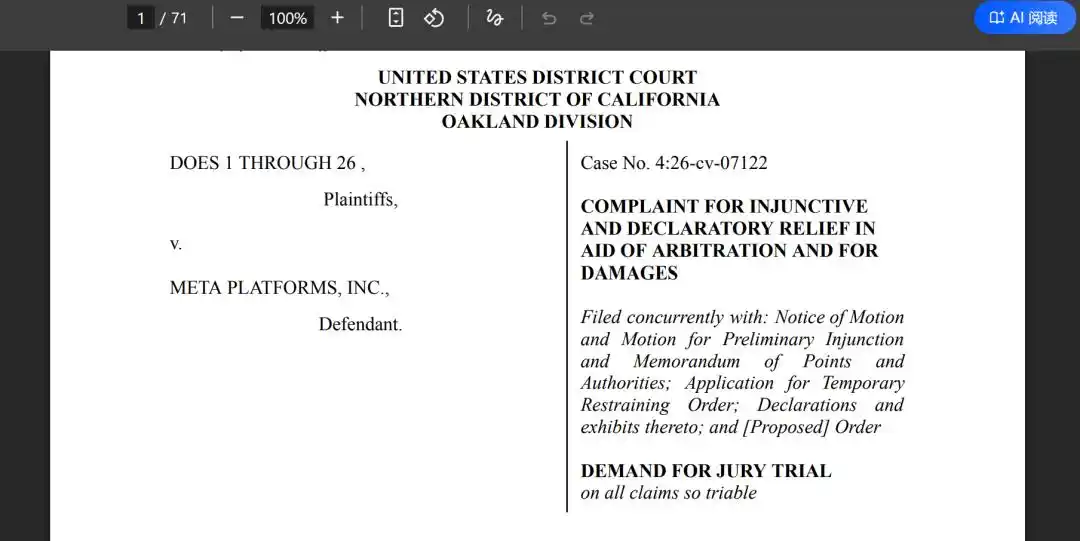
Twenty-six current and former Meta employees have sued the company in federal court, alleging that an internal set of AI systems was used in the layoff process in a way that systematically disadvantaged workers who were on legally protected leave.
The lawsuit was filed on July 13 in the U.S. District Court for the Northern District of California. The plaintiffs are based across six states and Washington, D.C., and include engineers, scientists, designers, researchers, managers, and directors. According to the complaint, all 26 had taken or requested parental leave, pregnancy-related leave, medical leave, or disability accommodations during the past 24 months.
Layoff notices went out on May 20
The complaint says one Meta scientist received an email from company leadership at 4 a.m. local time on May 20 stating that her position had been eliminated. She was on approved prenatal leave at the time. The filing says her water broke the next day, and she gave birth on the third day.
According to the complaint, Meta began sending layoff notices at 4 a.m. in Singapore and then moved through time zones into the U.K. and the United States. Several plaintiffs said they also received their notices at around 4 a.m.

After the notices were sent, some affected employees compared cases and said they saw a striking pattern: among those selected for layoffs, an unusually high share were on maternity leave, sick leave, or had recently asked for disability-related accommodations. The filing also says several direct managers appeared surprised by who was cut, and in some cases told employees as late as the day before the layoffs that they did not know who would be affected.
Plaintiffs describe a group of internal AI tools
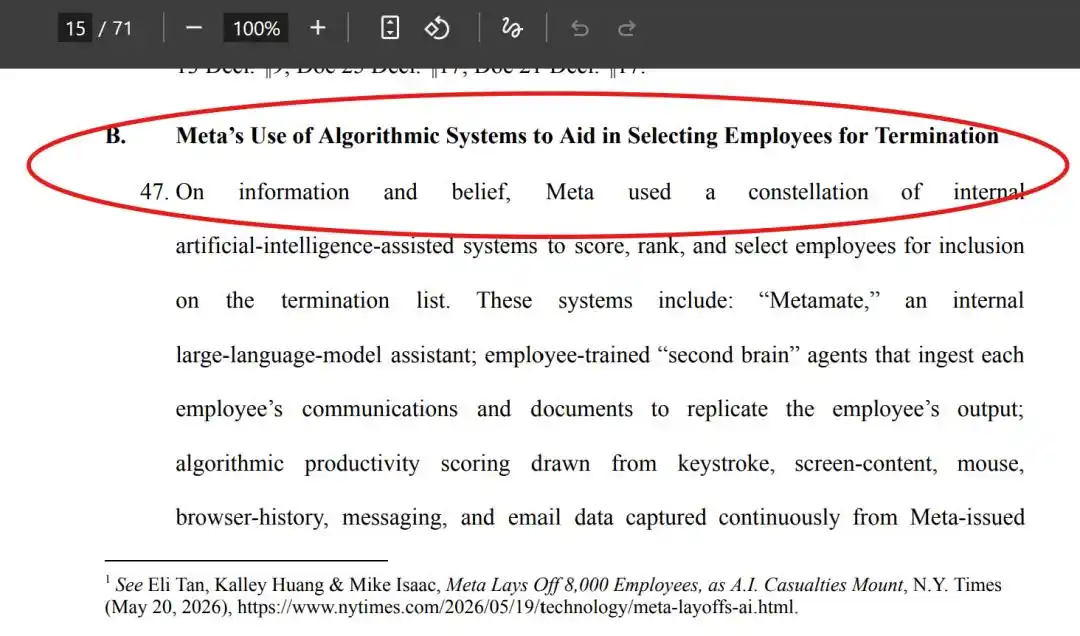
The complaint argues that layoff selection was not primarily driven by direct managers. Instead, it points to what plaintiffs call a “constellation” of Meta systems involved in evaluating workers.
- Metamate, Meta’s internal large language model assistant
- Second Brain, a personal agent employees were asked to train on their own communications and files
- Employee activity monitoring systems that collected keystrokes, screen content, mouse activity, browser history, emails, and messages on company devices
- AI token usage dashboards that tracked employee-level use of AI tools and compared workers with peers
- Algorithmic performance calibration tools that the complaint says had largely replaced manager-led review processes
The lawsuit says those systems drew on inputs including rolling 12-month performance ratings, code commits, AI tool usage, output volume, manager endorsements, and signals tied to roadmap alignment.
The plaintiffs’ argument is straightforward. A worker on 12 weeks of maternity or medical leave would not be able to generate the same metrics during that period. Yet the complaint says Meta did not remove protected leave windows from the data, did not exclude workers on leave from the pool, and did not pause the systems for individual review. In the plaintiffs’ telling, the systems read leave as low output and selected leave-taking workers at disproportionate rates.
Individual cases cited in the complaint
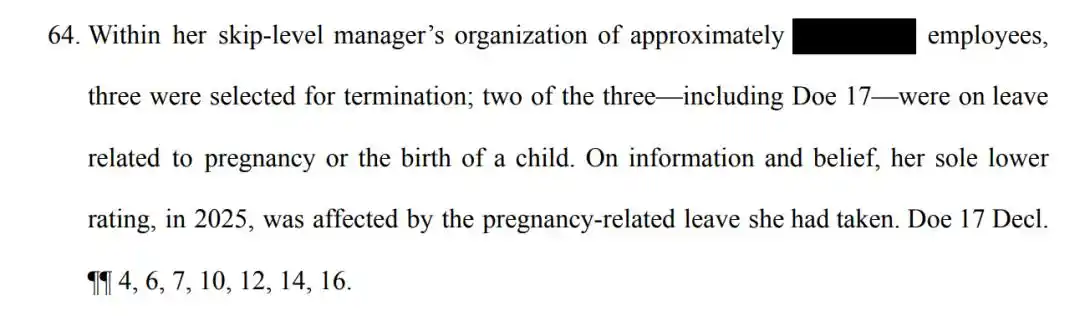
The filing says a scientist identified as Doe 17 was laid off while on prenatal leave. In her organization, three people were selected for cuts, and two of them were on pregnancy- or childbirth-related leave.
Another plaintiff, Doe 8, is described as a designer whose maternity leave had been approved through September. Her child was born in March. She received her layoff notice on May 20 while caring for a baby that was only a few weeks old. According to the complaint, she was the only person on maternity leave on her team.
Doe 19, a manager, allegedly returned from medical leave in 2024 and was moved from a management role to an individual contributor role five days later. The complaint says she was then selected for layoff just 16 days after starting a second period of medical leave in 2026.
The complaint also gives a detailed account involving an engineer identified as Doe 15. It says he was diagnosed with a serious health condition in March and that two doctors through Meta’s own healthcare provider approved 12 to 16 weeks of medical leave.
According to the filing, when Doe 15 informed his manager of the planned leave through Meta’s internal process, the manager reacted angrily and said, “The team cannot lose another person. If you take leave, leadership will definitely lay you off or nominate you for layoff.” The complaint says the manager then offered what was framed as a “win-win” arrangement: if Doe 15 gave up the leave, the manager would send human resources an extremely positive performance letter. The filing says the manager refused to put the threat in writing and said he wanted to “avoid a paper trail.”
The complaint says Doe 15 became afraid, did not submit the leave request, and stopped treatment that had already been scheduled. He worried that continuing care through Meta’s healthcare provider would expose his leave plans and trigger retaliation. He was later the only person on his team who was laid off.
After the layoff, the complaint says the manager sent him a message reading: “Sorry, the company moved about a month faster than we were able to get your good performance into the system.” The lawsuit also says that when Doe 15 had earlier pointed out that Washington state law protects employees on leave from adverse effects in layoffs, the manager replied, “This is Meta. The company can do whatever it wants.”
Plaintiffs seek to halt the layoffs
The 26 plaintiffs are asking the court for a preliminary injunction that would stop the layoffs from taking effect on July 22, restore their employment status to what it was before May 20, and require a court-approved independent auditor to examine the inputs, weights, and outputs of the algorithmic selection process.
Meta responded in one sentence: “These allegations lack factual basis, and personnel management and organizational decisions are made by humans, not AI.”
The case comes as Meta cuts jobs while increasing AI spending
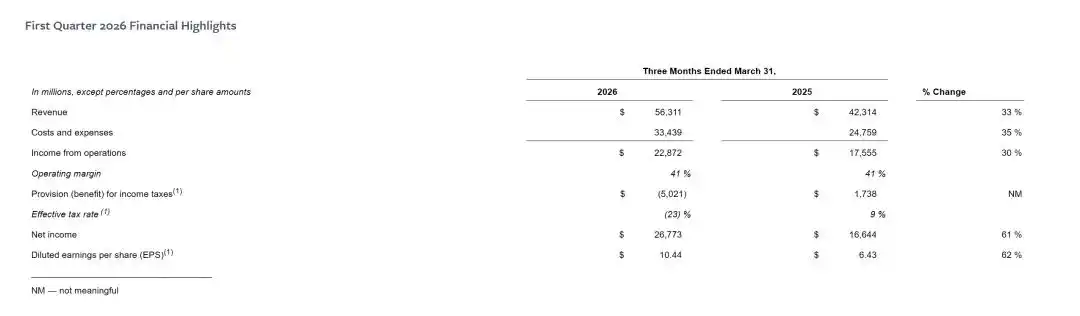
According to the public information cited in the article, Meta said in April that it would cut about 8,000 jobs, equal to 10% of its global workforce. At the same time, the company posted record revenue and said it would spend $125 billion to $145 billion on AI in 2026, more than double its 2025 spending.
One director-level plaintiff, identified as Doe 18, said Meta announced an AI performance evaluation project called “Checkpoint” and stated that employee AI adoption would become a core assessment metric, but did not reveal the details until after the May 20 layoff notices had gone out.
Doe 18 also said that, in his role as a senior finance lead in the infrastructure organization, he saw Meta include roughly $10 billion in layoff-related savings in its financial forecasts.

Complaint also points to employee monitoring and an internal data exposure incident
The article says Meta deployed an employee monitoring program across the company earlier this year, later formally named the Model Capability Initiative, or MCI.
Under that program, the company collected keystrokes, screen content, mouse activity, browser history, messages, and emails on Meta-issued devices. Some employees also had voice, video, and location data collected, according to the article.
The Guardian reported that more than 1,600 employees signed a petition asking Meta to stop using employee data to train AI. Chief Technology Officer Andrew Bosworth said during a Q&A that many employees were anxious about the future. “It’s pretty bad. I’m not going to sugarcoat it,” he said.
The article also says a later internal security incident made private employee conversations, performance data, and transcription records visible across the company, after which the system was halted.
One plaintiff was still cut despite heavy AI tool use
Meta has described the layoff round as part of an effort to build an “AI-first” company and retain employees who were embracing AI, according to the article.
But the complaint says plaintiff Doe 14 ranked in the top 2% companywide for AI tool usage at Meta at the end of 2025 and was still laid off after taking parental leave.
The article also says one plaintiff was directly told by a former manager that she had been targeted because of leave and should pursue legal action. She did, and so did 25 others.