

Meta Chief AI Officer Alexandr Wang has published an open letter explaining the core idea behind Muse, the AI assistant he has been leading at the company: giving ordinary people a better shot at turning their ambitions into reality. The letter surfaced as Muse continued to post strong early traction, drawing fresh attention to the value of Meta’s multibillion-dollar bet.

According to Sensor Tower, Muse recorded 2.8 million cumulative downloads in the U.S. and Canada App Store during its first 12 days, surpassing ChatGPT’s 1.3 million over the comparable period. On Sept. 19, the app set a U.S. record with 264,000 downloads in a single day. Meta’s market capitalization rose by about $234 billion over the past five trading days.
An open letter about desire
In the letter, Wang wrote that most people never say what they truly want, not because they lack desire, but because dreams often fade under the weight of practical obstacles. He positioned Muse as a “second brain” for every person, and as an “all-purpose manager” that can understand half-finished thoughts, help build plans, send emails, find funding and clear obstacles.
Wang wrote, “Every unrealized desire is a silent tragedy of human potential.” He argued that the world has long been shaped by a small number of people who somehow managed to turn desire into reality, and said Muse’s mission is to let each of the world’s 8 billion people unlock that agency for themselves.
In his framing, Muse is not a wish-granting genie. It is a practical executor — something that tells a user this is what you have wanted for your whole life, here is how to do it, and then gets to work.
The letter was published shortly after Meta Connect 2026. At that event, Meta introduced Muse Charm, a standalone pocket device designed for voice interaction, along with Meta VR glasses weighing 100 grams and priced at $1,299, and the third-generation Ray-Ban Meta Gen 3 smart glasses starting at $249.
From Scale AI to Meta
Wang’s path into Meta was itself a high-profile story. In 2025, Meta founder Mark Zuckerberg spent $14.3 billion to acquire the entire staff of AI startup Scale AI. Wang, the founder of Scale AI, reportedly received about $5 billion personally. At the time, some market participants viewed the deal as excessively expensive.
Wang co-founded Scale AI, a company focused on data labeling services for AI model training and once regarded as one of Silicon Valley’s most highly valued AI infrastructure companies. After Meta completed the Scale AI acquisition in 2025, Wang became Meta’s Chief AI Officer and took charge of the company’s AI product strategy.
Tech investor Adam Khoo wrote on X: “People thought Zuckerberg was crazy to spend $5 billion to hire Alexandr Wang. Now, the new Meta AI products developed under Wang have added about $200 billion to the company’s market cap. Suddenly, paying up for top talent doesn’t look so crazy.”
The report said the acquisition also had strategic weight, shifting outside perception of Meta in AI from a follower to a leader.
A camouflage T-shirt and a $30 outfit
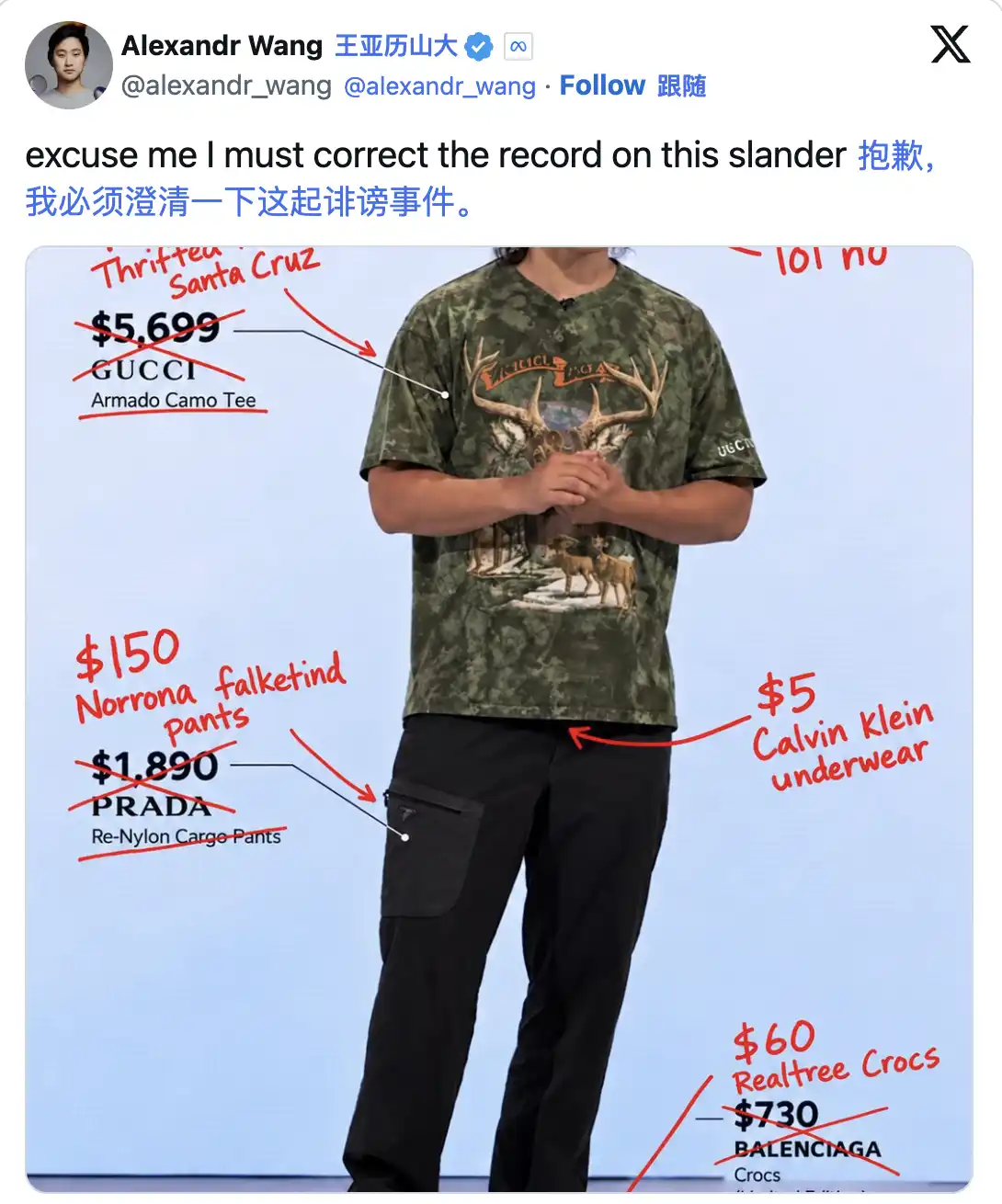
If Muse was Wang’s product statement, his appearance on stage at Meta Connect 2026 became another kind of personal signal. He wore a 1990s-style camouflage T-shirt with a deer-head graphic, paired with camouflage Crocs and black pants.
After the event, the outfit spread quickly on X, where some users speculated that the shirt was an $800 Hermès item.
Wang later responded, saying the shirt came from a thrift store in Santa Cruz and cost him $30, while the Crocs were about $60 and his Calvin Klein underwear cost $5. He described the luxury-brand speculation as “defamation.”
According to Business Insider, this was not the first time Wang had appeared in a similar deer or camouflage look. He had worn comparable outfits in an earlier Core Memory interview and in important internal meetings. The report said the anti-elite tone of that style matched his online persona on X, where he has called himself a “tweet cannon” and promoted Muse with a steady stream of meme-heavy posts. Some observers saw that as part of a deliberate personal brand, stripping away corporate polish while keeping a founder’s chaotic energy.