


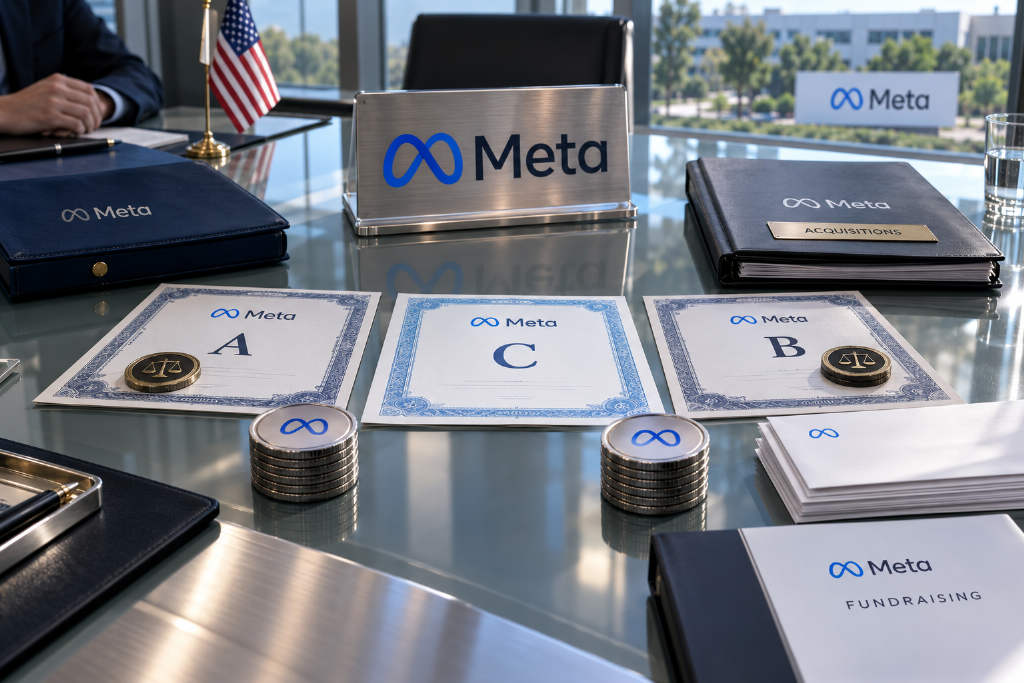
Meta said on Oct. 21, when it released its third-quarter results, that its board had approved a new class of non-voting Class C common stock, effective Jan. 19, 2027.
Each existing Class A and Class B share will receive one Class C share as a stock dividend. Meta said the post-distribution market price of Class A shares is expected to reflect an effect equivalent to a two-for-one stock split, while shareholder voting rights will remain unchanged.
Company says move supports founder-led structure
Meta said one reason for creating the Class C shares is to continue the founder-led model that, in its words, has driven the company’s success since its founding, and to ensure that founder and CEO Mark Zuckerberg continues to lead Meta.
Class C shares may be used for fundraising, compensation and acquisitions
According to Meta, the decision followed a unanimous recommendation from a special committee of independent directors formed by the board. The committee said the scale of investment needed to compete in the AI transition, expand infrastructure and push new strategies is substantial. The new shares could be used for fundraising, employee compensation, potential acquisitions and other general corporate purposes.
Meta also said its stock has risen more than 1,700% since listing, compared with about 495% for the S&P 500 over the same period.
Agreement signed with Zuckerberg
Meta said it has entered into a Founder Alignment Agreement with Zuckerberg. The terms cover his sale of the Class C shares received through this dividend, his role at the company and the conditions for any future distributions of Class C shares.
The amended certificate of incorporation has been approved by written shareholder consent. Meta plans to file it in Delaware and prepare for the Class C shares to list on Nasdaq. The record date and payment date for the stock dividend will be set later by the board.
Third-quarter revenue reached $64.601 billion
In its earnings report, Meta posted third-quarter revenue of $64.601 billion, up 26% from a year earlier. Net income was $9.86 billion, and earnings per share came in at $3.83.
The company recorded a litigation charge of $9.89 billion in the quarter, tied to an August settlement with 52 state attorneys general over lawsuits involving teen mental health and social media. Excluding that charge, earnings per share would have been $7.40.
Capital expenditures for the quarter were $34.91 billion, and free cash flow was negative $2.12 billion.
Full-year capital spending outlook narrowed
Meta narrowed its 2026 capital expenditure forecast from $130 billion-$145 billion to $135 billion-$145 billion. It also projected fourth-quarter revenue of $73 billion to $76 billion.
Meta said it will continue investing aggressively in its core business and emerging AI projects in 2027.