
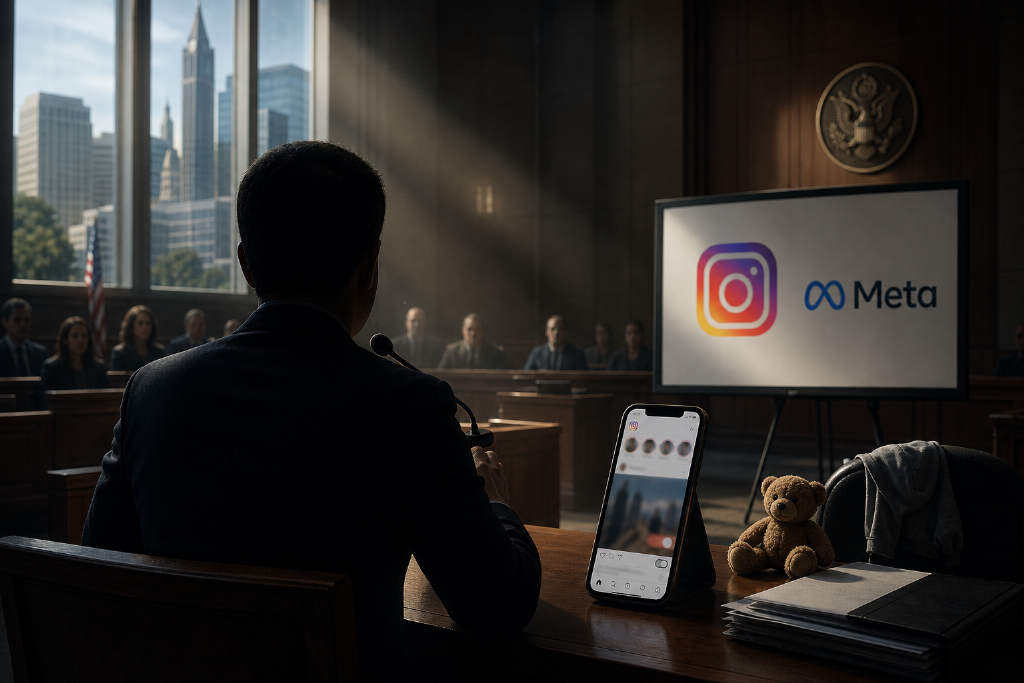
Meta’s child and teen safety lawsuit is now underway in federal court in Oakland, California, where former Meta engineering director Arturo Béjar testified that Instagram’s real approach to users under 13 was 「don’t ask, don’t tell」. Béjar also told the court that Mark Zuckerberg’s 2021 public statement rejecting the claim that Meta put profit ahead of user safety — 「This is simply not true」 — was itself untrue.
Béjar gave the testimony on Wednesday, his second day on the stand before an eight-person jury. He said he had interacted with Zuckerberg dozens of times and traced the problem to the company’s culture. In his telling, that culture made it nearly impossible for meaningful mental health and safety features to be built. Meta’s internal metrics, he said, were centered on how long people used the product and how frequently they returned, even if that use damaged mental health. 「If you leave the product, they can’t make money,」 he said.
Béjar says safety tools were built to fail
Béjar worked at Facebook from 2009 to 2015 and became known for work on online bullying. He returned from 2019 to 2021 as a consultant on Instagram’s wellbeing team after seeing what his daughter went through on Instagram during adolescence. In 2023, he testified before the U.S. Congress and accused senior Meta executives, including Zuckerberg, of knowing about the problems and choosing not to make substantive changes.
On the witness stand, Béjar said he reviewed multiple internal Meta studies that examined how often users, including teenagers, encountered harmful content and negative experiences. He also helped design similar surveys himself. Safety, he said, was never a 「meaningful priority」 inside Meta.
His clearest example was Instagram’s quiet mode. The feature can turn off push notifications and, in theory, give teenagers a break. But because it is optional rather than enabled by default, almost no one turns it on, Béjar said, leaving its real-world effect close to zero. In his account, features like that were 「designed to fail.」
States argue that 「kids are the product」
The states framed the case the same way in opening arguments on the first day of trial. California Deputy Attorney General Megan O’Neill told jurors that Meta designed its apps to hook users, keep them there as long as possible, harvest their data, and hide the truth from the public. She also cited an internal Meta study titled 「The young ones are the best ones」 and said that, for Meta, 「kids are the product.」
O’Neill said Meta knew children under 13 were on its platforms but failed to take even the most basic and obvious steps. As one example, she said Meta would disable a Facebook account after determining that the user was under 13, but would not disable the linked Instagram account, effectively leaving a back door open. That, she argued, stood in visible tension with Meta’s public claim that users must be at least 13 to sign up in compliance with the Children’s Online Privacy Protection Act, or COPPA.
According to the states, the case turns on design choices rather than content alone. The complaint says Meta used mechanics such as infinite scroll and like buttons to keep young users on the platform as long as possible. The longer they stayed, the more precise ad targeting became and the more money Meta made. The states also allege that Meta intentionally designed addictive features for children, concealed the harms, and collected personal data from children under 13 without parental consent, in violation of federal law.
Meta pushes back in court
Meta attorney Paul Schmidt tried to set a different tone in opening statements. He told the jury they would hear about important issues including teen mental health, social media, and how teenagers use social media. He said Meta believes it has responsibilities on those issues, including taking proactive steps and working with teens and parents to address them.
During cross-examination, Meta attorney Brian Stekloff shifted tactics. He asked Béjar about the quality of the colleagues he worked with and whether Béjar himself had ever actually 「solved」 any safety risk, in an apparent effort to show that the issues were complex and not something one engineer or one product feature could fix on its own.
Béjar did not change his position. He said his colleagues were professionals he respected, but no risk had truly been solved. Meta has also argued that 「social media addiction」 is not a recognized psychiatric diagnosis and therefore does not amount to fraud as a matter of law.
Four-state case is expected to run six weeks
The lawsuit was brought by California, Colorado, Kentucky, and New Jersey. It is being heard in the Northern District of California before Judge Yvonne Gonzalez Rogers and is expected to last six weeks. The four states are seeking $1.4 trillion along with structural reforms, a figure that nearly matched Meta’s market value of about $1.5 trillion at the time.
The litigation is only the first wave. Of the 29 states that joined the original action, 25 are still waiting for trial, according to the source material. There is also a separate lawsuit in Tennessee state court. In March this year, New Mexico won a $375 million jury verdict.
At the center of the case is whether platform design itself should carry legal responsibility. The dispute covers infinite scroll, like buttons, and safety switches that are off by default, and asks whether those choices amount to deliberate harm. The outcome is set to test whether platforms that make money from user time and attention can be pulled into the same liability framework.