
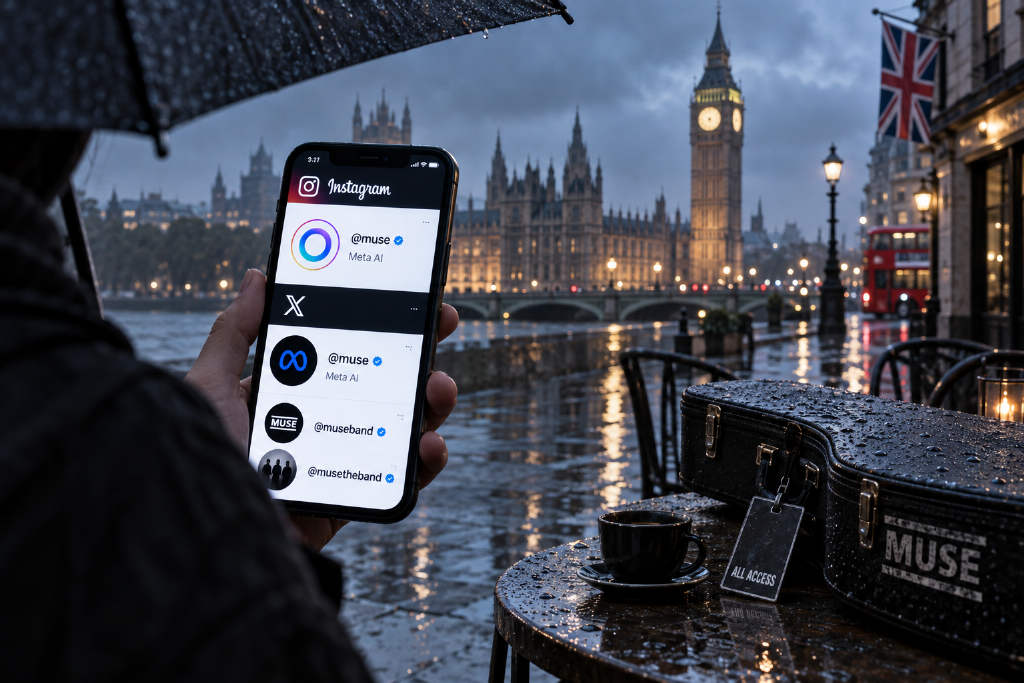
Meta’s release of its personal AI agent Muse has sparked a separate dispute over social media identity: users found that the @muse handle on Instagram and X had changed hands from the British rock band Muse.
The band, which has been active for 32 years, has won 2 Grammy Awards and 2 Brit Awards, and has sold more than 30 million albums. After Meta introduced Muse on Sept. 8, the four-letter @muse handle on both platforms was seen under Meta’s AI product name instead of the band.
The band has moved to different handles
Muse is now using @museband on Instagram and @musetheband on X.
Fans said they had noticed the handle change as early as around June this year, about three months before Meta announced Muse. Another report said the Instagram rename happened in July.
How the handle changed hands is still unclear
Meta and representatives for the band did not respond to media questions about how the handle transfer happened or whether any payment was involved. The band has not publicly explained the change either.
There is no evidence that Meta forcibly took the account. VICE said the band may have received a corporate relocation notice, but that remains speculation and has not been confirmed.
Earlier, when Mark Zuckerberg reposted Muse-related launch material from Threads to X, he mistakenly tagged the band’s account, briefly adding to confusion over whether the post referred to the rock group or the AI agent.
Usernames remain platform-controlled
The episode highlights a long-standing reality of social media platforms: usernames are not user-owned property, but identifiers controlled by the platform.
Meta has been involved in similar cases before. After the company rebranded to Meta in 2021, it obtained the @meta handle on Instagram. At the time, the company said users are allowed to change their Instagram usernames. In 2023, one month after Threads launched, the @threads handle, which had belonged to U.S. apparel retailer American Threads, also changed hands.
What Meta says Muse can do
Meta describes Muse as an AI agent that can handle routine tasks on a user’s behalf. Those tasks include reading and sending emails, booking flights and travel, filling out forms, managing schedules, negotiating prices, and, with authorization, paying by credit card.
The system runs in a dedicated cloud-based virtual machine called Muse Secure VM. Each user’s data is isolated, and the environment includes a built-in browser and file system. Wang said, 「Muse can never see your real passwords or payment details.」 Sensitive actions such as sending emails and making payments still require the user to press the final confirmation button.
Muse launched first in the United States and supports iOS, Android, and web access. Meta also plans to integrate it into Meta AI smart glasses later. The pricing tiers are free, $20 per month, and $100 per month.