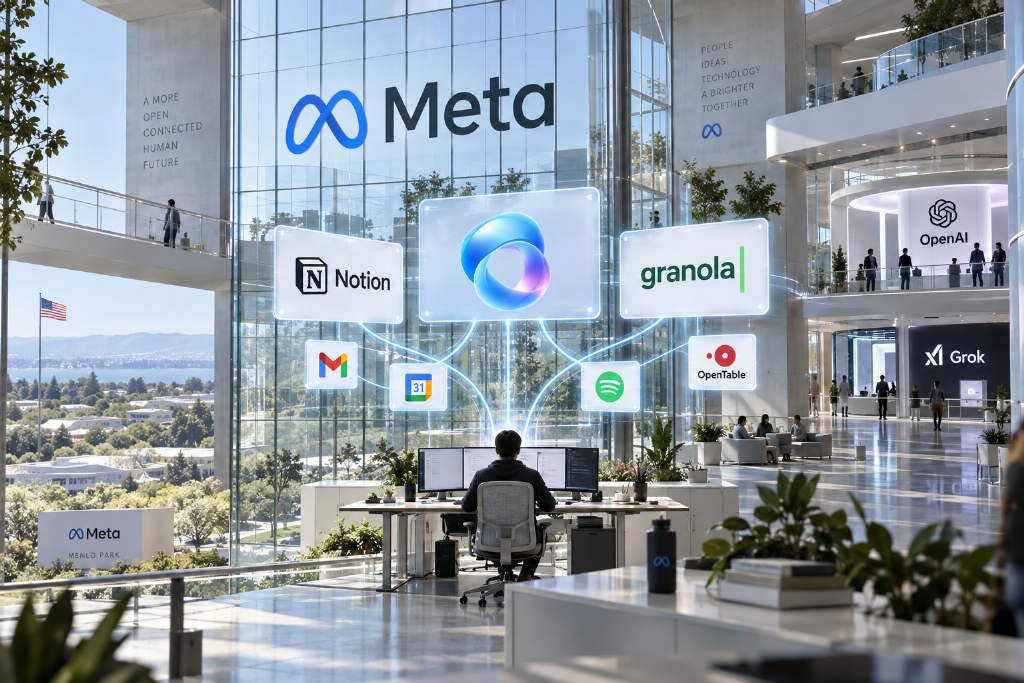
Meta has opened Muse Connectors to third-party developers, allowing outside services to plug directly into Muse. Under the setup, developers provide the API, while Muse handles the agent layer, browser access and user context. Users can state what they want done, and Muse calls the relevant service to complete the task. At launch, Muse already supported services such as Gmail, Google Calendar, Spotify and OpenTable, though those connectors were mainly built by Meta. The first new third-party additions are Notion and meeting notes tool Granola. The move places Meta more directly into the competition around personal AI agent ecosystems, where ChatGPT and Grok Bot already have their own plugin and service networks. The underlying shift described here is from users opening apps to find functions, toward agents routing requests to services in the background. Control of that layer could matter in the race for the next application distribution gateway.
Meta has opened Muse Connectors to third-party developers, allowing external services to integrate directly with Muse.
In this setup, developers provide the API, while Muse handles the agent layer, browser access and user context. Users can tell Muse what they want to do, and Muse then calls the relevant service to complete the task.
When Muse launched, it was already able to connect with Gmail, Google Calendar, Spotify and OpenTable, but those connectors were mainly provided by Meta. Developers can now build their own connectors for Muse, with Notion and meeting notes tool Granola among the first additions.
The contest around personal AI agent "app stores" is now taking shape. ChatGPT and Grok Bot already have their own plugin and service ecosystems, and Meta has now opened Muse to third-party developers as well. The model described here shifts from users opening apps to find features toward users simply stating a need, with an agent calling the service behind the scenes. Whoever controls that layer may end up closer to the next application distribution entry point.
This article was originally published by Bit.Fan. For more cryptocurrency news and market insights, visit www.bit.fan. Disclaimer:
The market information, project data, and third-party content displayed on this platform are for industry information sharing only and do not constitute any form of investment advice or return commitment.
Cryptocurrency trading carries high risks. Users should fully assess their risk tolerance and make independent decisions. All profits, losses, and legal responsibilities are borne by the users themselves.