
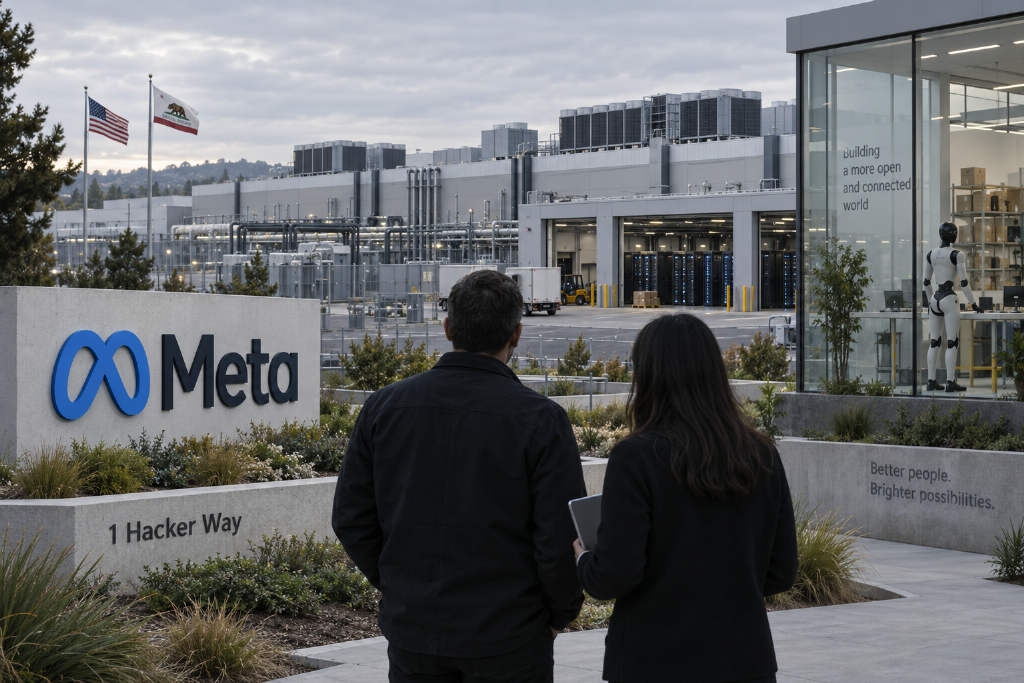
Meta this week rolled out its new flagship AI models, Muse Wonder and Muse Wonder Full, marking what the company described as a return to the race for frontier models. In a recent appearance on the Cheeky Pint podcast hosted by Stripe co-founder John Collison, Meta CEO Mark Zuckerberg and Meta Chief AI Officer Alexandr Wang gave one of their clearest accounts yet of how the company rebuilt its AI team over the past year, developed the Muse personal agent, and decided to spend tens of billions of dollars on computing infrastructure.
Zuckerberg said Meta discussed committing as much as $100 billion to $200 billion late last year, even before it knew whether the new model effort would succeed. He said he asked Wang directly, 「Alex, are you sure this is really going to work?」 Wang said the research direction looked exciting at the time, but the team only had early experimental results and could not guarantee how the final model would perform.
Meta says frontier AI spending has to be decided before the outcome is known
The exchange highlighted how frontier AI development differs from a traditional startup playbook. Companies often have to commit huge sums and build infrastructure years before a product is validated in the market.
On the cost of training frontier models, Zuckerberg used a 1GW data center as an example and said annual operating costs could run to about $15 billion. Once upfront capital spending for construction is included, the figure could reach $50 billion to $60 billion.
That, he said, covers only part of the bill. From early research and small-scale experiments to full pre-training, post-training, and inference for hundreds of millions of users, each stage requires substantial compute. Wang said that if the full development pipeline is included, estimating the cost of training a frontier model in the tens of billions of dollars is now reasonable.
He added that the harder part is timing. Those decisions often have to be made before the model is finished. Wang recalled that during a meeting of Meta executives in Hawaii late last year, Chief Financial Officer Susan Li repeatedly warned him in private that if the model underperformed, the company could face very serious financial consequences.
Wang contrasted that with the lean startup approach, which usually starts with a minimum viable product, tests demand, and scales investment gradually. Frontier AI works almost in reverse, he said. Data centers take years to plan and build, so companies cannot wait for a model to prove itself before spending, or they risk falling behind rivals.
Zuckerberg argued that the bet is not quite as dangerous as the headline numbers suggest. Even if Meta’s own models fail to meet expectations, he said, the compute could still be used by other companies as long as the broader AI industry keeps growing. And if Meta’s personal AI agent business does not develop as planned, some of that capacity could still be absorbed by its social platforms, recommendation systems, and other products.
Meta rebuilt its AI team after dissatisfaction with Llama 4
The interview also shed light on how Meta adjusted its AI strategy after setbacks around Llama 4. Zuckerberg said the company was unhappy with the direction of that effort and decided to rebuild the team, bringing in outside talent including former Scale AI CEO Alexandr Wang.
Wang said the new group did not pursue a strategy of hiring large numbers of researchers. Instead, it focused on talent density, concentrating compute resources on a smaller set of top researchers. He said the core research team at Meta Superintelligence Labs, or MSL, is under 200 people and closer to 100 in practice.
Rather than spreading compute across many competing projects, Meta wants each researcher to have enough capacity to move quickly. Zuckerberg said that structure combines the flexibility of a startup with Meta’s financial and infrastructure advantages.
Meta also changed its technical priorities. Instead of focusing only on general language model capability, the company folded long-term memory, multimodal perception, tool use, and persistent task execution for personal AI agents directly into the training targets.
Muse Wonder focuses on active memory and active focus
The Muse Wonder line, launched on Oct. 12, is the first major result of that team reset. According to Meta’s description, the new models emphasize two capabilities: Active Memory and Active Focus.
Active Memory is meant to let the model retain important information across conversations that span days, weeks, or even months, then use that information at the right moment in later tasks. Active Focus is designed to keep the AI working on complex jobs over longer periods and trying different approaches when one path fails, instead of stopping too early.
For a personal AI agent, Wang said, memory is not just a matter of expanding the context window. The model has to understand what is worth keeping, how to compress existing memory, and when to retrieve older information.
Zuckerberg framed the product strategy in a short line: 「The model is the product.」 He said software companies used to compete mostly on interface design, product features, and workflow. In AI-native products, the point of differentiation is shifting toward the model itself.
That includes decisions such as when Muse should proactively make a suggestion, how it should use personal data, how it should communicate with users, and what it should do when a task becomes difficult. Those choices, he said, can now be shaped through training and post-training rather than only through a conventional product layer.
That is also why Meta does not want ordinary consumers to manually choose models or reasoning intensity. Zuckerberg said complex model names and version numbers only raise the barrier for most people. What users actually want is an AI system that completes the task.
Muse was used to buy tea, analyze MMA footage, and improve its own workflow
Both executives also shared examples of how they use Muse. Wang said one of his favorite uses is having Muse continuously search for niche teas from around the world, including tea farmers and suppliers in Taiwan and Japan, then automatically find, purchase, and arrange shipping through an agent.
Zuckerberg described a different use case: using Muse as his mixed martial arts, or MMA, coach. He said he set up cameras in the gym and had Muse analyze his movements and those of his opponent, then deliver advice during the one-minute break between rounds. The feedback covered body balance, hip position, and defensive gaps during ground exchanges.
Because the break lasts only 60 seconds, Muse had to extract video frames, run visual analysis, and return feedback quickly. Zuckerberg said he once pushed the system to improve after it took about 30 seconds to finish the analysis. The model then tried to adjust the image-processing workflow behind the scenes so it could complete the task more efficiently.
He said that points to a broader shift in software development. People may end up using AI to write large amounts of code every day without realizing they are writing code at all. In that setup, the user only needs to describe the outcome they want, and the AI builds the necessary software tools on its own.
Meta expects AI agents to reshape commerce and service access
Beyond model training and product design, the three also discussed how AI agents could change internet business models. Zuckerberg said most companies today have websites, email addresses, and social accounts. In the future, they may also need dedicated service entry points for AI agents.
He said Muse can already interact with existing websites through a browser. Even if a merchant does not offer a dedicated agent API, the model can still operate webpages, search for products, and place orders in the same way a human would.
As usage grows, though, direct integration between agents and merchant systems should improve transaction efficiency and reduce the cost of interface-based interaction. Wang said the biggest difference between agentic commerce and traditional e-commerce is not just a shorter checkout flow. AI can make purchases automatically based on a long-term understanding of the user.
As an example, Muse can remember a user’s routines, family members, and recurring activities, then arrange purchases in advance. Zuckerberg said his 3-year-old daughter likes baking, which led him to start making desserts with her on weekends. Muse helps plan the activity and orders ingredients ahead of time through Instacart so they arrive in time for Saturday. He said he barely used Instacart before, but became a new user because of Muse’s automated purchasing function.
Meta says public leaderboards are not the only target
Asked about competition with OpenAI, Google, and Anthropic, Zuckerberg said Meta should not define success only by chasing public benchmark leaderboards. Many benchmarks, he said, were originally built by researchers for specific experiments. If AI companies rely on those metrics too heavily, they hand product direction to outside evaluators.
Meta has therefore been increasing the weight of internal evaluations, especially around whether a personal assistant can reliably complete long-duration tasks, understand user needs, and protect privacy while interacting with outside services.
Zuckerberg gave one example: if a user has a specific health-related need and wants AI to book a suitable restaurant, the model should be able to find an option that fits without disclosing unnecessary private medical information to the restaurant. He said that kind of judgment about personal context and disclosure boundaries is a key difference between a personal AI agent and a general coding agent.
On the competitive landscape, Zuckerberg said only a small number of companies may end up being able to build frontier models, control infrastructure, and integrate AI directly into consumer and enterprise products. For that reason, he said, Meta needs full-stack capability across model training, chips, data centers, applications, and end devices rather than long-term dependence on another company’s models.
He added that personal AI will not remain a chatbot that waits for prompts. In his view, it will become a long-term agent that understands a person’s life, makes suggestions on its own, and can carry out work and purchases on the user’s behalf. Whether Meta can turn that vision into a business at scale through Muse Wonder, he said, will determine whether this AI investment running into the hundreds of billions of dollars ultimately pays off.


