

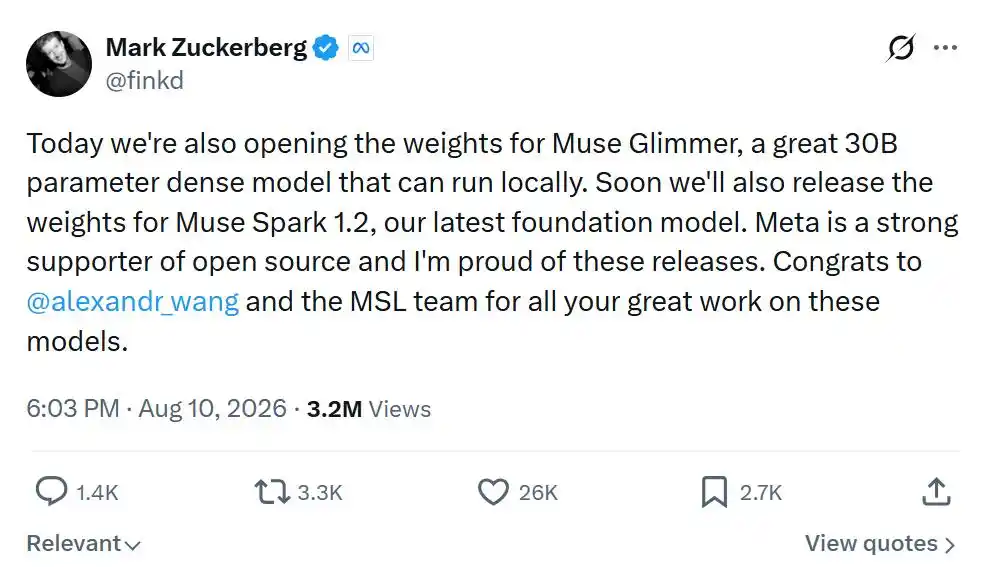
Meta has moved back into open-weight AI.
On Monday, the roughly $1.5 trillion company released the underlying parameters for Muse Glimmer, a new open AI model that developers can download and modify. Meta also said it will open the model weights for the more powerful Muse Spark 1.2 in the coming weeks. The company describes Spark 1.2 as its latest foundation model.
Chief Executive Officer Mark Zuckerberg said Meta has remained firmly committed to open source and that he was very proud of the releases.
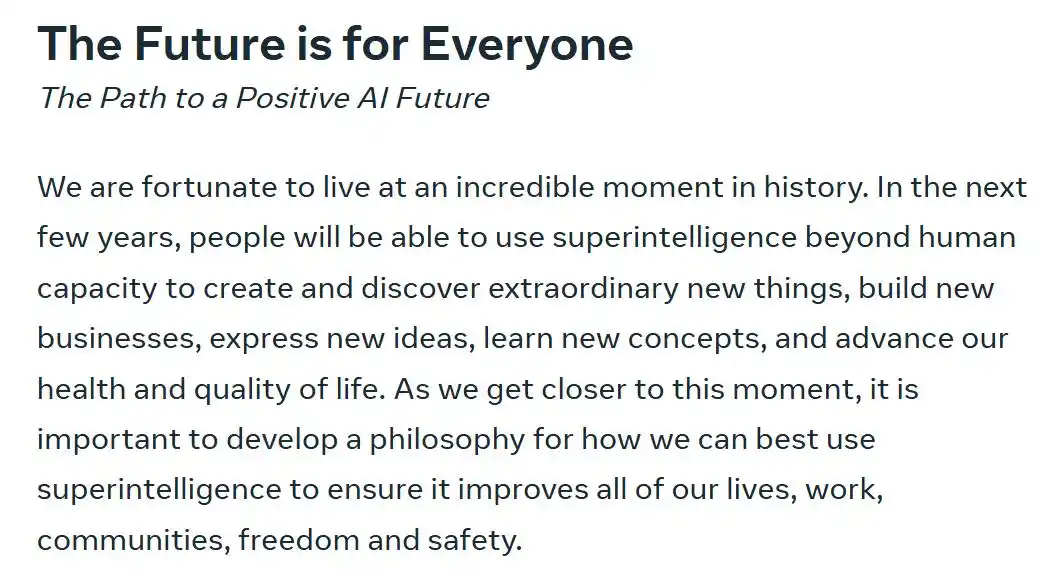
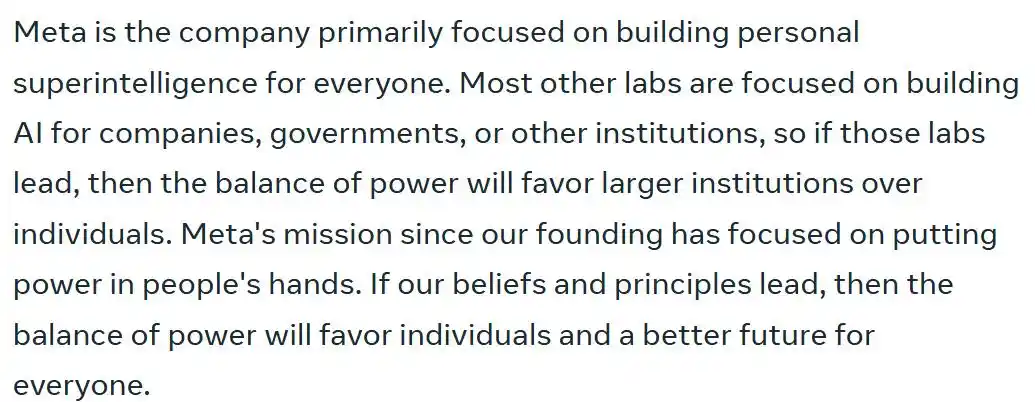
In a post published on Meta’s website, Zuckerberg said he wants to make powerful and free AI available to billions of people, giving individuals more capability and creating a counterweight to the power of large institutions.
In language that was clearly aimed at companies such as Google, Anthropic and OpenAI, he wrote: 「Most other labs are focused on building AI for businesses, governments, or other institutions. If these labs end up leading, then the balance of power will shift more toward large institutions and away from individuals.」
The post is available at https://www.meta.com/thefutureisforeveryone/
Meta swings back to open weights
The commitments signal that Meta is returning to the open AI path it previously used to set itself apart from competitors.
Earlier this year, the company did not release the underlying weights for Muse Spark, citing safety concerns. As competition among top AI companies has intensified, one question has moved closer to the center of the debate: how widely the most powerful AI technology should be made available.
Whatever the debate, the reaction to Zuckerberg’s renewed embrace of openness was largely positive in the comment sections. Yann LeCun offered applause for his former company. Other users posted comments including 「This is exactly the right move. Zuckerberg is really back.」 and 「We love open AI」.
What Muse Glimmer offers
Muse Glimmer is Meta’s first open-weight model since Llama 4 and the first Meta model released under the Apache 2.0 license.
The earlier Llama family used a custom license with restrictions on some commercial use cases. Apache 2.0 is much more permissive. Companies can deploy the model directly, continue fine-tuning it, build derivative models, and integrate those systems into their own products.
Muse Glimmer is distilled from Muse Spark. It has about 29.6 billion parameters in total, including a visual encoder with about 1.8 billion parameters. The model accepts text and image input, supports a 128K context window, and puts emphasis on multi-step reasoning, tool use, and failure recovery. Meta positions it as a base model for agents running on personal devices.
Traditional cloud-based agents need users to keep uploading files, messages, and working context. The longer the task, the more calls are required, and the higher the token bill becomes. Running locally keeps data on the device and makes latency and inference cost easier to control.
There is still a hardware barrier. The BF16 weights for Muse Glimmer are close to 60 GB, which makes the model hard to run on an ordinary computer. Meta’s 4-bit quantized version compresses the language model to under 20 GB, making it possible to run in environments with 24 GB or 32 GB of VRAM.
So the phrase 「runnable on a personal computer」 needs qualification. In practice, the source material says that means a high-end Mac or a PC equipped with hardware such as an RTX 5090.
Strong agent scores, weaker knowledge accuracy
On parameter efficiency, Muse Glimmer posted a respectable set of results.
Artificial Analysis gave it an intelligence index score of 35, which was 21 points higher than Llama 4 Maverick. That puts it close to Kimi K2.5 at 36, while still below Qwen3.6 27B and Ling 3.0 Flash, both of which scored 38.
In Meta’s published agent benchmarks, Muse Glimmer scored 75.5 on MCP Atlas, above Qwen3.6 27B at 62.5. On DeepSearch QA, it posted 74.6, again slightly ahead of Qwen3.6 27B at 71.1. In 𝛕3-Banking, a benchmark focused on tool use, the model scored 23.5 and led peers in its class.
Independent evaluations pointed to weak spots as well. Muse Glimmer scored 953 Elo on GDPval-AA v2, below the human baseline of 1000 and behind Qwen3.6 27B at 1141. Its hallucination rate on AA-Omniscience reached 82%, compared with 49% for Qwen3.6 27B. On Terminal-Bench 2.1, Muse Glimmer scored 52%, also below Qwen3.6 27B at 61%.
Based on those results, Muse Glimmer appears better suited to local tool use and workflow execution. For knowledge tasks that demand high accuracy, the source says it still needs retrieval support and human review.
Zuckerberg argues for open models and distillation
In Zuckerberg’s framing, the AI race comes down to two questions: who gets superintelligence, and what people do with it.
He wants to put 「personal superintelligence」 in the hands of billions of users, with AI taking part in everyday matters such as health, careers, finances, interests, and relationships.
That argument ties open models to personal autonomy and directly challenges the closed-source strategies pursued by OpenAI, Anthropic, and others.
Zuckerberg rejected the idea that safety concerns justify concentrating advanced capabilities. He argued that placing the strongest AI under the control of a very small number of institutions creates a new power risk of its own. Open models can be inspected by more developers, making flaws easier to expose and fix, while individuals can customize AI for their own needs.
He also defended model distillation.
OpenAI and Anthropic have recently accused Chinese companies more than once of using outputs from U.S. closed models to train their own systems. Zuckerberg said people should retain the principle of 「learning from observable information」. He also opposed restricting open models overseas and argued that U.S. open models should become the world’s best through competition.

Meta did not avoid safety issues altogether. Zuckerberg proposed that Meta’s independent directors should approve the safety standards required for model releases. He also said the company could provide intermediate training checkpoints to governments so risks can be identified earlier.
The ecosystem and compute business behind the move
Meta’s return to open weights also reflects practical pressure.
Open models from China are rapidly narrowing the gap with leading closed U.S. systems. DeepSeek, Kimi, and Qwen have continued to improve performance while expanding their reach through lower prices, customization, and local deployment. If U.S. model companies keep tightening access to weights, the global developer ecosystem could move faster toward other suppliers.
Meta needs to win those developers back. Muse Glimmer lowers the barrier for local deployment, while Muse Spark 1.2 raises the capability ceiling. Together, the two models can cover personal devices, private enterprise deployments, and cloud services.
Open releases can also create demand for Meta’s computing buildout. The company plans to invest as much as $145 billion in AI infrastructure this year and is preparing a cloud computing business. Model weights can be free, while inference, hosting, and developer tools can still produce revenue. In that structure, openness expands the ecosystem and cloud services handle monetization.
A $1 billion community fund for data center regions, announced the same day, fits into the same plan. Meta needs more data centers and also needs to ease local concerns over electricity, water use, and land consumption. In the source material, technology openness, policy positioning, and infrastructure expansion are presented as parts of one connected strategy.
Muse Glimmer alone is not enough to redraw the model landscape. Its significance lies in bringing Meta back into the open-weight camp and putting forward a usable product aimed at local agents.
If Meta follows through with the planned release of Muse Spark 1.2, the contest between open and closed models will intensify again.
The industry is now left with three questions: which capabilities can be opened, who pays the cost, and who writes the rules.