



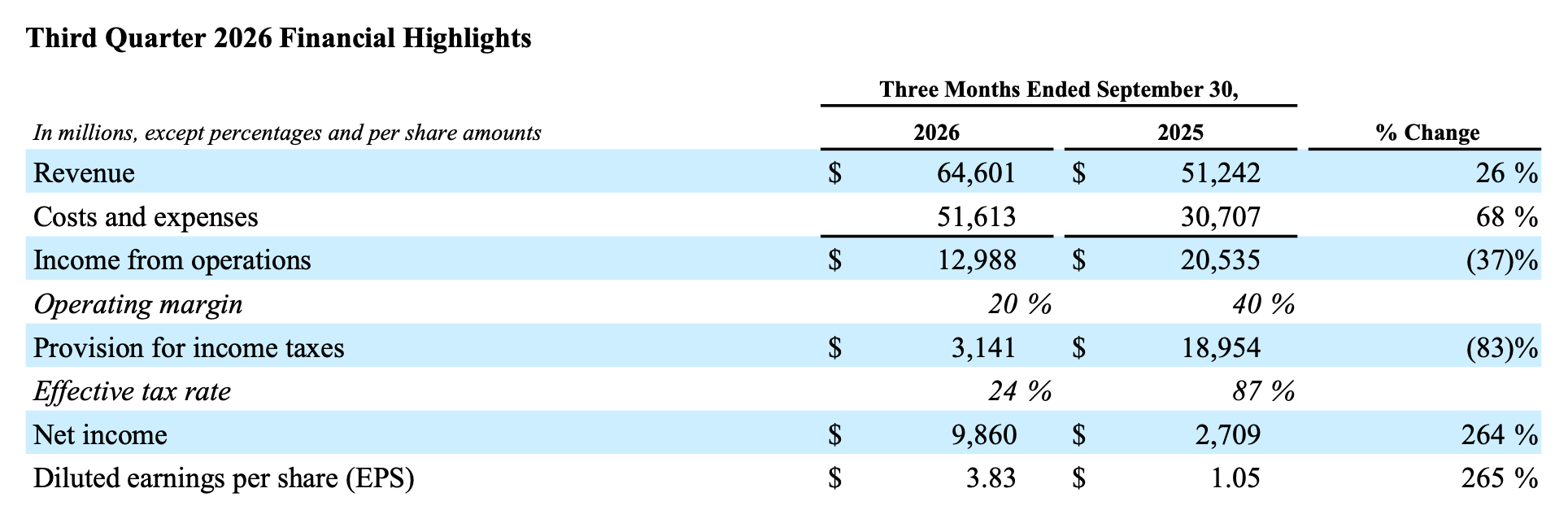
Meta Platforms delivered a quarterly report that cleared Wall Street’s first major test of AI monetization, even as the company’s cash profile deteriorated sharply under the weight of its spending plans. After the U.S. market closed on Oct. 21, Meta reported revenue of $64.6 billion for the third quarter of 2026, up 26% from a year earlier and above analyst expectations of $63.3 billion. The company said fourth-quarter revenue is expected to come in between $73 billion and $76 billion, with the midpoint also ahead of market estimates. Shares rose as much as 6% in after-hours trading before easing back to around 2%.
The report carried two stories at once. Meta still has a fast-growing advertising business and an early AI product, Muse, that has drawn more than 10 million users in North America within a month and a half of launch. But the company also posted its first negative free cash flow since going public, booked nearly $10 billion in legal settlement expense in a single quarter, raised its full-year capital expenditure outlook again, and introduced a new Class C common stock plan that gives it another tool for future financing and equity compensation.
A weaker profit line was driven mainly by a one-time legal charge
On the surface, Meta’s profit statement looked soft. Total costs and expenses in the third quarter rose 68% year over year to $51.61 billion, much faster than the company’s 26% revenue growth. GAAP operating income fell 37% to $12.99 billion, and the operating margin dropped to 20% from 40% a year earlier.
The main reason was a large one-off charge. In August, Meta reached a settlement with attorneys general from 52 U.S. states and territories over litigation related to adolescent mental health and social media addiction. According to material cited in the original report, the arrangement involves potential payments of as much as about $18.59 billion over the next decade. Meta recorded a $9.89 billion legal settlement charge in the third quarter, booked under general and administrative expenses.
Excluding that non-recurring item, Meta’s operating income for the quarter would have been about $22.88 billion, and diluted earnings per share would have been roughly $7.40. That compares with reported diluted EPS of $3.83 and was above the prior Wall Street expectation range of about $6.08 to $6.54.
Advertising remained the core engine, with both volume and pricing higher
The company’s underlying earnings power still came from advertising. Third-quarter revenue totaled $64.6 billion, up 26% year over year and above the market’s $63.3 billion expectation. Advertising revenue from the Family of Apps segment reached $63.06 billion, also up 26%.
The internal mix of that growth mattered. Ad impressions delivered across Meta’s apps increased 10% from a year earlier, while Family daily active people, or DAP, reached 3.64 billion, up 3%. Average price per ad climbed 14%.
In the original article’s reading, that 14% increase in ad pricing was especially important in a macro environment still marked by uncertainty. It pointed to the payoff from Meta’s heavy investment over the past two years in recommendation systems and automated ad tools such as Advantage+, which the article said has already surpassed a $75 billion annual revenue run rate. In that framing, AI has improved conversion and advertiser ROI, helping Meta preserve pricing power even as social traffic growth matures.
Meta’s fourth-quarter revenue guidance of $73 billion to $76 billion, with a midpoint of $74.5 billion, implies about 24% year-over-year growth and came in above Wall Street consensus of roughly $73.7 billion.
Muse gave investors a new data point on AI monetization
If the ad business showed how AI can improve an existing business line, Muse offered Wall Street an early look at what an AI-native product might contribute. Muse, Meta’s AI personal assistant launched in September, was a focal point on the earnings call, along with Muse Wonder, the frontier model introduced the week before.
Meta said that in just a month and a half, more than 10 million users in the U.S. and Canada had created personal Muse agents. About 25% of those users converted into daily active users, and early retention curves became more stable as usage time increased.
Shopping has emerged as Muse’s largest use case so far. Mark Zuckerberg said more than a quarter of Muse users had completed actual purchases on the platform, with average order value above $200. Meta also formally launched two subscription tiers in mid-October, priced at $20 and $100 per month, giving Muse two potential revenue streams: subscriptions and commissions from e-commerce referrals.
The company is also extending Muse across hardware and enterprise products. Starting next month, Muse will be integrated into Meta smart glasses and positioned as part of the hardware business model. On the enterprise side, CFO Susan Li said Meta plans to charge developers for access to its foundation models and the Muse Code programming agent, while gradually building a “Muse business agent network” for small and medium-sized businesses.
There are still constraints. The original report said dozens of external websites, including Amazon, have blocked Muse access over data security and competitive concerns, limiting the smoothness of cross-platform price comparison and shopping. Even so, Zuckerberg laid out an aggressive cost roadmap, saying Muse’s compute cost efficiency is expected to improve tenfold over the next year and become a highly profitable business over the next several years.

Capex surged and free cash flow turned negative
The other major issue in the quarter was the pace of spending. As Meta races with OpenAI, Anthropic and Google for AI infrastructure and compute capacity, capital expenditures, including principal payments on finance leases, reached $34.91 billion in the third quarter alone. For the first three quarters, purchases of property and equipment totaled $83.06 billion, nearly double the $48.31 billion recorded in the same period a year earlier.
That spending pace produced a historic financial turn. Meta generated $32.79 billion in operating cash flow in the third quarter, but after capital expenditures, free cash flow came in at negative $2.12 billion, compared with positive $10.63 billion a year earlier. According to the report, this was the first time Meta’s free cash flow had turned negative since the company went public.
Meta showed no sign of slowing down. The company raised the low end of its 2026 full-year capital expenditure guidance from $130 billion to $135 billion, narrowing the range to $135 billion-$145 billion, and said it would continue to invest “aggressively” in 2027.
At the same time, long-term debt rose to $80.92 billion from $58.74 billion at the end of last year. With operating cash under pressure and spending plans still expanding, investors have started to focus more closely on how Meta intends to fund the next phase.
New Class C shares add financing flexibility without changing control
Meta’s answer, at least in part, was a new Class C common stock plan. The company said it will distribute Class C shares to existing holders of Class A and Class B common stock on a 1:1 basis, with the arrangement expected to take effect on Jan. 19, 2027. Because the new shares carry no voting rights, the structure separates economic ownership from corporate control.
The original article argued that the plan carries at least three implications. First, as AI infrastructure spending rises, Meta wants to preserve more options across cash, debt and equity financing. A non-voting share class gives the company another instrument for future fundraising and stock-based compensation. Second, it helps preserve the current control structure. Meta’s Class A shares carry one vote each, while Class B shares carry 10 votes each. Adding a non-voting Class C line expands the company’s equity toolkit without changing the existing voting arrangement. That matters in particular for Zuckerberg, who has sought to retain firm control of the company.
Third, to support the new share plan, Meta’s board and Zuckerberg signed a Founder Alignment Agreement. The original report said the market had previously speculated that Zuckerberg might leave California because of potential multibillion-dollar tax exposure tied to the state’s proposed wealth tax, known as Proposition 40. Through the capital structure overhaul and related sale provisions, Zuckerberg has now committed to remain in California and stay in his role for the next eight years.
The report also stressed what the Class C plan does not mean. It does not show that Meta has already decided to raise the next round of AI funding through a large stock issuance, nor does it directly signal an imminent funding shortfall. It is better understood as a financing tool prepared in advance, giving the company more room to maneuver if the spending cycle keeps expanding.
Meta is shifting resources away from Reality Labs and deeper into AI
To make room for AI, Meta is also reshaping its internal business mix and organization. Reality Labs, the metaverse unit that has long weighed on results, is now set for a more explicit strategic pullback. In the third quarter, Reality Labs generated $443 million in revenue and posted an operating loss of $4.13 billion. For the first three quarters, cumulative losses reached $13.17 billion.
This time, management gave a clearer timetable for narrowing those losses. CFO guidance indicated that Reality Labs’ full-year 2026 loss is expected to narrow to $18 billion-$19 billion, and then fall further to around $15 billion in 2027. In the original article’s interpretation, the billions of dollars saved are likely to be redirected toward AI initiatives centered on Meta Superintelligence Labs, or MSL.
The workforce is changing as well. As of Sept. 30, 2026, Meta had 66,775 employees, down 15% from a year earlier and about 12% lower than the prior quarter. Yet while headcount fell sharply, research and development expense for the first three quarters jumped to $59.41 billion from $40.24 billion a year earlier. The article described that divergence as a sign that ordinary roles are being cut while resources are being concentrated into expensive AI compute and top-tier model researchers.
The quarter eased immediate pressure, but the return on AI spending is still unproven
For now, Meta has bought itself time. A strong revenue print, upbeat fourth-quarter guidance and an early user and commerce signal from Muse were enough to calm some of Wall Street’s concern over an “AI confidence crisis.” The after-hours share reaction suggested investors are still willing to tolerate negative free cash flow in the short term as long as the ad engine remains strong and new AI products show real transaction conversion.
That does not mean the pressure is gone. Meta also raised its full-year total expense guidance to $175 billion-$179 billion, and regulatory risk remains unresolved. The central question left by the report is straightforward: when hundreds of billions of dollars in capital spending begin to flow through as heavier depreciation in 2027, and if financing expectations around the Class C structure eventually turn into action, can incremental revenue from Muse and AI-driven advertising outpace the company’s swelling compute bill? The quarter did not answer that. It only showed that the spending cycle is still accelerating.