
Meta’s so-called “100 million yuan club” has added another Chinese researcher.
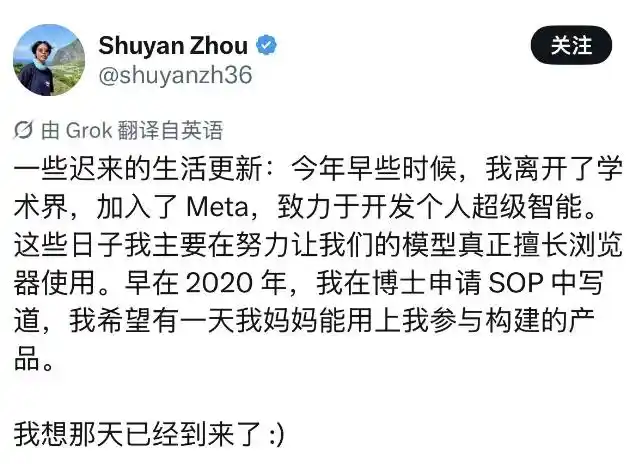
Shuyan Zhou, a Harbin Institute of Technology alumna and a creator of WebArena, said she left academia earlier this year and joined Meta’s “AI dream team,” the company’s Superintelligence Labs. She also spelled out the core assignment for her new role: building an AI browser.
She said that interest goes back to the motivation she described when applying for her PhD. She wanted, one day, to give her mother a device that could be driven by conversation and automatically buy airline tickets.
From HIT and HKU to Carnegie Mellon
Zhou is an alumna of Harbin Institute of Technology in computer science and also holds a bachelor’s degree in computer science from the University of Hong Kong.
After graduating in 2018, she joined Carnegie Mellon University’s Language Technologies Institute, where she pursued graduate study through the PhD level and completed her doctorate in 2024.
The source article says that, although only two years have passed since she received her PhD, her Google Scholar citations have reached 9,569 and her h-index stands at 25.
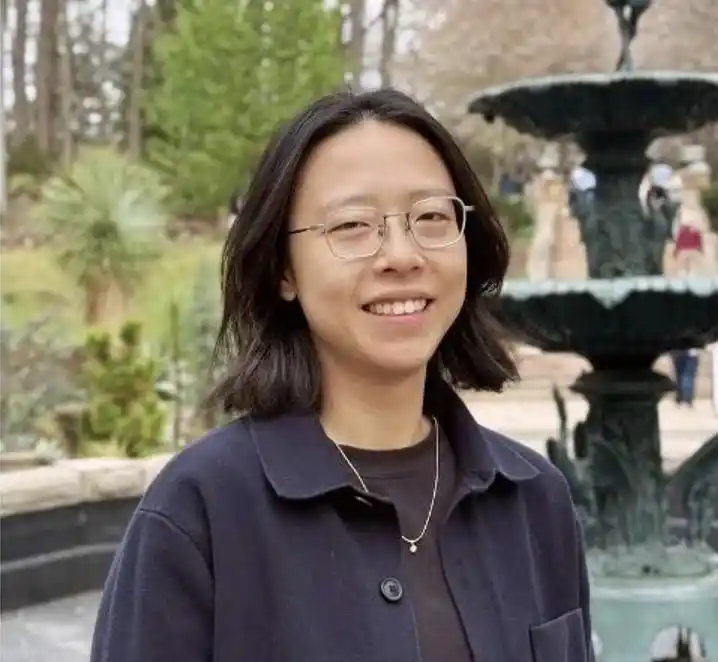
Back in 2020, when she began her doctoral work, Zhou had already narrowed her research focus to a question that would define the next several years: how to let AI enter real digital environments and complete tasks for users.
In practical terms, that means a user only needs to state a goal, and an agent can decide which page to open, where to click, what information to fill in, and how to adjust after making a mistake.
The article links that motivation to her mother. Years ago, Zhou gave her a Chinese-language version of Alexa, Amazon’s voice assistant. The device could handle simple commands such as playing music or checking the weather, but it could not book flights. Her mother still had to call Zhou and get step-by-step instructions.
That experience led Zhou to think about whether a conversational device could complete tasks automatically and help people like her mother live more easily.
According to the article, she wrote that original motivation into her PhD application materials in 2020. Four years later, her dissertation, “Using AI Agents to Solve Real-World Tasks,” offered a staged answer. The same thread now points to the work she is taking on at Meta.
A return to Meta after Duke
This is not Zhou’s first stint at Meta.
In 2024, she joined Meta GenAI and worked on Llama general computer-use agents in a team led by Ruslan Salakhutdinov. The article notes that Salakhutdinov was also the PhD advisor at Carnegie Mellon for Yang Zhilin.
Last year, she left Meta and moved to Duke University as a faculty member, where she stayed until earlier this year.
WebArena and the push to evaluate agents on realistic websites
Zhou’s best-known project is WebArena, which came out of her doctoral work.
WebArena is described as a realistic web environment for building autonomous agents, with support for real interaction and task execution.
Before WebArena, many browser agents were tested on simplified webpages or static datasets. Those settings made experiments easier, but they did not reflect continuous operations, page changes, or user permission issues on real websites.
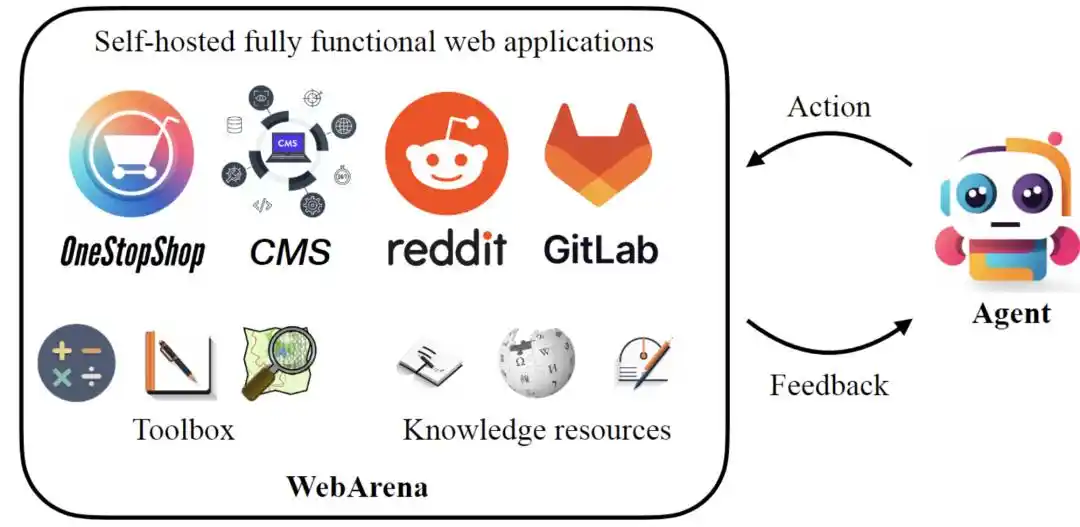
That gap became the central problem WebArena set out to address: how to evaluate an AI system’s ability to operate webpages and finish tasks in an environment closer to the real internet.
To do that, the project rebuilt websites for e-commerce, forums, code collaboration, and content management using open-source software, creating an interactive environment that could be deployed independently and reused.
Zhou and her collaborators also designed 241 task templates and generated 812 benchmark tasks to test whether AI could follow natural-language instructions and complete sequences of search, click, input, page navigation, and content editing actions.
VisualWebArena and OSWorld expanded the scope
Zhou later worked on VisualWebArena, which kept the basic WebArena framework but expanded evaluation from text to images, icons, and page layouts. It added 910 web tasks that require visual understanding.
After that, she worked with the University of Hong Kong’s XLANG team and other institutions on OSWorld, extending evaluation from the browser to the full computer system.
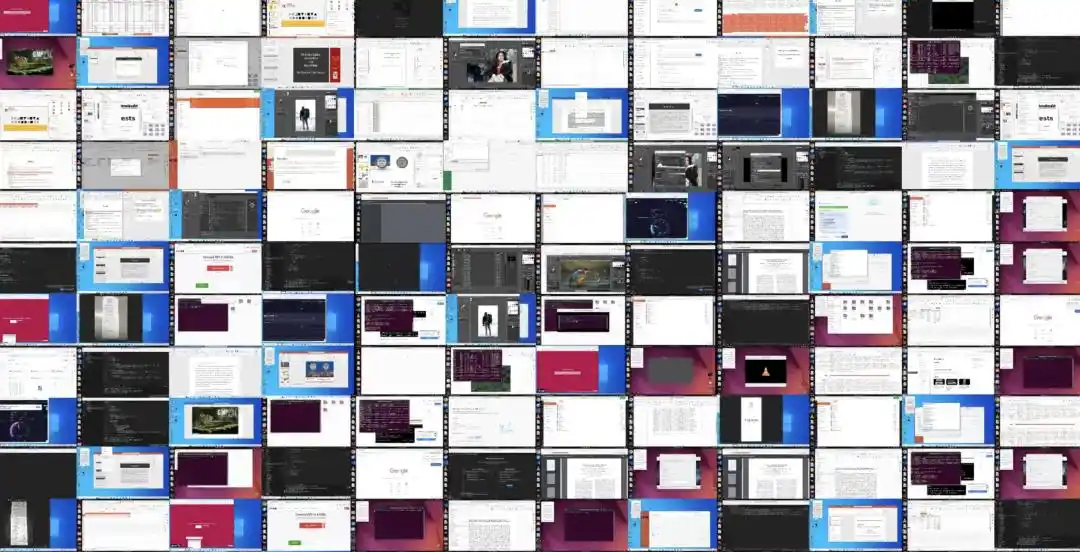
OSWorld includes 369 computer-use tasks involving browsers, file systems, office software, and coordinated operations across multiple applications.
The project was first released in April 2024 and was later selected for the NeurIPS 2024 Datasets and Benchmarks track. Data cited in the paper showed that humans achieved a 72.36% completion rate on the test tasks, while the best-performing model reached only 12.24%.
The article says the list of unresolved issues is long: visual grounding, long-horizon planning, dynamic environments, error recovery, and security permissions. Those are the same kinds of problems Zhou is likely to face in building an AI browser.
Meta formed MSL in June 2025
Zhou has joined Meta Superintelligence Labs, or MSL, which the article says was established in June 2025.
MSL is described as Meta’s unified AI organization after a business reorganization. It brought together TBD Lab, which is responsible for next-generation foundation models, FAIR for long-term research, product and applied research teams focused on deployment, and MSL Infra for compute and engineering support.
The stated goal is “personal superintelligence.”
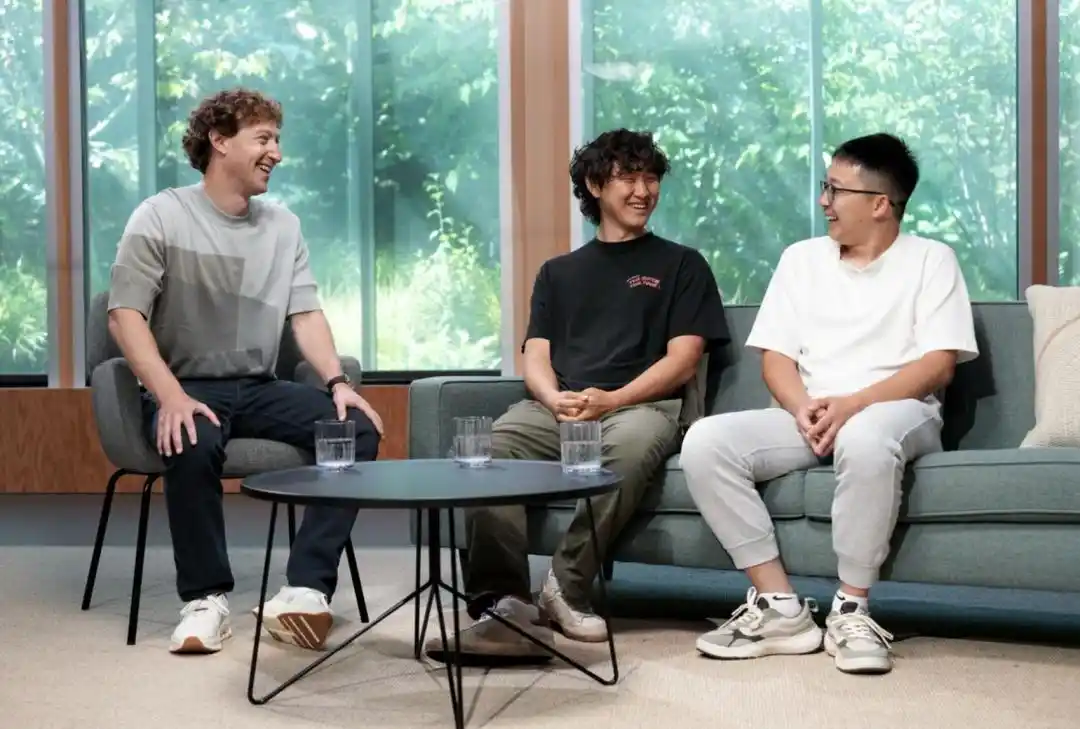
According to the article, Mark Zuckerberg’s view is that superintelligence should not replace humans. Instead, it should understand user needs and help users create value through entry points such as Meta AI, WhatsApp, Instagram, and smart glasses.
To support that effort, Meta launched a high-priced talent recruitment push last year, offering top researchers compensation packages of as much as $300 million over four years. That is where the “100 million yuan club” label came from.
Chinese researchers hold a large share of visible roles at MSL
The article says that among the publicly known managers and researchers at MSL, people of Chinese origin account for close to half.
- Alexandr Wang, the overall head of MSL, is described as a Chinese entrepreneur who founded Scale AI at 19 and later received a $14.3 billion investment from Meta.
- Chief Scientist Zhao Shengjia graduated from Tsinghua University and previously worked at OpenAI on ChatGPT, GPT-4, and reasoning models.
- Chief Researcher Song Yang is known for work on diffusion models, previously led OpenAI’s strategic exploration team, and now helps shape the lab’s research direction with Zhao.
- Bi Shuchao studied mathematics at Zhejiang University, previously served as an engineering lead at Google, worked on multimodal post-training at OpenAI, and is now researching reinforcement learning, model post-training, and agents at MSL.
- Dawn Song studied at Tsinghua as an undergraduate, is a UC Berkeley professor, and works on AI safety and trustworthy agents at MSL.
The article argues that Chinese researchers and graduates trained by Chinese universities have moved into some of the most central roles in frontier model, agent, and AI safety research.
Muse Spark and Muse are already out
After completing its organizational reshuffle and talent recruitment, MSL has also begun shipping products.
In April this year, Meta released Muse Spark, described as the first model launched after MSL’s creation. It is a multimodal reasoning model designed for personal-agent scenarios.
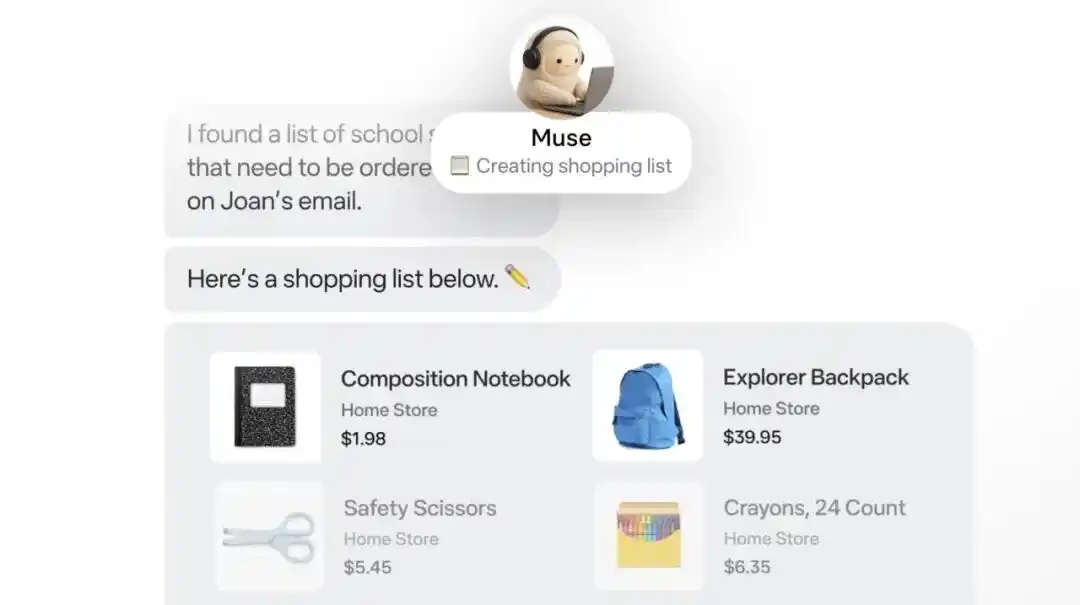
In September, Meta followed with Muse, a personal agent powered by Muse Spark.
The article says users can assign goals to Muse and let it handle email, fill out forms, shop, or make long-term plans. It is also expected to connect with AI smart glasses in the future.
Seen from that angle, the path taken by Muse is directly related to the research line Zhou has followed for years in web and computer-use agents. Her move to Meta to work on an AI browser puts more attention on how that line of research may turn into products.
This article was originally published by the WeChat public account Quantum Bit, written by Cheng Qian.