


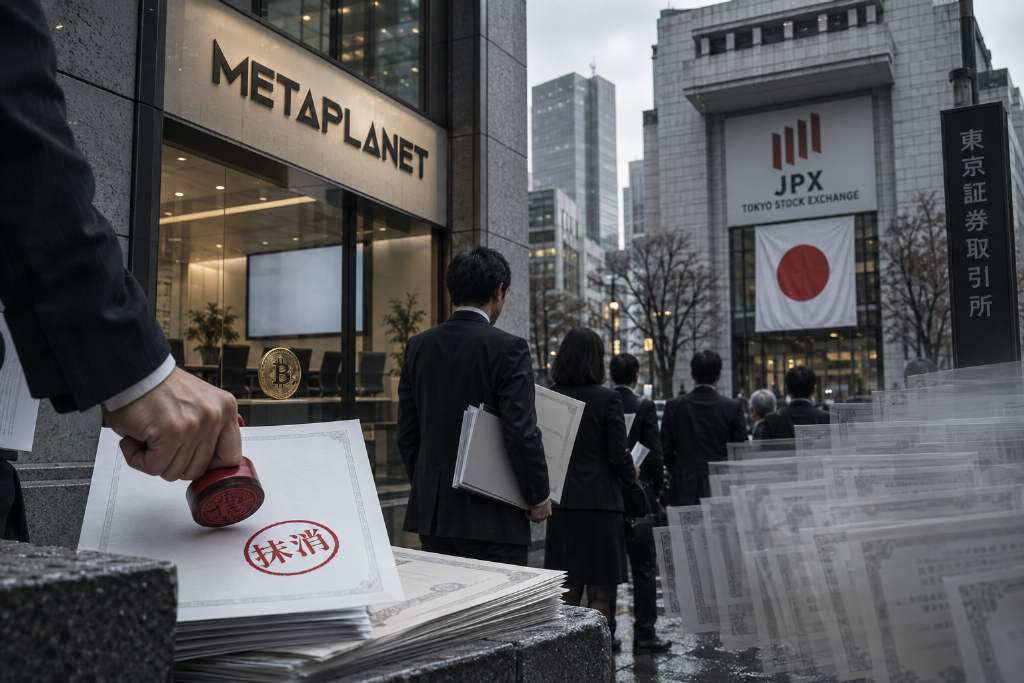
Metaplanet shares slid for two straight trading sessions, falling 7.51% on Sept. 7 and 9.96% on Sept. 8 to close at 244 yen. The stock was down about 17% across the two days as a dispute over the Japanese bitcoin treasury company’s Series 10 stock acquisition rights continued to weigh on sentiment.
How the Series 10 rights expanded with dilution
According to the company’s official disclosure filed with the Tokyo Stock Exchange, the rights were originally linked to a floating share count and were not changed to a fixed number until Aug. 18. The key provision said the number of shares tied to the rights would automatically adjust to 20% of the company’s fully diluted outstanding shares. In practice, each capital increase enlarged the number of shares behind the rights.
The Series 10 stock acquisition rights were approved by the board in December 2022 and passed by special resolution at an extraordinary shareholders meeting in February 2023. They were issued as paid stock options to seven directors, supervisors, and employees. The subscription price was 18 yen per unit, the exercise price was 10 yen per share, and the total issuance was 460,000 units.
The company’s own share-count disclosures show how large the mechanism became. Outstanding shares stood at 114.69 million when the rights were issued in February 2023. That figure rose to 153.94 million in April 2024, when Metaplanet adopted its bitcoin treasury strategy, and reached 1.28128 billion by the end of June 2026. On the same basis, the potential share count tied to the rights expanded from roughly 46 million to about 319 million shares.
Cap fixed on Aug. 18, Gerovich exercised 10 days later
On Aug. 18, Metaplanet’s board resolved to abolish the adjustment clause and fix the potential share count at 319,464,000 shares. The company also signed five-year lockup agreements with existing holders and said it intended to transfer part of the rights to a newly created long-term employee incentive plan.
In the disclosure, Metaplanet said the reason for removing the mechanism was that it had gone beyond its original incentive purpose and had become a factor that made it difficult for existing shareholders to gauge the upper limit of future dilution.
The timing is at the center of the backlash. In a separate disclosure dated Aug. 31, the company said Chief Executive Officer Simon Gerovich exercised 92,000 units on Aug. 28 and received 64,032,000 common shares, just 10 days after the ceiling was fixed. His personal holdings of common stock increased from 15,555,500 shares to 79,587,500 shares.
The same filing said the 64.032 million shares are subject to a five-year lockup and, in principle, cannot be sold or transferred before Aug. 17, 2031.
Shareholders ask for 273 million shares to be canceled
Shareholders have not accepted the cap as a sufficient remedy. Their position is that the ceiling only stops future expansion and does not undo the portion that has already occurred. They are asking the company to cancel about 273 million shares.
A second line of dispute concerns Gerovich’s relationship with major shareholder MMXX Ventures. According to The Block, Gerovich said in remarks on Sept. 6 that the company had not done a good enough job explaining the structure. He described himself as a “significant but non-controlling” shareholder of MMXX’s parent company and denied taking part in that company’s investment or trading decisions.
Shareholders are seeking more specific information on two points: MMXX’s ownership structure, and whether Gerovich or his related parties obtained any economic benefit when MMXX sold Metaplanet shares during the 2024 rally period. As of the information cited in the report, neither question had been answered.
ABMedia said bitcoin traded relatively flat during the same period. Chain News had previously reported that Gerovich said inflation and yen depreciation were giving rise to an Asian bitcoin cycle, when the company’s public narrative was still focused on its bitcoin-buying strategy.