
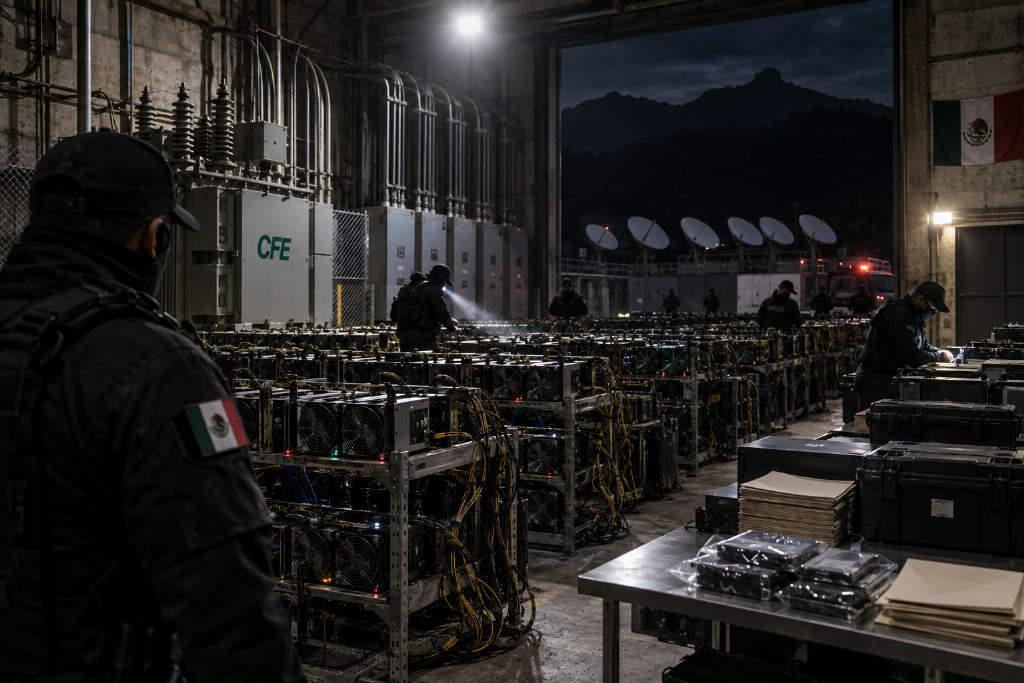
Mexican authorities have uncovered a large underground cryptocurrency mining operation in the northern mountain region of Puebla, according to information confirmed by the Puebla state government on Sept. 6. Mexico’s Federal Attorney General’s Office (FGR), the Navy, and state public security agencies searched a property in Tlaola and found about 300 active professional GPU units, a pad-mounted transformer, roughly 80 medium-voltage power terminals, and eight satellite internet antennas.
Remote Tlaola site drew scrutiny over its power setup
Tlaola is located in the Sierra Norte mountain region near the Nuevo Necaxa hydroelectric system. Local officials said large-scale crypto mining consumes substantial electricity and generates significant cooling noise, which is why operators often place such facilities in sparsely populated areas. In this case, the unusually large power connection became one of the main triggers for the investigation.
One of the central questions is whether the site obtained electricity without authorization from nearby power infrastructure. Mexican media, citing public security officials, said the main alleged offense under investigation is electricity theft. Mexico’s Federal Electricity Commission, or CFE, has also joined the probe.
Mining is legal in Mexico, but unauthorized power use is not
Crypto mining itself is not illegal in Mexico. The legal issue, according to the report, is whether the equipment was using CFE electricity through unauthorized connections.
Mexico’s power grid has long faced non-technical electricity losses. Annual CFE data show that in 2024, inspections and recovery actions led to the recovery of about 2,358 GWh of electricity, involving roughly 5.782 billion pesos. The figures point to continued problems tied to power theft, meter irregularities, and illegal hookups.
This is also not the first underground crypto mine found in the area. The report said that in 2025, authorities uncovered at least three similar facilities in Puebla and nearby Tlaxcala. The Tlaola case is the fourth underground crypto mining operation in the region to draw attention since the start of 2025.
Second line of inquiry focuses on the use of mined virtual assets
The other, more sensitive, part of the investigation is money laundering. In an official statement, the Puebla state government said investigators are analyzing whether virtual assets generated by the infrastructure were used to “give funds linked to illegal activity a lawful appearance.”
So far, officials have not released wallet addresses or the amount of funds involved, and they have not confirmed the involvement of any specific criminal group. At this stage, the case can only be described as a money-laundering investigation, not a confirmed money-laundering offense.
The report said the risk in this model is that criminal proceeds can first be used to buy mining hardware and cover operating costs, then be converted through mining into newly created crypto assets with seemingly normal on-chain origins. If the electricity is also obtained illegally, the cost of mining could fall sharply.
Confirmed facts remain limited as laundering probe continues
Regulators around the world have stepped up efforts in recent years to track this kind of crypto-enabled financial crime. In its latest 2026 Crypto Crime Report, Chainalysis estimated that known illicit addresses received at least $154 billion in crypto assets in 2025, up 162% from a year earlier. Even so, illicit transactions still accounted for less than 1% of the overall crypto transaction volume tracked by the firm, and a large part of the increase came from sanctioned entities rather than conventional laundering activity alone.
What has been confirmed in the Tlaola case is the existence of the underground mine and the presence of a large number of operating GPU devices. Illegal electricity use is a primary focus of the investigation. The laundering angle remains at the stage of reviewing the source and use of funds, with no public evidence so far showing that the mine was in fact used to launder money for a criminal group.
The report noted that if later disclosures include wallet addresses, the tokens mined, and the actual scale of power consumption, the case may offer a clearer answer to a broader question: whether criminal groups are building a new laundering infrastructure around cheap, or even near-zero-cost, electricity and crypto mining.