
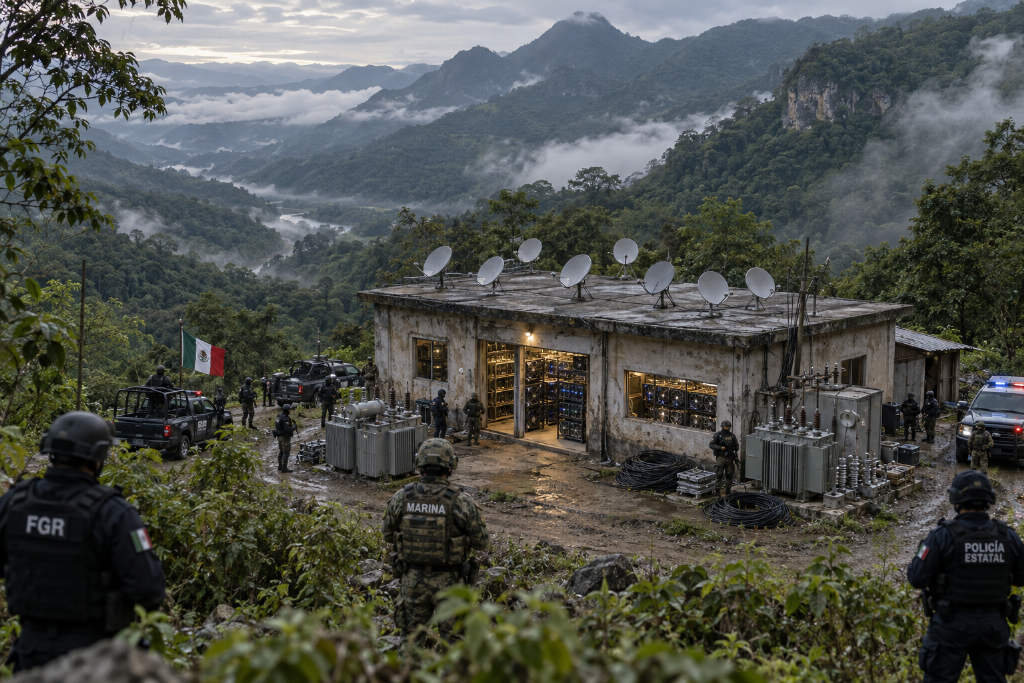
In early September 2026, federal authorities in Mexico carried out a raid in the Sierra region of Puebla and uncovered what local police later described as a suspected illegal cryptocurrency mining site.
The search team was led by personnel from Mexico’s Federal Attorney General’s Office, or FGR, and included members of the navy and state public security police. After moving through dense jungle, officers surrounded an old house hidden deep in the woods.
Inside, they found no signs of everyday living. Instead, roughly 300 machines were running around the clock at high intensity, filling the building with loud mechanical noise. Local reports largely referred to the equipment as GPUs, which suggests the operation may have been targeting a GPU-mineable cryptocurrency rather than Bitcoin. Authorities also found transformers, 80 medium-voltage connection terminals, and eight satellite dishes mounted on the roof. Because of the site’s isolation, satellite links appear to have been used for outside network access.
Police later confirmed that the remote property had been used as a suspected illicit crypto mine. Mining itself, however, is not treated as a standalone criminal offense under Mexican law.
Power irregularities led investigators to the site
Hiding a mining operation in a remote forest follows a simple logic. Mining equipment generates heavy heat and noise, making urban locations difficult to use without drawing complaints. Security officials in Puebla said these activities typically consume large amounts of power and produce constant noise, so operators tend to choose areas far from local communities.
There was another reason this group appears to have chosen the Sierra area. The site is near the Nuevo Necaxa hydroelectric facilities, where electricity resources are abundant and proximity to power infrastructure can make illegal tapping easier. Investigators said the network took advantage of its location near hydroelectric assets to steal large amounts of energy.
The breakthrough came from the physical power network rather than from blockchain data. Investigators found large-scale irregular power connections, and one unauthorized transformer installation became one of the key leads. Police followed those anomalies and eventually located the mining facility.
Prosecutors have opened the case under the theory of theft of state energy. At the same time, forensic accountants are continuing to trace the source of funds used to buy the costly equipment, and possible money-laundering links remain under review.
Why stolen electricity changes the economics
The incentive behind a remote mining site is profit. A Reuters-related report cited in the article said estimates tied to the Cambridge Bitcoin Electricity Consumption Index put the cost of producing one Bitcoin at close to $45,000, while Bitcoin traded around $77,000 to $78,000 in early September.
Even with that spread, compliant miners still face tight operating conditions because electricity is usually the largest expense in the business. The article puts power costs at roughly 60% to 80% of total expenses. A small increase in electricity prices can sharply reduce margins.
That equation looks very different if the operator does not pay for power. Samuel León, a researcher at Universidad Iberoamericana in Mexico who studies electricity theft, said the main cost of the business is 「almost zero」 if the electricity is stolen. Under those conditions, operating risk drops and apparent profit rises sharply.
Authorities suspect that power-theft mining in the area has grown beyond isolated actors. Earlier, in early 2025, law enforcement had already dismantled a site in the Nuevo Necaxa area. That investigation pointed to a property linked to the Mexican Electrical Workers Union, or SME, which was accused of being used for illegally connected mining activity. Later in 2025, two more concealed mining sites were uncovered near the border between Puebla and the neighboring state of Tlaxcala. Officials said these were not isolated cases but part of a larger network targeting areas near hydroelectric plants and using large-scale illegal grid connections.
The unpaid cost is pushed into the public system
The savings enjoyed by an illicit mining site do not disappear. They show up as losses elsewhere in the system. According to public figures cited from Mexico’s state power utility, non-technical losses caused by electricity theft, illegal line connections, and meter tampering reached about 6,346 gigawatt-hours from January to July 2024. The estimated value was about 13.8 billion pesos, or roughly $817 million.
That figure covers just over half a year on the books of a single utility. The regulatory setting makes the issue harder to handle. In Mexico, personal crypto mining is not specifically criminalized and is not prohibited as such. Cryptocurrencies are not recognized as legal tender, but holding, trading, and mining them are generally allowed in principle. The result is a permitted but cautious market with fragmented oversight, a structure that can be exploited by illicit operators.
On-chain visibility does not cover the energy chain
Chainalysis said in its 2026 report that inflows to illicit cryptocurrency addresses worldwide reached at least $154 billion in 2025, up 162% year over year. Of that amount, about $104 billion went to sanctioned entities, while stablecoins accounted for about 84% of illicit transaction volume. The report said the jump was mainly driven by sanctions evasion, state or quasi-state fund flows, and laundering networks.
That helps explain why investigators moved from illegal power connections to the financing behind the mining hardware. Blockchain systems can make digital asset transfers visible, but they do not automatically reveal the physical energy inputs used to produce those assets. Machines can be hidden in remote terrain and hash power can shift across networks, yet the electricity consumed is real and does not vanish.
The Puebla case points to a wider governance gap linking energy security, compliance oversight, and anti-money-laundering enforcement. The 300 machines found in the jungle have been shut down. But if stolen electricity continues to create outsized margins, similar operations may reappear somewhere else.