
MiCA Transition Ends: A Milestone for European Crypto Regulation
On July 1, 2026, the transition period for the European Union's Markets in Crypto-Assets Regulation (MiCA) officially expired. From this date onward, any entity providing crypto-asset services to users within the EU must hold a MiCA license. Unlicensed operations face severe penalties: France's AMF has warned that violations can lead to up to two years imprisonment and fines of €30,000, with regulators also retaining the power to publish blacklists and request website takedowns.
MiCA, the EU's first comprehensive regulatory framework for crypto assets, took effect in 2023 and covers all 27 member states plus the three EEA countries (Norway, Iceland, Liechtenstein). Before MiCA, European crypto regulation was highly fragmented—a single exchange needed to register with Germany's BaFin, obtain France's PSAN license, and meet varying standards across countries. MiCA's core goal is to replace this patchwork with a unified rulebook, a typical EU approach to harmonization.
Core Rules: CASP Classification and License Categories
MiCA designates all crypto-related service providers operating in the EU as Crypto-Asset Service Providers (CASPs). They must apply for authorization with their national regulator, specifying the exact services offered. The regulation divides services into ten categories, including: operating a trading platform (order matching), custody and administration of crypto assets, exchange of crypto assets, execution of orders on behalf of clients, portfolio management, and advisory services. A single MiCA license only covers the categories indicated at application; exchanges offering multiple services (e.g., trading, custody, transfers) must apply for a license covering all those activities.
MiCA also includes a dedicated sub-framework for stablecoins: asset-referenced tokens (ARTs) and e-money tokens (EMTs) must meet issuance authorization and reserve requirements, with larger issuers facing stricter oversight. The regulation introduces a "passporting" mechanism: once a firm obtains a MiCA license in any EU member state, it can expand services to other member states via a notification procedure, eliminating the need for separate national applications.
Transition Periods: Varied National Deadlines Accelerate Purge
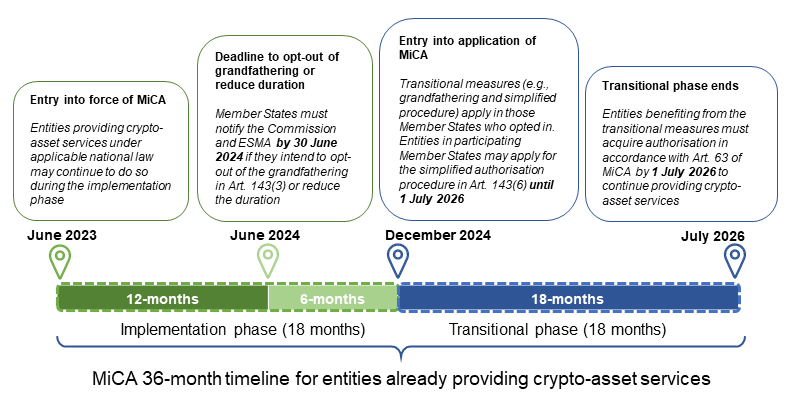
Stablecoin rules came into effect in June 2024, and CASP rules in December 2024. To accommodate existing crypto firms already registered or operating under national regimes, MiCA allowed member states to set transition periods of up to 18 months, expiring no later than July 1, 2026. During this period, platforms could continue operating while completing MiCA applications. However, national implementation varied significantly: the Netherlands ended its transition early on July 1, 2025, forcing local exchanges to obtain licenses ahead of time; Germany shortened its transition to end of December 2025, using the deadline to pressure applicants for faster approvals; Lithuania's transition ended with over 240 registered firms shutting down. By June 2026, 20 of the 27 member states had ended their national transition periods before the final July 1 deadline.
License Gap: 75% of Platforms Lose Legal Status; Binance and MEXC Out
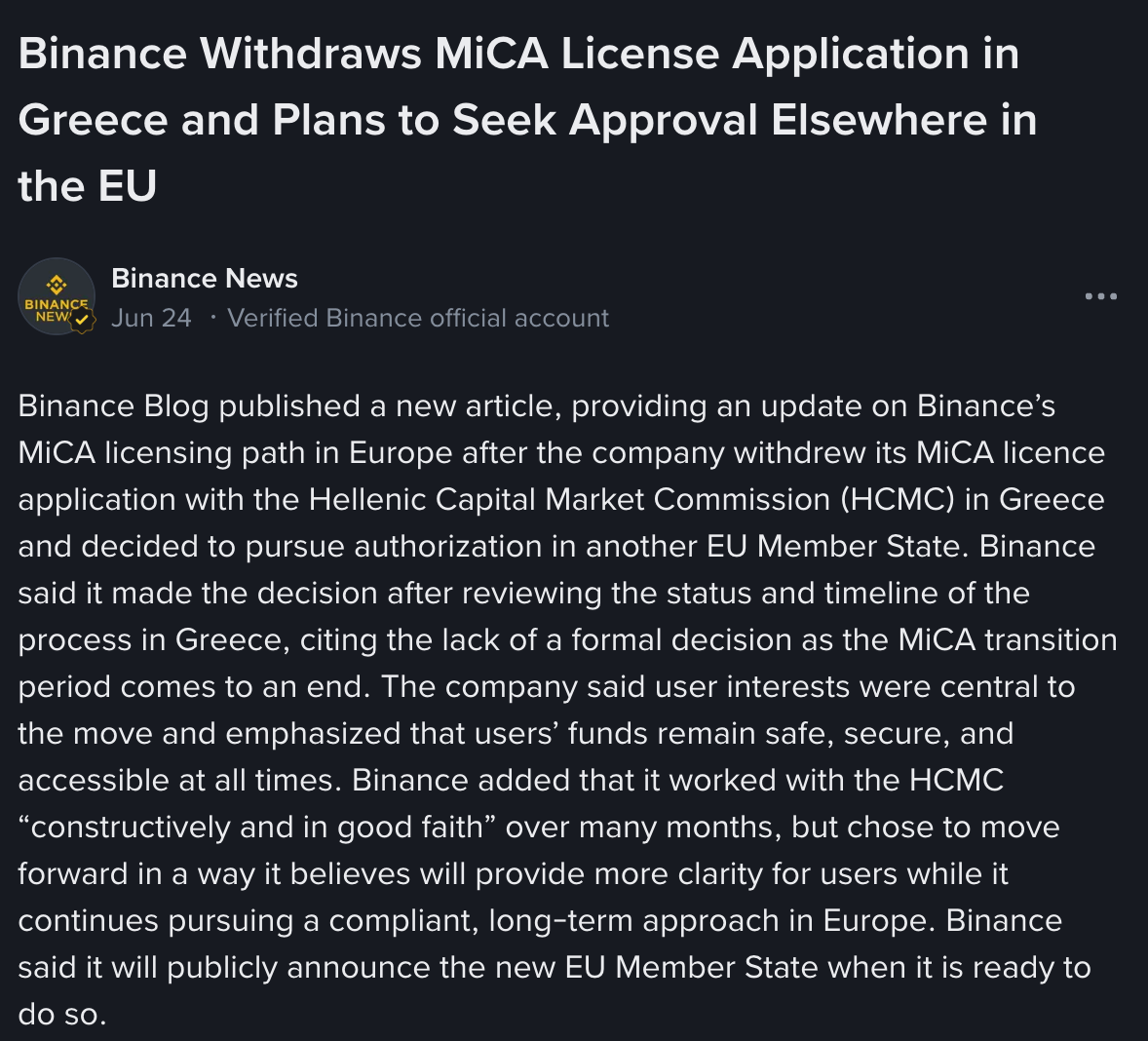
According to data cited by Crypto News, as of May 2026 only about 194 crypto firms had obtained full MiCA authorization within the EU, compared to an estimated 1,100 to 3,000 platforms previously registered or operating under national regimes. Law firm Hogan Lovells estimates that about 75% of platforms operating under old national registrations will lose legal qualification after the transition ends. Exchanges that failed to obtain authorization include major names such as Binance and MEXC.
The case of KuCoin is more complex: it obtained an Austrian FMA license in November 2025, but FMA subsequently prohibited it from formally operating due to vacancies in key AML and sanctions compliance roles. KuCoin has appealed, and it still cannot accept new EU users.

Stablecoin Shakeout: USDT Delisted, USDC and Euro Stablecoins Rise
The stablecoin sector has already completed its restructuring. Tether's USDT, the world's largest stablecoin, never obtained MiCA authorization. CEO Paolo Ardoino stated publicly that MiCA's requirement to deposit most EMT reserves in EU-regulated bank accounts is incompatible with Tether's existing reserve model. The result: Coinbase delisted USDT in December 2024, Crypto.com followed on January 31, 2025, and Binance and Kraken delisted it in March 2025. USDT is now fully removed from major EU compliant platforms.
Circle's USDC and EURC both received EMT authorization. As of June 2026, USDC had a market cap of approximately $75 billion, making it the dominant stablecoin in EU compliant scenarios. Meanwhile, the ART framework—MiCA's highest threshold—has yet to see any issuer obtain authorization.

In parallel, a consortium of 37 banks including BNP Paribas, ING, and UniCredit has launched Qivalis, a project to develop a euro-pegged compliant stablecoin, aiming to compete with dollar-pegged stablecoins and carve out a place for euro digital currency.
User Risks and Action Steps: Account Migration and KYC Requirements
For EU users, after July 1, using unlicensed platforms carries several practical risks: the platform may stop accepting new deposits, may require withdrawals within a specified timeframe, or may restrict account operations without prior notice. An analysis by OKX Europe found that between May 2025 and May 2026, approximately 41% of total European crypto app downloads came from exchanges without MiCA authorization, and an estimated 60% of European crypto users were using unlicensed platforms.

If a platform has notified users to migrate accounts (as experienced by some EU users of Bybit, Bitvavo, Kraken, Coinbase, and Crypto.com), this typically means completing a new KYC identity verification and accepting updated terms of service—a normal part of MiCA's anti-money laundering requirements. Users should proactively check their exchange's MiCA authorization status and withdraw funds to compliant platforms or self-custody wallets.
MiCA Is Not the End: 2027 Review and Future Regulatory Outlook
The European Commission launched a formal review consultation of MiCA on May 20, 2026, accepting comments until August 31, with a final report due to the European Parliament by June 30, 2027. The consultation covers 86 questions, addressing stablecoin competitiveness (especially the weak position of euro stablecoins against dollar stablecoins), DeFi, staking and lending, RWA tokenization, and whether ESMA should gain direct supervisory authority over major CASPs.

France, together with Austria and Italy, supports ESMA directly overseeing top CASPs to reduce standard deviations among member states. Looking ahead, European crypto regulation will continue to tighten, raising compliance barriers but also creating a clearer playing field for compliant firms. For exchanges and stablecoin issuers, obtaining a MiCA license has become the sole passport to operate in the EU.