
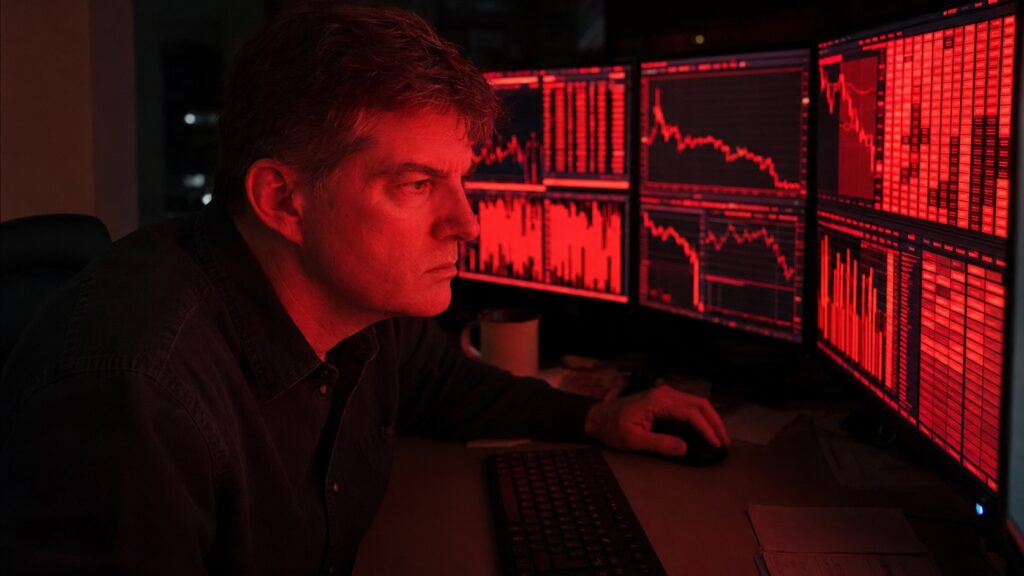
Michael Burry, widely known for “The Big Short,” disclosed his latest positions and then used a Substack post on the same day to warn that U.S. stocks are nearing the edge of a rapid breakdown.
He argued that the force behind a possible sell-off is not deteriorating fundamentals. Instead, he said, the risk comes from a chain reaction created by Wall Street quant funds that automatically respond to market volatility.
Automatic selling tied to volatility
In the Aug. 4 post, Burry said volatility-focused investment funds are setting off an automatic wave of selling. These funds rely on quantitative strategies to detect shifts in market volatility in real time and adjust positions without manual intervention. In a more turbulent market, that setup can create a loop in which lower prices lead to more selling, and more selling drives prices down again.
He specifically pointed to Wall Street’s active quant funds. Unlike products that simply track an index, these funds use algorithms to scan market signals on an ongoing basis. Once volatility rises, they cut exposure automatically. Burry said that in a market where volatility is running far above historical norms, such funds have become an unseen amplifier.
Momentum names lead the decline
The report said recent losses in momentum stocks offer a clear example. These are stocks that rose sharply over a short period. In recent weeks, as investors took profits, memory makers and chip companies that had rallied quickly came under broad selling pressure.
- The iShares MSCI USA Momentum Factor ETF (MTAW) is down 14% from a recent high
- Burry added to a short position in Micron (MU) at $880 on the same day
- SK Hynix fell 3.88%
- NVIDIA fell 1.33%
- Broadcom fell 2.01%
Goldman Sachs also released analysis the same day saying CTA deleveraging has not run its course. The bank estimated that another $24.9 billion could be sold into a downturn, with corporate buybacks left as the main source of market support in August.
Consistent with his earlier view
According to the article, Burry’s latest warning follows the same line as his view from early 2025. At that time, he said gains in AI-related stocks had surpassed the rise seen during the internet bubble, reaching 784%. This time, the focus shifted to the mechanism behind the rally itself: quant funds using algorithms to chase momentum, only for that same process to work in reverse once the trend turns.
The piece also drew a contrast with Burry’s “Big Short” positioning in 2019. Then, his bet centered on a wave of mortgage defaults. This time, the target is broader market fragility, with large pools of capital concentrated in a narrow set of quant strategies that could trigger cascading selling once volatility expands.
Potential read-through for Taiwan semiconductor stocks
The report said Taiwan investors may also need to watch the spillover from selling in momentum names. U.S. technology shares have a high correlation with semiconductor names such as TSMC and MediaTek, and when momentum funds reduce positions in U.S. AI hardware stocks, Taiwan’s supply chain often comes under pressure as well.
It added that after the open on Monday, all three major U.S. indexes moved higher, but AI hardware shares were already under pressure. The Dow Jones Industrial Average rose 1.06%, while NVIDIA, TSMC and Broadcom all traded lower.