
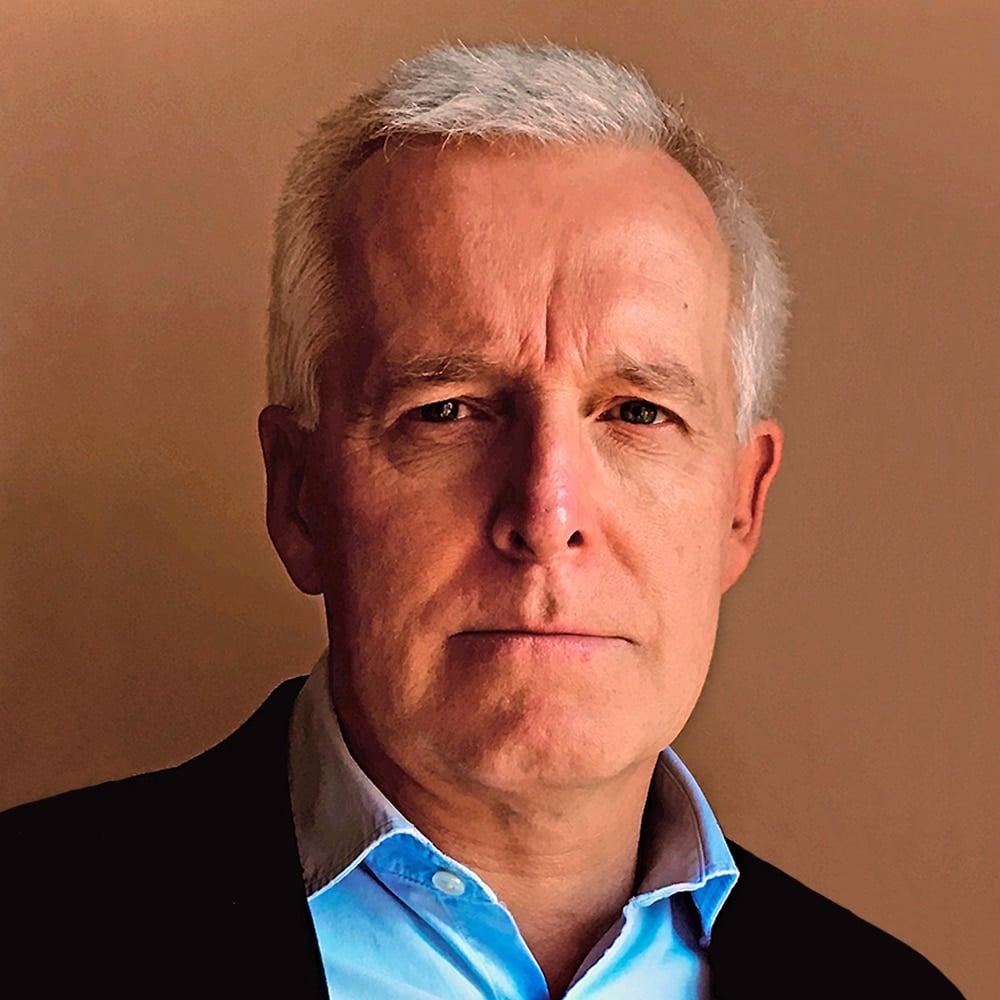
Michael Howell, founder of CrossBorder Capital, said on the What Bitcoin Did podcast that global liquidity growth has already peaked and begun to turn lower, a shift he says is showing up in weaker performance from liquidity-sensitive assets such as Bitcoin. His broader argument was that the modern financial system is built around debt refinancing, and liquidity swings still drive the rise and fall of markets.
In Howell’s framework, markets come first, the economy follows, and geopolitics sits further downstream. What matters most for investors is not a conventional macro narrative but whether money is flowing into the financial system or out of it.
Liquidity starts in finance, then moves into the real economy
Howell said the world effectively has two large pools of money: one in financial markets and another, more separate one, in the real economy. In his view, investors often confuse the two, even though they function very differently.
For markets, that distinction matters. Money sitting in the real economy drives economic activity. Money sitting in the financial or asset economy pushes up asset prices. Howell said the first stage of any cycle is money creation inside the financial system. That money circulates there first and only later spills over into the real economy.
That is why he said the economy is downstream from markets. He acknowledged feedback effects from the real economy back into finance, but said the first move still comes from changes in financial-sector liquidity. In that sense, the stock market does not so much predict the economy as reflect a liquidity shock that later echoes through economic activity.
Howell added that, despite his economics doctorate, much of what he learned came from market practice rather than academic theory. He said neither Keynesian nor Austrian frameworks do a good job of explaining recurring cycles. In his view, both spend more time describing imbalances during crises than explaining the repeated liquidity patterns that investors actually face.
Debt refinancing sits at the core of the cycle
He identified central banks as the main drivers of liquidity cycles. When they respond to outside shocks, pandemics, or financial crises, they inject liquidity into markets. Howell said the main objective is not primarily to revive economic activity but to stabilize the financial system and the banking sector.
He described financial crises as debt refinancing crises. By his estimate, global debt stands at roughly $350 trillion to $400 trillion, with an average maturity of about five years. That means $70 trillion to $75 trillion in debt has to be rolled over every year. If the financial sector and its intermediaries do not have the balance-sheet capacity to handle that process, the refinancing chain breaks down and a crisis begins.
Howell said that in a modern fiat-credit system, old debt often serves as collateral for new lending. Around 70% to 80% of loans are collateral-based, he said, and the collateral is often another debt instrument such as U.S. Treasuries. For that reason, policymakers cannot easily tolerate defaults in core debt markets. They have to keep liquidity flowing so refinancing can continue.
Once debt rollover is supported, excess liquidity spills into risk assets, corporate bonds, and equities. That is the process Howell associates with asset bubbles. Bitcoin and gold, he said, are among the clearest barometers of that environment.
A stronger economy can drain liquidity from markets
Howell said liquidity eventually leaks into the real economy through wealth effects, higher consumption, and fresh investment. But once the real economy gains momentum, it starts pulling liquidity away from financial markets.
That leads to what he called a paradox. Strong real economic activity rarely comes with strong financial markets, while strong financial markets often coexist with weak real economic conditions. If stronger growth also lifts inflation, central banks tighten financial conditions, refinancing pressure builds again, and the system moves toward another intervention cycle.
For Howell, that is the key to reading macro conditions. Liquidity does not expand in a straight line. It moves in cycles, and investors need to know where they are in that cycle.
Howell rejects the Bitcoin four-year cycle
He said debt is compounding across much of the developed world because debt-to-GDP ratios in most economies are already above 100%. Once interest costs reach scale, the debt burden can grow in a self-reinforcing way. Reversing that trend would require governments to restore fiscal surpluses, which he said is not realistic under current Western welfare systems unless those systems are fundamentally reworked.
Still, he does not argue that every crisis must be larger than the last. What he does see is fairly stable timing. CrossBorder Capital’s work points to a global liquidity cycle averaging about five to six years, which aligns with the average maturity profile of global debt. In that sense, he said, the cycle is fundamentally a debt refinancing cycle.
He contrasted that view with the popular idea of a Bitcoin four-year cycle. Howell said plainly that he does not believe Bitcoin is governed by a four-year cycle. He believes the five- to six-year liquidity cycle is the real driver for both Bitcoin and gold.
As for whether the next crisis will be larger than 2008, he said that depends on how quickly policymakers respond.
Cycle peak came near the end of last year’s third quarter
Howell walked through a chart of the global liquidity cycle and said CrossBorder Capital’s data goes back to 1965, covering roughly 90 economies and around 30 data series per country.
He said the sine wave laid over the chart was estimated using Fourier analysis in 2000 and has not been changed since. He also noted that the Foundation for the Study of Cycles in the U.S. reviewed the data last year and reached the same conclusion: the cycle runs at about 65 months.
According to Howell, the cycle bottomed in September 2022, rose from there, and peaked near the end of the third quarter last year. The bad news, he said, is that the next trough may not arrive until some point in 2027, likely in the second half of the year.
That upswing in liquidity fed what he called a bubble. Now that liquidity momentum is fading, the most sensitive assets have started to struggle first, with Bitcoin standing out as the clearest example.
Liquidity leads crypto by 13 weeks, Howell says
Another chart compared the six-week rate of change in global liquidity with a crypto basket made up of 60% Bitcoin, 30% Ether, and 10% Solana.
Howell said that when the liquidity data is shifted forward by 13 weeks, the correlation rises above 0.55. On the latest readings, he said, crypto prices still look delayed relative to the slowdown already visible in liquidity.
When the host cited macro strategist Luke Groman, who has called Bitcoin the “last functioning smoke alarm” for liquidity, Howell’s answer stayed on the same theme: asset prices do not move in isolation. They often reflect liquidity changes with a lag. In Howell’s words, Bitcoin may be the most liquidity-sensitive asset on the planet.
Gold follows liquidity too, but with a China channel
Howell said gold behaves in a similar way, though the transmission channel differs. Because buying crypto is illegal in China, liquidity created by the People’s Bank of China does not directly flow into crypto markets. It does, however, have a major effect on gold.
He said PBOC liquidity changes tend to influence gold prices after about two to two and a half months. Gold has shown weakness in recent weeks, he added.
Howell pushed back on the idea that the past year’s rally in gold was purely a “great debasement” trade. In his view, that debasement has not really happened in the West yet. Western governments will eventually have to monetize their expanding debt, which would bring large inflation, but he said China is the main place where that process is already visible.
Because China maintains capital controls, excess liquidity cannot easily leave the country. Households are left with gold as a practical inflation hedge. Howell also linked China’s ban on crypto purchases to the risk of capital outflows.
He added that a closer look at the charts suggests China sharply reduced liquidity injections around the time Iran tensions began, in part to slow the economy and reduce oil imports. After the U.S.-Iran memorandum of understanding was torn up, he said, China appeared to resume liquidity injections. If that continues, gold could find support in the coming weeks.
U.S. yields and short-end stress are the next risk, in his view
Asked whether Bitcoin would react violently to falling liquidity, Howell did not offer a simple directional call. What he did say was that “cycles don’t respect trends.” Even if Bitcoin rises sharply over the next several years, he said, it could still trade below current levels by the end of this year.
He then shifted to the U.S., which he described as the biggest developing problem. In his view, the world’s two most important macro prices are oil and U.S. Treasury yields, and both have been held well below normal levels. That, he said, has been a major force behind stronger economic growth.
Howell pointed to a chart showing a relationship between U.S. nominal GDP growth and the risk-adjusted U.S. 10-year Treasury yield. He said yields are now far below where they should be and face meaningful upward pressure. He compared the setup to holding an inflated beach ball under water: once released, it can shoot up fast.
He argued that the U.S. Treasury and the Federal Reserve have been leaning heavily on the repo market to suppress yields and reduce interest costs. But pressure at the long end, he said, shows up elsewhere, especially at the short end. He singled out the 2-year Treasury yield as a place where private-sector expectations for future rates are becoming visible.
When the host cited Jeff Ross and said this shows the market, not the Fed, sets rates, Howell said he agreed “100%.” The long end always sets the short end, he said, and the Fed can only exert influence for a very short period.
He sees little room for easing in the U.S. now
On Kevin Warsh, Howell said he does not think easier policy is actually workable because the U.S. economy is already growing very quickly.
He said annualized M2 growth had briefly climbed close to 10% a few weeks earlier, while Philadelphia Fed data showed a sharp jump in activity and elevated inflation pressure. That, he said, fits with nominal GDP running at 9% to 10%. In that environment, trying to ease would be reckless.
He also said a stronger dollar points toward tighter conditions, not looser ones. He highlighted the negative spread between SOFR and the U.S. 2-year Treasury as a signal similar to what appeared in 2021 and 2022, suggesting a tightening mechanism is approaching. He linked the previous tightening episode to a 25% decline in the S&P 500 and a 75% drop in Bitcoin.
On Warsh’s comments around inflation and policy messaging, Howell said that looked like an effort to preserve flexibility. He noted that the Fed last hit its 2% inflation target about 63 or 64 months ago. In his view, policymakers are reluctant to admit underlying inflation may be much higher because they fear inflation expectations becoming entrenched. But he said those rhetorical moves imply they know rates ultimately need to rise, even if they are trying to delay the process.
Refinancing wall from 2025 leads him to stay cautious near term
When asked what happens if the “beach ball” is released, Howell introduced what he called the debt-liquidity ratio. The financial market’s core role, he said, is to refinance debt. When that ratio gets too high, there is not enough liquidity in the system to roll debt over, and that is when crises break out. He said every past financial crisis arrived when this ratio was at extreme levels.
When liquidity is abundant instead, the result is asset bubbles. That is the phase he believes markets have just passed through. Since policymakers usually respond to crises by injecting more liquidity, Howell still sees Bitcoin and gold as long-term insurance against monetary inflation.
He is more careful on timing. During the pandemic, rates fell to zero or below zero, and many borrowers refinanced then. That created a large maturity wall. Starting in 2025, he said, the stock of debt needing refinancing will keep rising, even before counting new borrowing tied to areas such as defense spending.
If things go off track, repo collateral markets could be hit first. After that, term premiums in bonds could break down or credit spreads could widen, pushing large amounts of capital into safe assets. For that reason, Howell said he would not buy aggressively right now. He warned against trying to catch a falling knife and said Bitcoin and gold could rebound strongly on a medium-term horizon once conditions stabilize.
QE as a repeating feature, not a one-off response
When the host asked whether that means a financial crisis roughly every six years, Howell said the pattern does appear to look that way.
He said his team argued during the global financial crisis that the future would be dominated by quantitative easing, not as a one-time QE1 event but as a repeating sequence of QE2, QE3, QE4 and beyond. Central banks, in his view, now have to re-inject liquidity into the financial system on a regular basis because the system cannot absorb the refinancing burden on its own. He dismissed the idea of a major long-term shrinkage in the Fed’s balance sheet.
As for how governments escape the debt trap, Howell said inflation is the only real route available. They cannot allow government bonds that serve as collateral to default, because that would damage the entire credit system. He repeated that the “great debasement” has not yet truly occurred in the West, while China is already much further along that path.
He added that Western governments may eventually try to keep capital trapped at home rather than allowing it to move into inflation hedges. In his telling, the West is still facing a debt problem that has not fully arrived but cannot be avoided.
Howell says AI-led growth will not solve the debt burden
The host also asked whether stronger economic growth, perhaps catalyzed by AI, could offer a path out of the debt problem. Howell’s answer was blunt: no chance.
He said long-run growth ultimately depends on demographics, especially a younger labor force, and that condition is not in place.
For listeners looking for practical positioning, Howell said he still favors gold and Bitcoin. He added that investors should pay close attention to jurisdictional risk and diversify as much as possible.
His closing assessment was stark. The world has changed, he said, and the West is bankrupt. He used the U.K. as an example, arguing that rapid turnover at the prime minister level reflects the fact that there is no money to carry out any durable agenda. He suggested a similar problem may exist across Europe. Against a backdrop that could include left-leaning policy or state pressure on pension funds to buy bonds, Howell said gold and Bitcoin remain high-quality international assets worth holding.