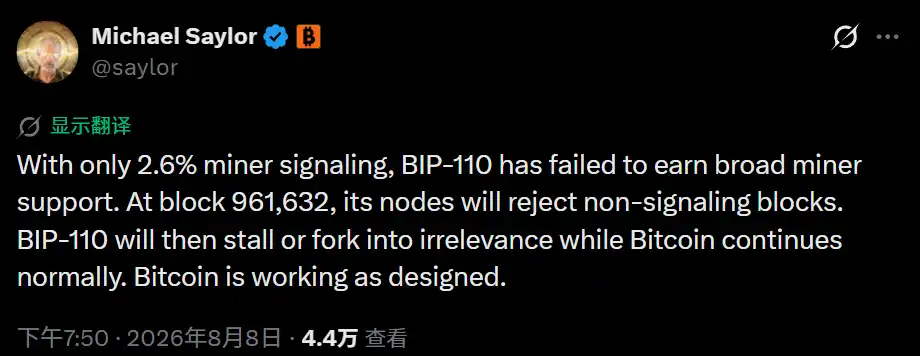
According to BlockBeats, on Aug. 8, Michael Saylor, founder of Strategy, said that only 2.6% of miners have signaled support for BIP-110, meaning the proposal has not gained broad support. In the same post, Saylor pointed out that at block height 961,632, nodes would reject blocks that do not signal in favor of BIP-110. He went on to say that after that point, BIP-110 would either stall or fork into an irrelevant existence, while Bitcoin itself would continue to run normally. 'Bitcoin is working as designed,' Saylor wrote. BIP-110 is a temporary soft fork proposal designed to add seven consensus restrictions over roughly a one-year period. Those restrictions include limiting new script public key lengths, placing caps on certain pushed data and witness item sizes, and disabling some Taproot extension paths. The proposal intends to substantially reduce arbitrary non-payment data that can be embedded in transactions, such as inscriptions and runes. This, in turn, would reduce the load on nodes, suppress spam data, and help Bitcoin stay focused on its role as money.
Michael Saylor, founder of Strategy, said on Aug. 8 that BIP-110 has failed to gain broad miner support, with only 2.6% of miners signaling in favor. According to the proposal's rules, at block height 961,632, nodes are expected to reject blocks that do not signal support for BIP-110. Saylor expects the upgrade to either stall or split into an inconsequential fork, while the Bitcoin network continues to operate normally.
"Bitcoin is working as designed," he added.
BIP-110 is a temporary soft fork proposal that would add seven consensus restrictions over roughly a one-year period. These restrictions include limiting the length of new script public keys, capping certain pushed data and witness item sizes, and disabling some Taproot extension paths.
The stated aim is to sharply reduce arbitrary non-payment data that can be embedded in Bitcoin transactions, such as inscriptions and runes. Doing so is meant to lower the burden on nodes, curb spam data, and help Bitcoin stay focused on its role as money.
This article was originally published by Bit.Fan. For more cryptocurrency news and market insights, visit www.bit.fan. Disclaimer:
The market information, project data, and third-party content displayed on this platform are for industry information sharing only and do not constitute any form of investment advice or return commitment.
Cryptocurrency trading carries high risks. Users should fully assess their risk tolerance and make independent decisions. All profits, losses, and legal responsibilities are borne by the users themselves.