
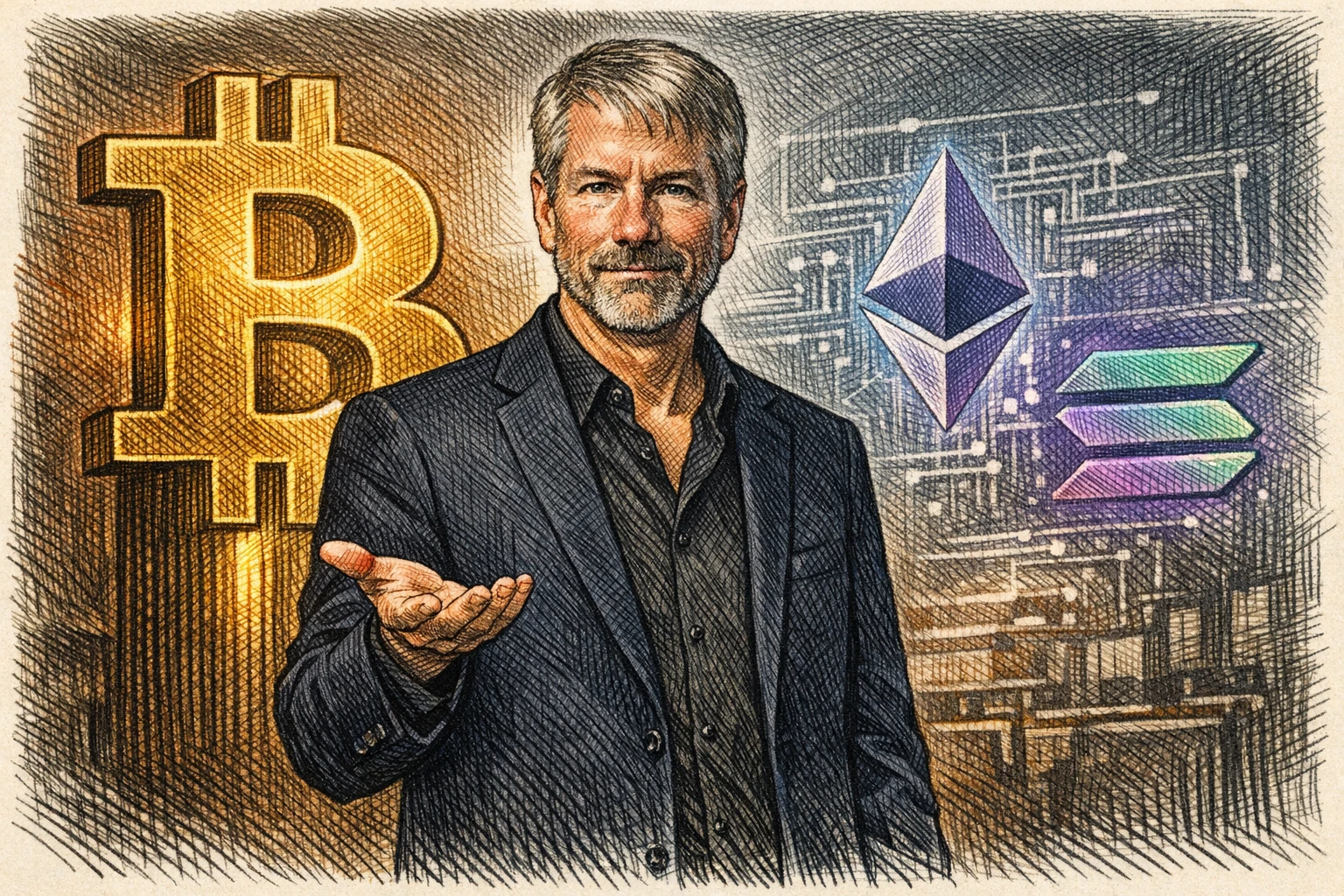
Michael Saylor used Strategy World 2026 to present a noticeably different stance on Ethereum and Solana. In April 2025, he had compared the two networks to “balsa wood and clay bricks,” while calling Bitcoin “steel.” By February 25, 2026 in Las Vegas, he was listing Solana, Ethereum, NASDAQ, and the London Stock Exchange in the same sentence as platforms capable of distributing digital credit.
Public blockchains move from rivals to infrastructure
Saylor’s public messaging has shifted in stages. In May 2024, during that year’s MicroStrategy World event, he delivered the line “Bitcoin: There is no second best,” arguing that no other crypto asset would gain Wall Street acceptance. Later, after spot Ethereum ETFs won SEC approval, he softened slightly and said that development was positive for Bitcoin because it added another line of defense. Even so, in April 2025 he was still warning that Bitcoin was “steel,” while Ethereum and Solana were weaker materials, invoking the collapses of FTX and Terra/Luna as cautionary examples.
His latest framing was more operational than rhetorical. He said credit can be created, tokenized, packaged into private funds, public funds, ETFs and ETPs, then linked to bank accounts and crypto accounts before being distributed across platforms. In that list he specifically named Solana, Ethereum, Binance, and Coinbase Base. That wording put public chains inside the same financial plumbing rather than outside Bitcoin’s orbit.
A three-layer model built on Bitcoin reserves
The “Digital Credit” framework he presented rests on three layers. The first is “digital capital,” which in his structure means Bitcoin as the reserve asset. According to the source material, Strategy holds 717,000 BTC, more than 3.4% of total Bitcoin supply, at an average cost of about $76,000. On this point, his core thesis has not changed: Bitcoin remains the base reserve of the system.
The second layer is “digital credit,” or yield-bearing financial instruments issued against Bitcoin collateral. Saylor pointed to Strategy’s STRC preferred stock as a working example, with an annualized dividend of 11.25% paid monthly. He also said that during a 45% drawdown in Bitcoin from its peak, STRC’s par value lost 0% while still paying 4.5% in dividends. He summarized the function of digital credit with four actions: reducing risk, compressing duration, converting currency, and extracting yield.
The third layer is “digital currency,” covering stablecoins and payment instruments derived from those credit products. In this setup, Ethereum and Solana are not the monetary base. They are transmission mechanisms. Bitcoin stores value at the center, while public blockchains carry that value and the associated credit products into markets, accounts, and payment channels.
A $300 trillion credit target and the market response
Saylor tied this structure to a very large addressable market. He estimated the global credit market at about $300 trillion and said it could double over the next decade. If Bitcoin-backed digital credit products were to capture 5% to 10% of that market, the implied opportunity would be roughly $50 trillion to $60 trillion.
The source says markets reacted quickly. Within 24 hours of his remarks, Solana rose 13%, pushing its market capitalization close to $50 billion. Solana’s official X account also reposted a clip of the speech. XRP, by contrast, was not mentioned during the presentation, a point that drew complaints from parts of the XRP community.
Institutional signals also emerged at the event. Anchorage Digital, a crypto firm with a U.S. federal bank charter, and energy company Prevalon Energy both announced plans to add STRC to their corporate treasuries. In that framing, Bitcoin is no longer treated only as an asset to sit on the balance sheet. For some buyers, it is being connected to products designed to generate cash flow.
Whether this means Saylor has abandoned Bitcoin maximalism depends on what is being measured. His conviction in Bitcoin itself is still visible in the 717,000 BTC position. What changed is the architecture around it: Bitcoin remains the reserve base, while Ethereum and Solana are recast as infrastructure serving a broader Bitcoin-led credit system.