

The era of the traditional blind-pool venture fund is starting to give way.
In a piece by Shoal Research and Odin, translated and published by TechFlowPost, the authors argue that the classic 10-year closed-end VC fund is being challenged by a hybrid approach: small managers raise lean microfunds for early-stage investing, then use deal-by-deal special purpose vehicles, or SPVs, to add capital into selected follow-on rounds. Their case is that the structure can reduce blended fees for limited partners while allowing general partners to stay focused on the earliest investments.
The article frames the shift in direct terms. A “small fund + SPV” setup, it says, beats a single larger fund both mathematically and in incentive design, while co-investment is becoming closer to a standard feature of the industry than an exception.
Why blind pools are no longer the default answer
The authors begin with the traditional VC model: a 10-year closed-end blind-pool fund. LPs commit capital for a decade, often longer in practice, and hand investment discretion to the GP without making decisions deal by deal.
That structure depends on a high level of trust. The article says it was designed for a very different market, one in which managers were overseeing single-digit or low double-digit millions of dollars and making early-stage bets at a time when a company that looked obviously attractive to LPs was often already near an exit.
That backdrop has changed. Companies now raise more rounds, round sizes are larger, and LPs themselves are more sophisticated. Many are former founders or senior executives in strategic fields, which means they can identify compelling opportunities earlier than they once could. In the authors’ view, that makes follow-on decision-making much easier than it used to be.
From that starting point, the article argues that blind pools should not remain the default structure forever. They serve a purpose in the earliest stages, when a VC firm has to form conviction before nearly everyone else. But once a company begins to show obvious traction metrics or a stronger market position — possibly as early as Series A, and at least by Series C — lower-fee co-investment tools often make more sense. They can reduce the cost of capital and gather LPs whose interests are more directly aligned.
SPV infrastructure has become easier to use
The article says better back-office infrastructure over the past five years has reduced the friction involved in setting up SPVs on a deal-by-deal basis. That has made it easier for independent GPs and smaller partnerships to deploy capital through two complementary tools at the same time.
- A small fund can spread LP money across early opportunities that are inherently risky and hard to assess, functioning like a portfolio of options.
- Curated co-invest opportunities let LPs increase exposure once a company becomes more attractive, functioning more like targeted investing.
The authors note that both approaches have a place, depending on an LP base and a GP’s own preferences. Even so, they say it is becoming harder for small fund managers to avoid SPVs if they want follow-on capital, while managers who operate only through SPVs may also be comfortable without a traditional fund structure.
Enrico Melis of Animal Syndication Company is quoted in the piece as saying: “The best investments I’ve been involved in have weird ownership structures — a bit added later, with some opportunistic tools layered on top. The moment you try to rigidify something as messy as early-stage VC and turn it into a model, you force the wrong ways of thinking.”
The article adds that early-stage companies used to build relationships with large later-stage investors in order to secure future follow-on money. That strategy has become riskier in recent years, it says, because the market has concentrated into fewer firms that are interested in a narrower set of opportunities. The authors also say there have been reports of large firms disrupting fundraising for smaller funds in an attempt to control more of the market.
They do not dismiss the role of mid-sized funds that continue backing portfolio companies in later rounds. If those firms deploy reserves through a sensible process-alpha strategy, the article says, they may still produce attractive returns on larger pools of capital. But the piece argues that this may not translate well to smaller firms, because scale itself can drag on performance and growing organizations can drift toward consensus, losing the agility that independent investors and small partnerships often have at the edge of the market.
LP demand for co-invest rights is rising
The article cites a PitchBook analyst report that says: “LP co-investment activity is expected to increase gradually over the medium term. As more institutional investors build internal resources and portfolio infrastructure capable of co-investing consistently across diversified deal flow, the gradual institutionalization of large LP direct programs should improve the risk-return profile of the strategy and expand the pool of LPs able to execute selectively.”
In venture capital, demand for co-invest has become something of a meme, the authors write. Everyone wants it, but many participants still do not fully know how to use it. They describe this as a growth pain that often appears when an industry starts treating co-investment as an ideal standard, much as private equity did earlier. Over time, they argue, better tools, standards, and talent should catch up with the practice.
The piece is also blunt about what is driving part of today’s demand. It says the appetite for co-invest rights in VC is still fueled in large part by FOMO and by a simplistic application of power-law thinking. When an investor encounters a “hot” portfolio company, LPs often want to buy in directly, both for status and for better-looking IRR metrics.
That behavior comes with a cost. Because the impulse is opportunistic, LPs often do not yet have the understanding or internal process needed to evaluate those investments well. The authors say there is a learning curve on the LP side too.
They give a specific example from a difficult fundraising environment: some LPs pressure emerging managers to offer zero-fee, zero-carry SPVs. In the authors’ view, removing carry is a poor way to align incentives unless the LP’s main goal is simply to harvest deal flow. The article says this treatment of co-invest also helps explain why many GPs default to fund expansion.
Even with those frictions, the authors expect co-invest activity to keep growing. They describe that as a natural evolution in a market trying to maximize access to investment opportunities while lowering blended fee costs.
The economics: a $10 million microfund versus a $38.3 million fund
The article then turns to structure and economics. It says the authors previously examined how private-equity-style co-invest rights and fee schedules could improve the economics of mega VC funds, and argues that the same logic applies in the smaller end of the market.
They present two hypothetical scenarios.
In the first, a manager raises a $10 million microfund to support 30 initial checks of $250,000 each, then uses deal-by-deal SPVs for selected follow-on investments. In that setup, the SPV assumes a 2% GP commitment, no management fee, and 10% carry.
In the second, the manager raises a $38.3 million fund large enough to execute the exact same investment and follow-on strategy entirely inside the fund, with no SPV.
The authors assume both scenarios produce the same portfolio outcome, generating a 4x gross return. Under that assumption, they say, the microfund wins on DPI because it suffers less fee drag.
The article acknowledges the tradeoff for newer GPs charging a 2% management fee: less immediate income. But it argues that the smaller vehicle can close faster, produce stronger performance marks, and make future fundraising easier. It also says that if one accepts the premise that a $10 million fund is more likely than a $38.3 million fund to produce a higher multiple, the compensation gap created by carry can narrow quickly. In the meantime, the GP still has a workable salary and LPs still gain access to attractive deal flow.
The article makes the point plainly: compensation should be tied to performance.
At the same time, the authors say the numbers only capture part of the picture. The mathematical edge of the microfund matters, but not as much as the alignment effect. In their framing, a hybrid structure rewards “missionary” GPs rather than fee-driven mercenaries, which should improve decisions and returns at a system level.
They add that smaller funds also let GPs operate more effectively as independent investors, maximizing what the article calls their idiosyncratic surface area. Those managers are not forced to make hires they may not need simply to justify fee income, and they do not face pressure to chase larger, later-stage rounds just because the fund is too large. For investors who excel at frontier-stage investing, the article presents this as the ideal setup.
Survey of 56 GPs shows SPV adoption is already substantial
The article says the market is still evolving and that smaller managers are beginning to use deal-by-deal structures more effectively. That shift, it says, is being driven by fundraising friction and the broader concentration of capital. SPVs, in this telling, have become an important lifeline for managers trying to support portfolio companies in later rounds.
But the transition is not complete. The authors say there is still a lot of work to do before LPs can embrace SPVs without hesitation and capture performance benefits from them. Part of the problem is infrastructure. Most of it, they argue, is education. GPs and LPs need to understand current standards and how those standards can be improved.
Against that backdrop, Odin surveyed 56 GPs earlier this year. The article includes the survey link: https://spvsurvey.joinodin.com/.
Of those 56 respondents, 51 invest at the Pre-Seed or Seed stage. Eighty percent manage funds below $100 million, and 61% have five years or more of venture investing experience.
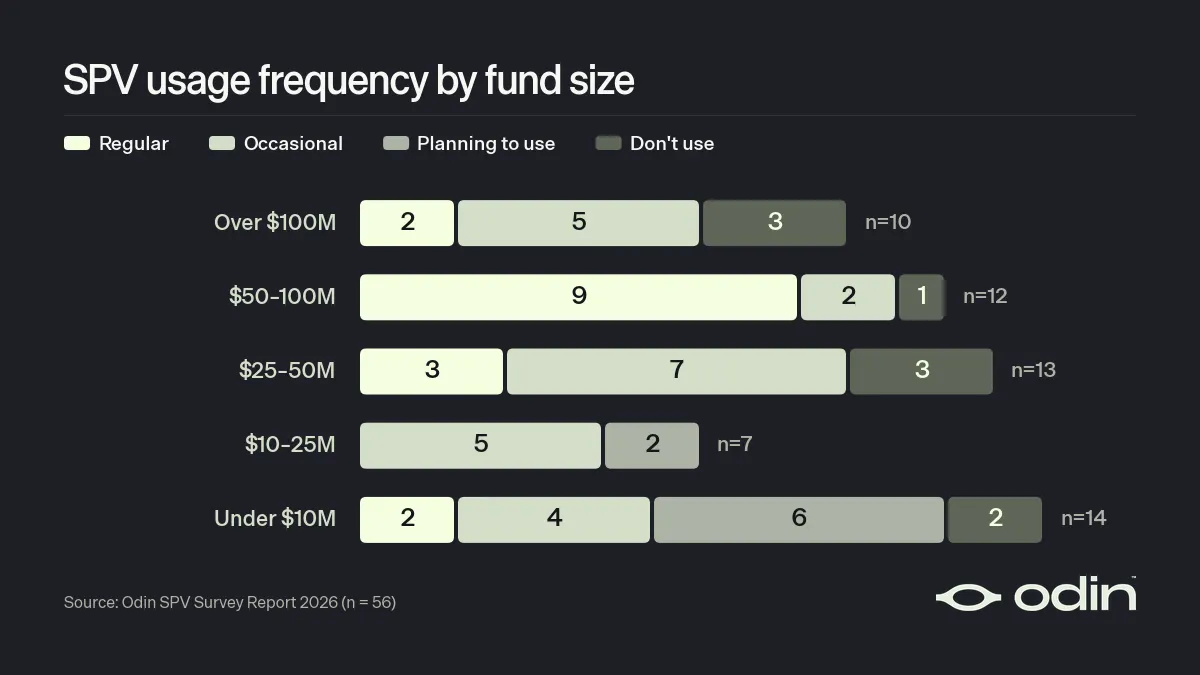
A chart in the article says 39 of the 56 surveyed GPs already use SPVs, with adoption highest among funds in the $50 million to $100 million range. The source is Odin SPV Survey 2026.
The article breaks that down further. Of the 39 existing users, 16 use SPVs frequently and 23 use them occasionally. Of the remaining 17 managers, 8 plan to begin using SPVs in the future. That brings current and potential users to 84%.
Adoption is highest among more experienced GPs and among those running funds between $50 million and $100 million, the article says. These are often managers with networks that can supply capital but without reserve levels large enough to cover follow-on rounds from the fund itself.
Follow-on capital is the primary use case. Among 47 respondents who either use SPVs or plan to use them, 39 cited that purpose.
Amy Brandenburg of Denver Ventures is quoted as saying: “Our seed fund invests at the earliest stage. We run a light-reserve model and instead use SPVs directly for growth rounds. That makes a $20 million fund feel much bigger to our companies and lets us deploy more capital into the winners without running out of money.”
Terms are LP-friendly on fees, but GP commitments vary
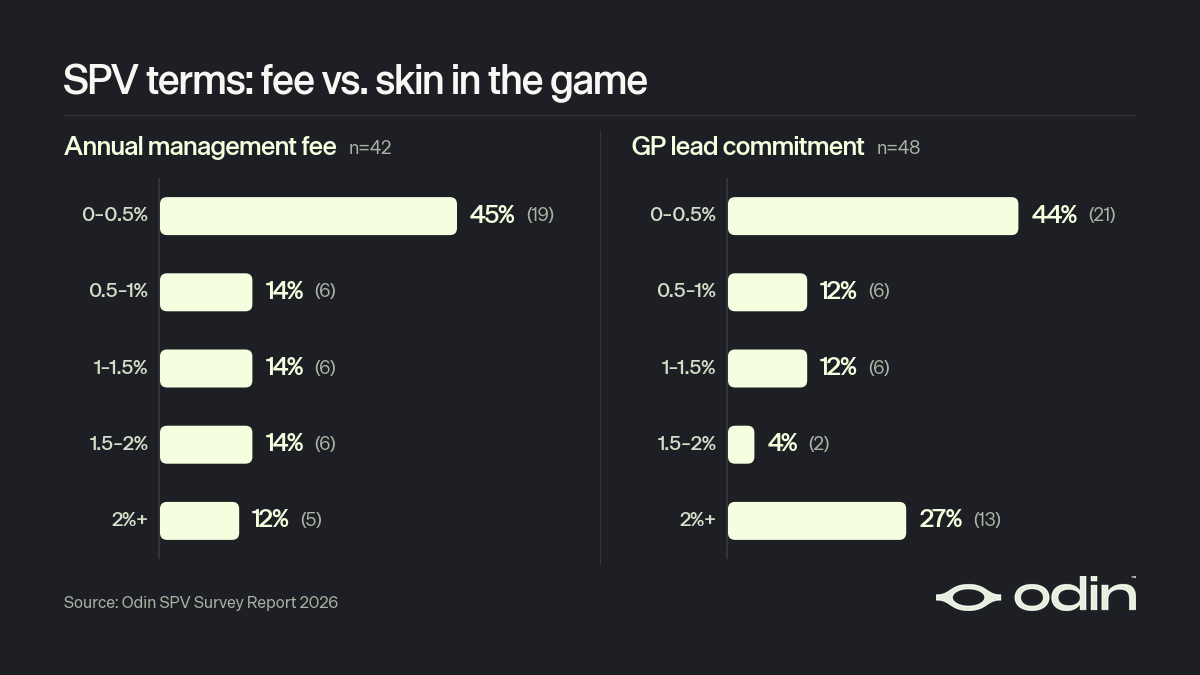
Survey results in the article suggest SPV economics are usually more favorable to LPs. A 0% to 0.5% management fee is the clear norm, cited by 45% of respondents. Carry most commonly falls in the 16% to 20% range, cited by 46%, while 26% charge only 1% to 10% carry. Two-thirds of managers pass setup and administration costs directly to LPs at cost.
The GP side looks different on lead commitments. According to the article, 44% of respondents invest only 0% to 0.5% themselves, while just 27% commit 2% or more.
The authors say that where the market still disagrees on terms, there is room to build better standards, improve outcomes, and remove friction from the process. Their stated goal is to lower costs for GPs, make sure managers actually bear risk, keep them focused on outcome quality rather than fee maximization, and reward LP loyalty through pro rata access.
Dan Kimerling of Deciens is quoted as saying: “We generally believe in dancing with the people who brought you. So while SPVs can help bring in new LPs, our existing LPs always get the first opportunity.”
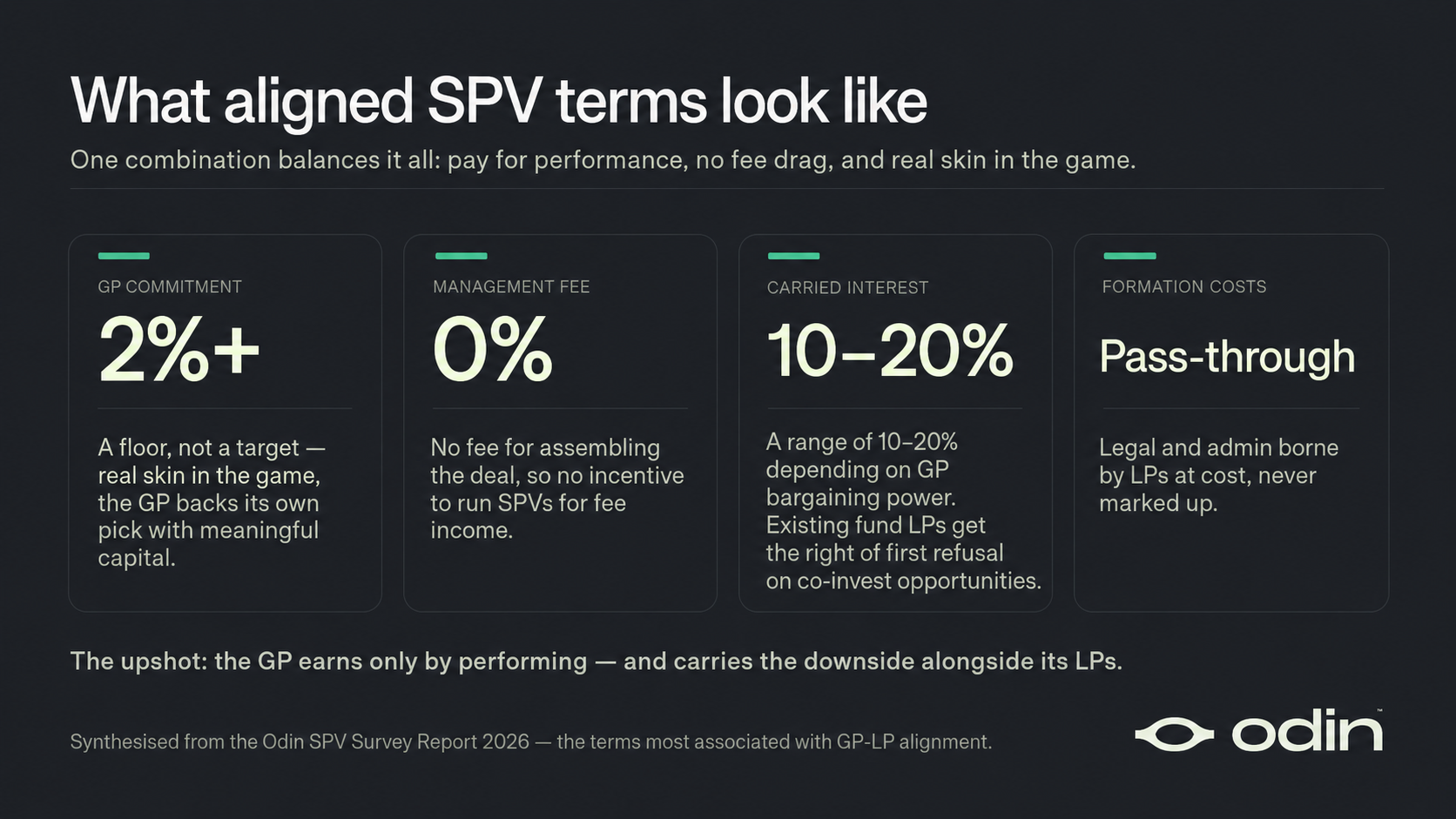
For situations where a GP is using SPVs to fund follow-on investments in companies already backed by the fund, the article proposes a model structure: GP commitment of at least 2%, a 0 management fee, 10% to 20% carry, and LPs covering formation costs at cost. The source is Odin.
SPVs should not be used to hide economics
The article says there will always be exceptions. If an SPV is unrelated to the fund itself, GP commitment may be better understood as a percentage of the lead investor’s net worth rather than a fixed minimum.
Still, the main boundary is clear. SPVs should not be used as a mechanism to hide deal economics or to shield fund performance from excessive risk. They need to be structured and offered transparently, honestly, with a clear purpose and aligned incentives.
Helen Min of Articulate is quoted as saying: “An SPV is just a tool, and there’s no point liking or disliking them. Strong opinions should be reserved for how they’re structured, whether there is two-way transparency, and how they’re managed.”
What the article says LPs need to do next
The final section turns to LP behavior. If smaller funds perform better, the article argues, then using standard fee incentives to push managers toward growth is irrational. If sustained outperformance depends on keeping fund size stable — and with it the same strategy, organizational footprint, and target opportunity set — then strong smaller managers should have room to raise fee percentages rather than simply expand the fee base.
On that logic, the authors expect managers to seek additional capital through SPVs so they can keep supporting founders. They say that arrangement is economically attractive for LPs as well, because it improves alignment and reduces fee drag.
In return, LPs need to be more prepared to participate in those deals. That means understanding the relevant terms, the cost of failing to honor commitments, and the portfolio approach required to capture performance upside. The article also says LPs must be willing to compensate successful co-investment through carry.
The piece ends by arguing that as these elements come together over the next few years, the venture industry will be stronger. In the authors’ view, a shift toward more developed co-investment is an overdue evolution away from overstretched 10-year fund tools and fee incentives that no longer serve the market well.