
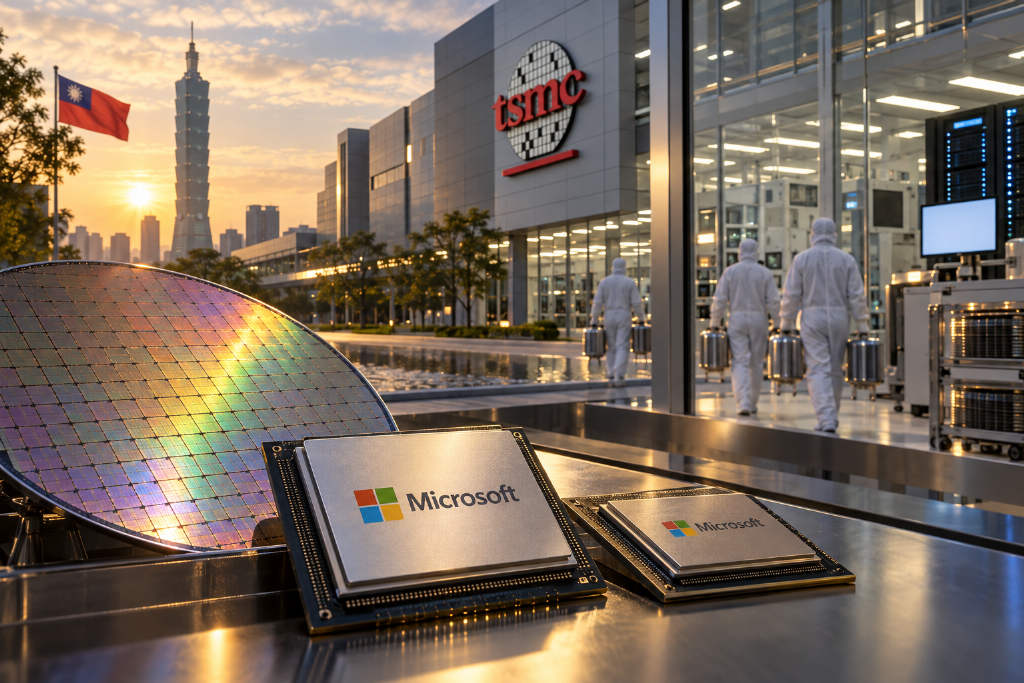
Microsoft is stepping up its in-house artificial intelligence chip effort to reduce dependence on costly external processors and relieve pressure from cloud computing expenses. Market information cited in the report says the company is preparing its second-generation Maia 300 chip and has asked Taiwan Semiconductor Manufacturing Co. (TSMC) about manufacturing capacity for more than 300,000 units, with delivery scheduled to be completed in 2027.
Benjamin Bien, general manager of Microsoft Taiwan, recently said Microsoft’s internally developed application-specific integrated circuits, or ASICs, are moving ahead smoothly in design, capacity and deployment, and are expected to enter large-scale mass production next year. With internal demand for computing power still high, the new chips will first be used for Microsoft’s own services, including Microsoft 365 and Copilot, and will not be opened to third-party rental customers for now.
Mass production is expected to begin next year
According to the Economic Daily News, Bien said development and production of the ASIC chips are progressing steadily, with Microsoft expecting to begin large-scale mass production next year. These custom chips are designed mainly for front-end inference workloads and other highly predictable computing patterns, with the goal of improving both energy efficiency and computing efficiency. Microsoft is seeking tighter control over hardware to support the operating demands of its large generative AI product lineup.
Maia 300 capacity is being lined up with TSMC and reserved for internal services
Chain News previously reported that Maia 300 could make its debut as early as the second half of this year. That report said Microsoft had approached TSMC about an order for more than 300,000 units, with delivery expected to be completed in 2027. Over the longer term, Microsoft’s internal target is said to be as high as 1 million units.
Still, Microsoft’s own supply of computing power remains tight. Management has made clear that output from the new chip will be prioritized for internal workloads such as Microsoft 365 and Copilot, and will not be made available to outside enterprise customers in the very short term.
Lowering compute costs is a central reason behind the push
A core part of Microsoft’s chip strategy is to reduce reliance on purchases of expensive graphics processing units, or GPUs, as well as model invocation costs. Internal Microsoft briefing materials cited in the report say deploying dedicated chips could cut related AI computing costs by about 30% to 40%.
As enterprises try to manage token consumption and swings in spending, Microsoft is also promoting FinOps, short for Financial Operations, to help customers evaluate return on investment and compute expenses with greater precision.
Scale and ecosystem remain under market scrutiny
Although Maia 300 is said to include architectural upgrades for both training and inference performance, Microsoft still needs to prove out the broader ecosystem around its in-house chips. The earlier Maia 200 was deployed only in a limited number of Microsoft data centers, and the report says it had no external customers.
By comparison, Google is expected to produce as many as 300 million TPU units next year and has already opened compute rental services to outside users. Against that backdrop, the report says Microsoft still trails in production scale and commercialization, and the benefits of its in-house chip strategy will need more time to be tested.