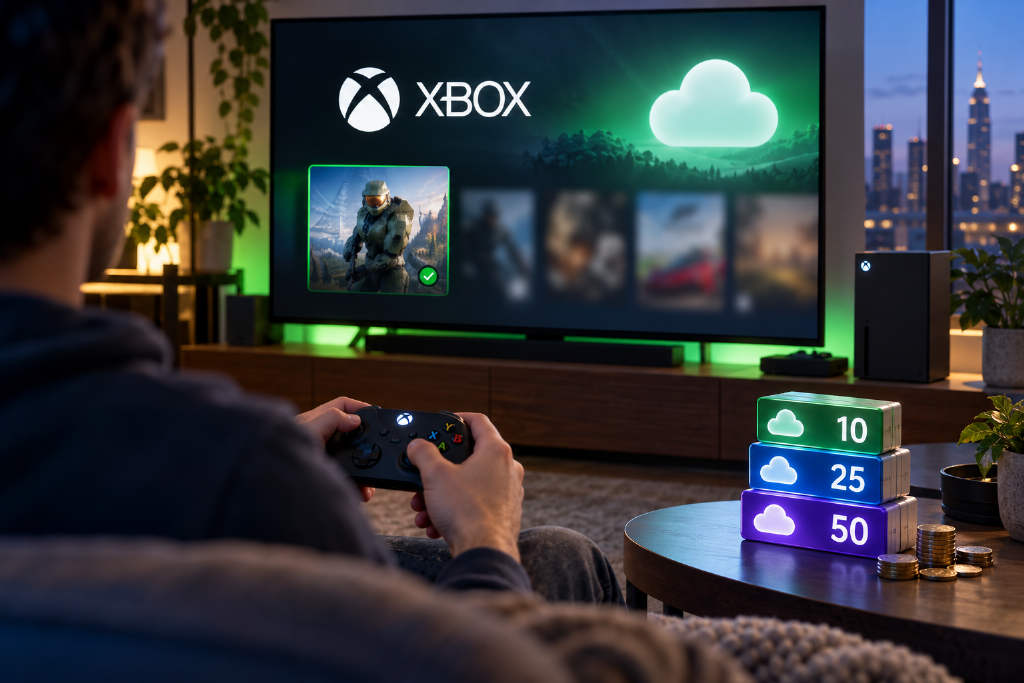
Microsoft has started testing a new hourly cloud gaming model for Xbox. In a post published on Xbox Wire on Oct. 21 U.S. time, the company said Xbox Insider members who do not subscribe to Game Pass can now buy Cloud Playtime hours, with a broader rollout planned for November.
Three launch tiers for Cloud Playtime
The introductory pricing comes in three bundles: 10 hours for $3.99, 25 hours for $7.99, and 50 hours for $11.99. Ars Technica calculated that the pricing works out to about $0.24 to $0.40 per hour.
Those hours are not a standalone game purchase. Microsoft said the packages can be used with already owned cloud-playable games or with some free-to-play titles. In practice, that means a player may need to buy the game first and then pay again for the time spent streaming it through the cloud.
Backlash centers on paying twice
According to Microsoft, purchased hours do not expire before they are used. The paid option also offers ad-free streaming, shorter queue times, and higher image quality.
Ars Technica senior gaming editor Kyle Orland compared the setup to feeding coins into an old arcade machine, while noting that an arcade cabinet did not require players to buy the machine first. That is where much of the criticism is focused. Players have already paid for the game, but switching to cloud access on another device can trigger a second, time-based fee.
The report said the change sparked heavy discussion on Reddit and other player communities, with many comments questioning whether the model amounts to a form of double charging. The original article also noted that BlockTempo could not independently verify the exact engagement figures tied to those discussions.
Game Pass cloud access was already moving to capped usage
The hourly package did not appear out of nowhere. On Sept. 3, Microsoft said in an official notice that Game Pass cloud gaming would move to monthly usage caps starting in November. The limits were listed as 15 hours for Ultimate, 10 hours for Premium, and 5 hours for Essential. Before that change, subscribers had unlimited cloud streaming.
Microsoft said cloud gaming costs rise with both user numbers and play time, and acknowledged that some players would see higher effective costs, while estimating that only 4% of Game Pass subscribers would be affected. Xbox plan pages also indicate that subscribers who use up their monthly allowance will need to buy additional hours.
Using outside estimates of roughly 30 million Game Pass subscribers, Ars Technica said 4% would equal about 1.2 million heavy cloud users. That figure was a media estimate, not an official Microsoft disclosure.
Microsoft is also testing a free ad-supported version
Alongside the paid bundles, Microsoft is testing a free ad-supported streaming option for Insider users. Windows Central reported that, during the test period, each play session on the ad-supported version is limited to 30 minutes. The paid Cloud Playtime package is positioned around shorter waits and better visual quality.
Cloud gaming pricing remains unsettled across the industry
Charging models for cloud gaming have shifted repeatedly across the sector. Google Stadia once let players stream purchased games without a time cap, though those games could not be downloaded for local play. After Stadia shut down in 2022, Google refunded players in full for their purchases.
Sony's PlayStation Now, launched in 2014, originally used a rental-style structure, with 90-day streaming access priced as high as $30. It later moved to an all-you-can-play subscription model and is now folded into the $20-a-month PlayStation Plus Premium plan.
NVIDIA's GeForce Now also uses time limits. According to NVIDIA's official blog, paid members receive 100 hours of play time per month and can buy an extra 15 hours after that. The add-on costs $2.99 for the Performance tier and $5.99 for the Ultimate tier.
That puts GeForce Now's extra usage at roughly $0.20 to $0.40 per hour, close to the Xbox Cloud Playtime range. The difference is in the structure: GeForce Now sells extra hours on top of a monthly plan, while Xbox is making hourly access available as a standalone purchase for non-subscribers as well.
November rollout will be the next test
The change points to a broader pricing problem in cloud gaming, where expensive server infrastructure is pushing services away from being a bundled subscription perk and toward metered access sold on its own. Microsoft has said heavy cloud users are a minority. Whether non-subscribers will accept a model that asks them to buy a game and then pay by the hour to stream it should become clearer after the wider November launch.