
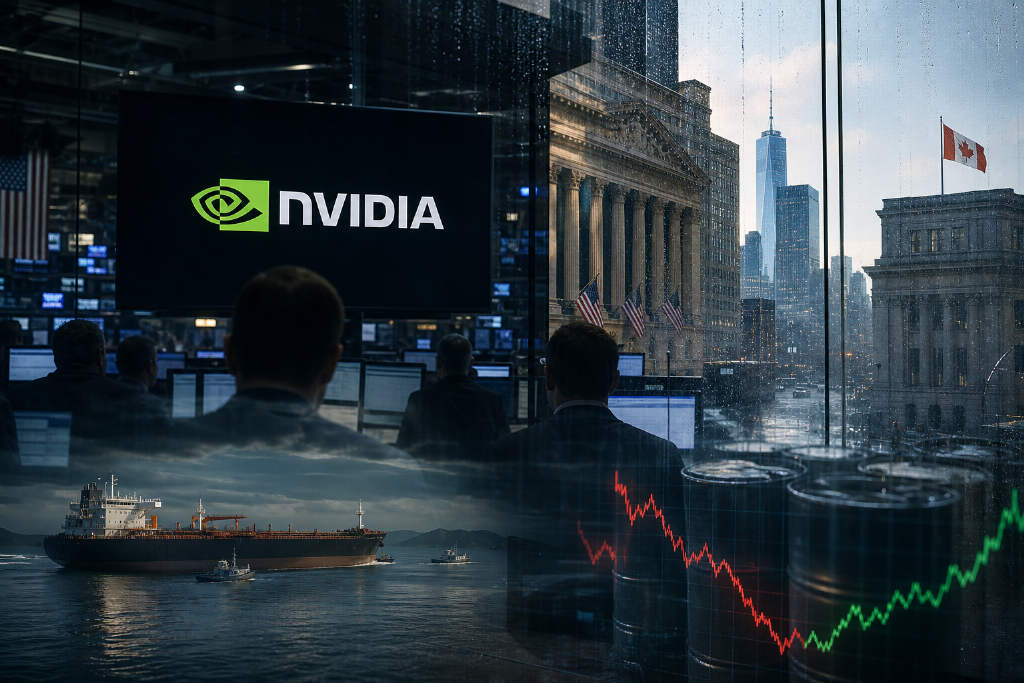
U.S. stocks finished higher as easing Middle East tensions knocked oil prices lower and sent money back into risk assets, with AI hardware names drawing much of the market’s attention before Nvidia’s earnings release.
The Dow Jones Industrial Average rose 0.30%, the S&P 500 added 0.32%, and the Nasdaq Composite climbed 0.66%, leading the three major indexes.
Oil drops as Middle East risk cools
The biggest shift in the market came from a sudden cooling in Middle East risk. Russian media reported that the United States and Iran had reached consensus on ceasefire terms, including free navigation through the Strait of Hormuz, and that both sides were expected to publish the terms in the coming days and begin talks under the Islamabad memorandum.
Iran and Oman were also said to have reached a temporary aviation understanding that would allow only merchant vessels to pass, while warships would be barred. A permanent arrangement is expected to be discussed within 30 to 60 days.
At the same time, Iran’s deputy foreign minister rejected the U.S. claim that mines in the strait had already been cleared. The official also restated that reopening the waterway would require a full end to the fighting in Lebanon, the lifting of the blockade, progress on Yemen, and full U.S. compliance with its commitments. Otherwise, the strait would remain closed.
Crude prices fell sharply. WTI settled down 4.57% and dropped below $80 a barrel, while Brent fell more than 5% and slipped under $85.
Weaker data and buyback plans support Treasuries
Lower oil prices eased inflation pressure, and soft U.S. economic data added to the bid in Treasuries. U.S. consumer confidence fell to 89.4 in August, the lowest level in seven months, while July new home sales also came in below expectations. The market took both signals as evidence that domestic demand may be cooling.
The 10-year Treasury yield fell about 7 basis points to around 4.62%, and the 30-year yield dropped about 6 basis points to roughly 5.17%.
The effect of Treasury Secretary Bessent’s expanded long-dated bond buyback plan is also still feeding through the market. Since the plan was announced, Treasuries have outperformed same-maturity interest-rate swaps, and the spread between 30-year Treasuries and swaps has narrowed to its lowest level since February. Traders have started to view the Treasury as a potential downside backstop for the long end.
That rebound is still contested. Stanley Druckenmiller, billionaire investor and an early mentor to Bessent, publicly criticized the expansion of long-bond buybacks, arguing that the Treasury should not artificially suppress yields because the real drivers of higher long-term rates are the United States’ structural fiscal deficit, debt load, and inflation that remains above target.
His warning was direct: if the government keeps defending bond prices, it could eventually weaken the credibility the Treasury market has built over time.
For now, the move in long bonds looks more like a temporary repair driven by policy support, lower oil, and weaker data than by any basic change in the U.S. fiscal picture. The 10-year yield is still above 4.6%, and the 30-year remains near 5.2%.
Gold holds firm, copper hits records, trade friction rises
Gold did not retreat with oil. Spot gold touched $4,697 intraday and closed up 0.15%. In Asian trading on Aug. 26, New York gold briefly reached around $4,730.
Silver and gold mining shares also moved higher. Coeur d’Alene Mines, Gold Fields, and Endeavour Silver rose more than 3%, while Newmont and AngloGold Ashanti gained more than 2%.
Copper was stronger still. COMEX copper rose 1.67% to a record close, and LME copper also set a record. The report said potential U.S. copper tariffs have pulled inventories into the United States in advance, tightening LME spot supply, while AI data centers, the power grid, electrification, and defense demand continue to offer long-term support.
Trade tensions also intensified. Canada said it would impose 15% to 50% tariffs on about $20 billion of U.S. goods starting Sept. 8. Tariffs on steel and aluminum will rise to 50%, and the list also covers motorcycles, home appliances, food, clothing, video game consoles, and smartphones. The White House is also discussing further countermeasures against Canada.
AI hardware rebounds before Nvidia results
Risk appetite in U.S. equities was concentrated in AI hardware. The AI-related segment of the S&P 500 rose more than 1%, while the index excluding AI-linked names was nearly flat. Capital rotated back into semiconductors, memory, optical communications, and compute infrastructure ahead of Nvidia’s earnings.
Nvidia rose 2.19%, ending a seven-session slide. The company introduced the Jetson Orin Nano 2 robot computer for robotics, drones, and edge AI applications, saying inference performance is 2x that of the prior generation with lower power consumption.
Attention has now shifted to Nvidia’s second-quarter earnings due after the close tonight. Market expectations place revenue at $92 billion to $92.3 billion, nearly double from a year earlier. Investors are not only watching for a beat. They are also focused on gross margin, China business, progress on next-generation chips, and whether AI demand is still strong enough to support valuations.
Mark Malek, chief investment officer at Siebert Financial, said Nvidia is operating at full speed across nearly all of its business lines, but the issue is that the market already expects it to be very good, so “good” may not be enough and any flaw could trigger volatility.
The financing scale behind AI infrastructure keeps expanding. Morgan Stanley said the five hyperscale cloud companies, together with Nvidia and Broadcom, have committed more than $3.1 trillion to third-party AI infrastructure through guarantees, leases, and purchase commitments. Google alone accounts for $890 billion, and the cloud providers’ total undiscounted commitments exceed $2.7 trillion, close to their operating cash flow for the next three years.
Another key AI theme is higher memory pricing. South Korea’s DRAM export prices in August jumped 401% from a year earlier because AI servers require large amounts of HBM, crowding out conventional DRAM capacity. Goldman Sachs expects the DRAM supply gap to widen from 5.0% this year to 5.9% next year. TrendForce also warned that by 2027, DRAM and NAND could account for 68% of major cloud providers’ capital spending, server DRAM prices could be up about 270% cumulatively by 2026, and HBM could still rise another 70% to 140% in 2027. In other words, the AI server bottleneck is spreading from GPUs into memory, packaging, power, and optical links.
Winners and losers across sectors
Nvidia’s 2.19% gain came as it launched the Jetson Orin Nano 2, a new entry-level robotics computing platform with 2x stronger inference performance, extending its reach into edge AI and robotics. The move also snapped the stock’s seven-day losing streak.
Optical communication names led the market higher. Lumentum gained nearly 7%, Applied Optoelectronics rose more than 5%, and Coherent, Marvell Technology, and Ciena each added more than 4%.
AMD surged 4.91% after Raymond James upgraded the stock to “strong buy” and raised its price target from $565 to $641, citing opportunity in the AI server CPU market.
Micron rose 2.48%. The stock advanced even after Micron’s CEO recently disclosed sales of $38.8 million in stock, with buying interest supported by a Goldman Sachs report that projected a global memory shortfall through 2028. Among related storage names, Seagate, Western Digital, and Rambus each climbed more than 3%.
SpaceX rose 2.19% after announcing plans to invest $100 billion in a giant Starship launch site in Louisiana, with a goal of supporting thousands of Starship flights per year.
Moderna jumped 14.36% after its mRNA cancer therapy succeeded in Phase III trials. Bank of America lifted its price target to $170 from $40, and Piper Sandler, Goldman Sachs, JPMorgan, and Barclays also raised their targets. In related drugmakers, Merck rose nearly 4% and Pfizer added more than 2%.
Energy shares lagged as oil fell. Apache dropped nearly 4%, Occidental Petroleum and Devon Energy each lost nearly 3%, Exxon Mobil fell more than 2%, and Chevron and ConocoPhillips each slipped more than 1%.
Dick’s Sporting Goods, listed as DKS, plunged 30.68% after second-quarter results missed expectations across the board and the company cut its full-year earnings per share guidance to $11 to $12, versus prior market expectations of $14.2. Company executives said high living costs are severely weighing on spending by middle-income U.S. households. Among related consumer names, Nike fell more than 3% and Target lost 3.8%.
Large-cap tech performance was mixed. Microsoft rose 0.90%, Meta gained 1.97%, and Tesla added 0.37%. Apple slipped 0.14%, Google fell 0.32%, and Amazon lost 0.39%. The market showed a clearer preference for companies with visible AI upside, while staying cautious on consumer hardware and e-commerce.
What markets are watching next
On Aug. 26, Gamescom in Cologne runs from Aug. 26 to Aug. 30, with Microsoft, Nintendo, Tencent, NetEase, and CDPR among the companies appearing. Traders are watching for announcements tied to new games, AI game tools, cloud gaming, and hardware ecosystems.
Also on Aug. 26 at 20:30, the United States will release July core PCE and the revised second-quarter GDP reading. The report notes that PCE is the inflation gauge the Federal Reserve watches most closely. If inflation comes in above expectations, Treasury yields could rise and the Nasdaq could face pressure. If it comes in below expectations, gold and technology shares could find support.
Deutsche Bank’s California Technology Conference will be held from Aug. 26 to Aug. 27 in Dana Point, California.
The Shenzhen AGIC General Artificial Intelligence Expo will run from Aug. 26 to Aug. 28, alongside a packed schedule with the Data Expo, with markets watching embodied intelligence and the commercial rollout of AI applications.
At 04:00 on Aug. 27, Nvidia will report earnings. Key points for the market include data center revenue, Blackwell shipments, Rubin progress, gross margin, and forward guidance. Strong guidance could reignite the AI trade, while weaker-than-expected margin or order quality could extend the pullback in semiconductors.
The Jackson Hole global central bank symposium runs from Aug. 27 to Aug. 29. Global central bankers are set to discuss financial innovation, inflation, and policy paths, and markets are also preparing for remarks from Warsh, which could amplify moves in bonds and the U.S. dollar.