
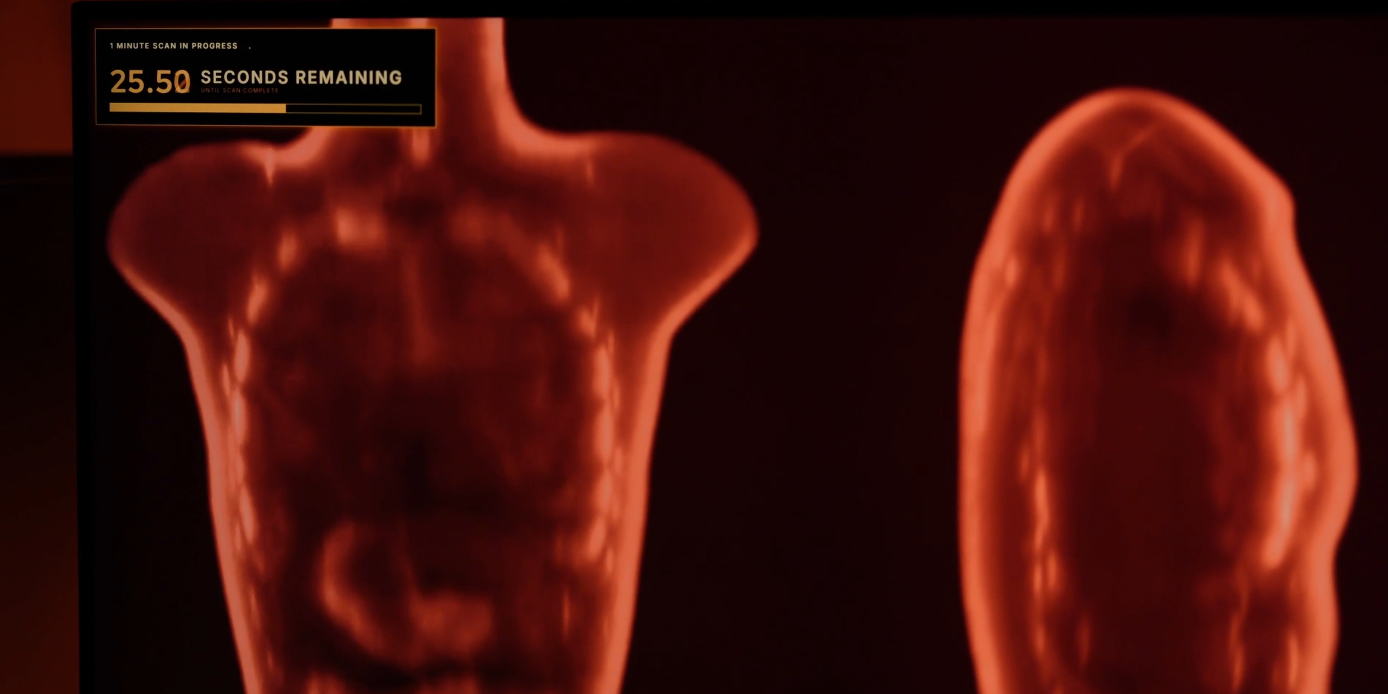
An AI imaging company with zero experience in medical devices has announced it will build a full-body scanner that it claims is 'as powerful as MRI.' Midjourney CEO David Holz detailed the pivot last week: users step into a water tank, submerge for 60 seconds, and get scanned by 40 Butterfly Ultrasound-on-Chip modules. The company describes the experience as 'like going to a spa' but insists the resulting images are 'comparable to MRI.' Holz even hinted to The Verge that future systems could surpass MRI.
The rollout plan is ambitious: the first spa in San Francisco by 2027, 50,000 scanners deployed by 2031, and a monthly scanning capacity of 1 billion. Midjourney has invested $74 million and signed a partnership with Butterfly Network in November 2025. Medical lead Tom Calloway told The Verge the device is positioned as a 'wellness product,' not a diagnostic device, having confirmed with the FDA that it cannot claim cancer screening or life extension. A third-generation scanner is expected in 2028, with 'night and day' improvements in image quality and speed.
Ultrasound's Fundamental Limit: Bone and Fat Block the Waves
Ultrasound has a hard physical ceiling: it cannot penetrate bone or air-filled cavities. Sound waves bounce right off bone and air interfaces, leaving the chest, abdomen, and skull as dead zones. Fat tissue rapidly attenuates ultrasound signals, degrading image quality for larger users. All demo images shown by Midjourney feature slender subjects.
The water bath method theoretically improves signal transmission, but requires extremely pure, bubble-free water with dedicated degassing equipment, and the water must be changed after each user. Users also need to shave beforehand to avoid air bubbles trapped between skin and water. Dr. Scott Reeder, professor of radiology at the University of Wisconsin, notes that current ultrasound typically takes over 30 minutes for regional scans, while MRI and CT, though longer, deliver far superior information. 'Getting to a level comparable to MRI or CT is a big leap,' he says. 'This is not a mature technology.'
Dr. Venkatesh Murthy, professor of preventive cardiology at the University of Michigan, says the company's claimed resolution is 'purely theoretical,' the MRI equivalence claim 'has no basis,' and the images shown are 'clearly insufficient.' He also flags a marketing-regulatory gap: 'The messaging is more about cancer screening and life extension than body composition.' He points out that accurate body composition measurements already exist — 'some weighing scales are about as accurate.'
Experts: 'More Scam Than Pivot'
The harshest words come from Dr. William Morrison, professor of radiology at Thomas Jefferson University. He calls the announcement a 'vibe-based rollout' — a strategy driven by emotion and expectation rather than technical data. He says the demo images are 'far behind current CT and MRI,' the water bath method has been 'largely abandoned' in modern imaging, and the whole thing 'feels more like a marketing campaign than a pivot.' His verdict: 'It may be more scam than pivot.'
Dr. Matthew Davenport, professor of radiology at the University of Michigan, calls the claims 'among the most egregious I've seen.' Dr. Mark Anastasio, professor of imaging science at the University of Washington, is more reserved: full-body ultrasound is 'feasible,' but 'there is currently no evidence' that it can rival MRI.
Midjourney's fallback is its regulatory positioning. As a wellness product, it avoids strict medical device rules. But that means paying users get scans with no diagnostic value. Reeder warns that if people skip mammograms or colonoscopies because of this, 'that would be concerning.' Davenport raises an ethical point: 'Bringing an unvalidated product to market with claims that are almost certainly not deliverable is ethically problematic.' He and Reeder co-authored a JAMA article this year on whole-body MRI screening, cautioning that mass imaging does not automatically equate to good medical decisions.