
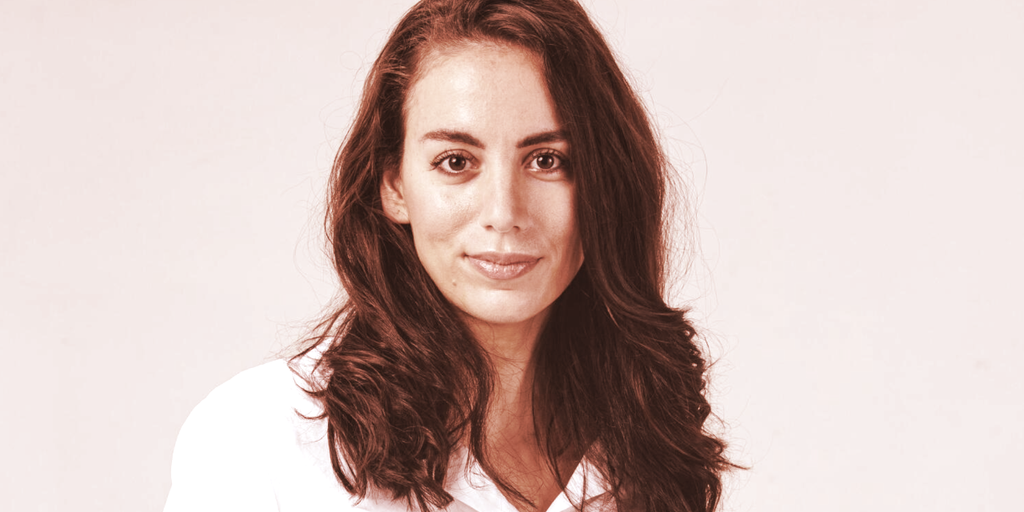
Mira Murati has released the first model from Thinking Machines Lab, the startup she founded after leaving OpenAI in September 2024. The model, called Inkling, is multimodal, trained from scratch, and distributed with fully open weights available for free download.
Murati’s exit from OpenAI came after a turbulent stretch at the company. When OpenAI’s board removed Sam Altman in November 2023, Murati, then CTO, was named interim CEO. Altman returned five days later, Murati resumed the CTO role, and then left the company roughly 10 months after that. She launched Thinking Machines Lab in February 2025.
The startup stayed quiet after its formation, but it did not stay small. In July 2025, Thinking Machines Lab raised $2 billion at a $12 billion valuation. The round was led by Andreessen Horowitz, with Nvidia, Accel, ServiceNow, Cisco, AMD, and Jane Street also participating. At the time, it was described as one of the largest seed rounds in Silicon Valley history.
Reports in November 2025 said the company was seeking a new round at a $50 billion valuation. Those talks collapsed by January 2026.
What Inkling is
Inkling uses a mixture-of-experts architecture, where only part of the network is activated for each input. That design is meant to keep inference fast without giving up model depth.
The model is large by any measure. It has 975 billion total parameters, with 41 billion active for each task, making it impractical for local deployment on a typical machine.
Inkling is also multimodal. It can take text, image, and audio inputs, and it supports a 1 million-token context window, or roughly 750,000 words. Thinking Machines said the model was pretrained on 45 trillion tokens spanning text, images, audio, and video.
Murati wrote on X: "Our first model, Inkling. Trained from scratch, weights are open, fine-tunable on Tinker today."
Fine-tuning refers to retraining an existing model on a more specialized dataset so it performs better on a specific task. Tinker is Thinking Machines’ cloud platform built around that use case. The company also published the full weights on Hugging Face under an Apache 2.0 license, with no restrictions.
Benchmark results
Thinking Machines is presenting Inkling as a well-rounded generalist model rather than one that sacrifices broad capability to dominate a narrow category.
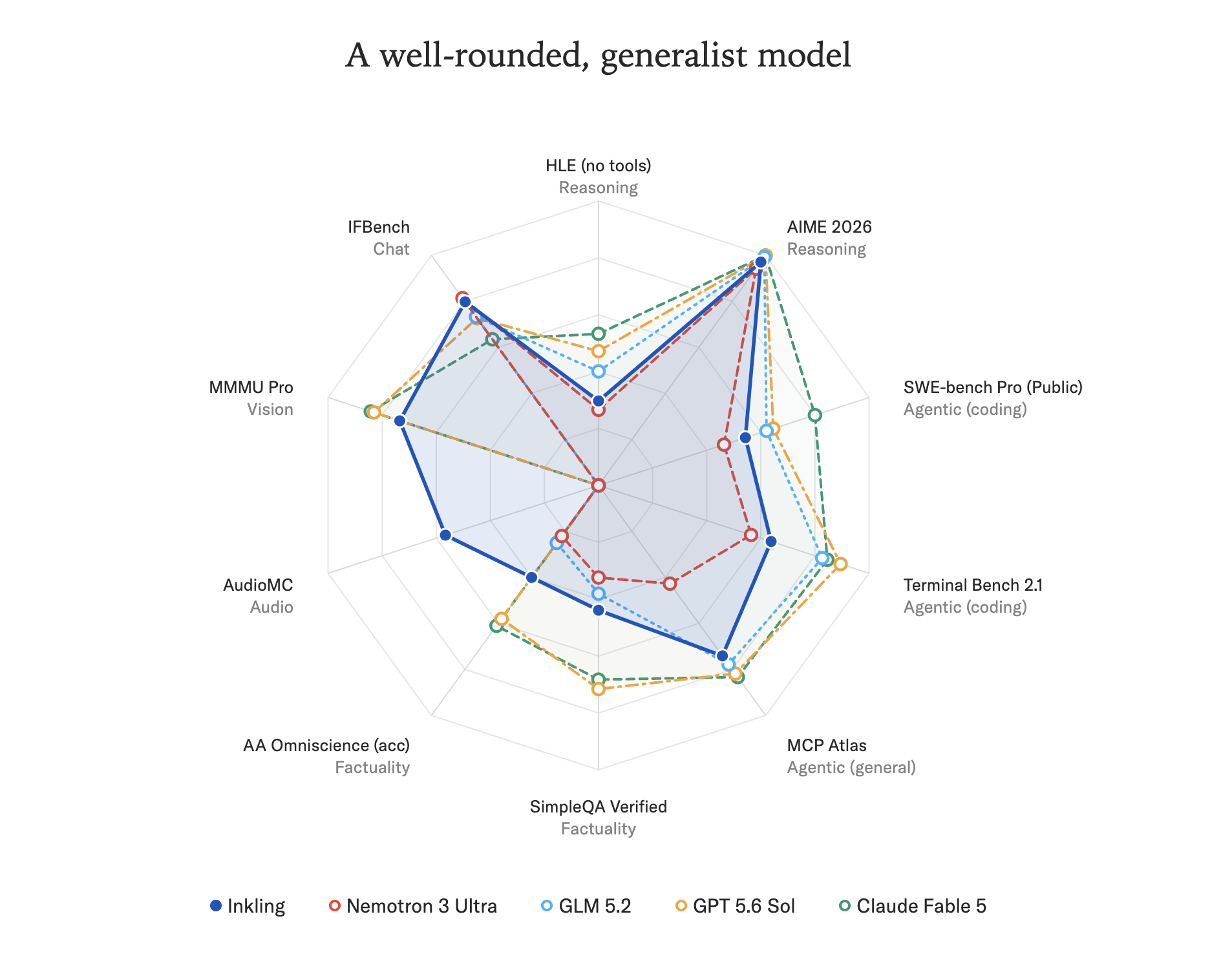
Its strongest showing comes in agentic tasks. On MCP Atlas, which measures how reliably an AI agent completes real-world tasks through the Model Context Protocol by using external tools and services, Inkling scored 74.1%. That was nearly 30 points above Nvidia’s Nemotron 3 Ultra, the main Western open-weights rival in the comparison.
On SWE-Bench Verified, which tests whether an AI agent can autonomously fix real software bugs on GitHub, Inkling scored 77.6%. Nemotron posted 70.7%.
Chinese models still lead in several areas. Z.ai’s GLM 5.2 scored 82.7% on Terminal Bench 2.1, compared with Inkling’s 63.8%. That benchmark measures autonomous AI coding agents in a real terminal environment. Kimi K2.6 led on Humanity’s Last Exam, which tests PhD-level scientific reasoning.
Thinking Machines acknowledged that Inkling is not the strongest model available today, whether open or closed.
The company’s case is narrower than that. Inkling, it says, is the most capable open-weights model built by a Western lab. For developers who, for legal, security, or compliance reasons, do not want to route workloads through models built in Beijing, that creates another option besides self-hosting Chinese models.
The report also notes that Inkling trails the best Chinese models across most categories, but may still appeal to developers whose preferences, expectations, or values are better aligned with a Western open-weights system. Later fine-tunes could also improve performance in specific tasks and make those variants more competitive on benchmarks against Asian models.
On FORTRESS Adversarial, which measures how consistently a model refuses genuinely harmful prompts without over-blocking legitimate ones, Inkling scored 78.0%. According to the comparison cited in the report, that was the highest mark among all open-weights models included.
Inkling-Small previewed
Alongside the main release, Thinking Machines also previewed Inkling-Small. That version has 276 billion total parameters and 12 billion active parameters, and the company said it already matches the larger model on most reasoning benchmarks.
Its weights will be released after testing is complete, though no timeline was provided.