
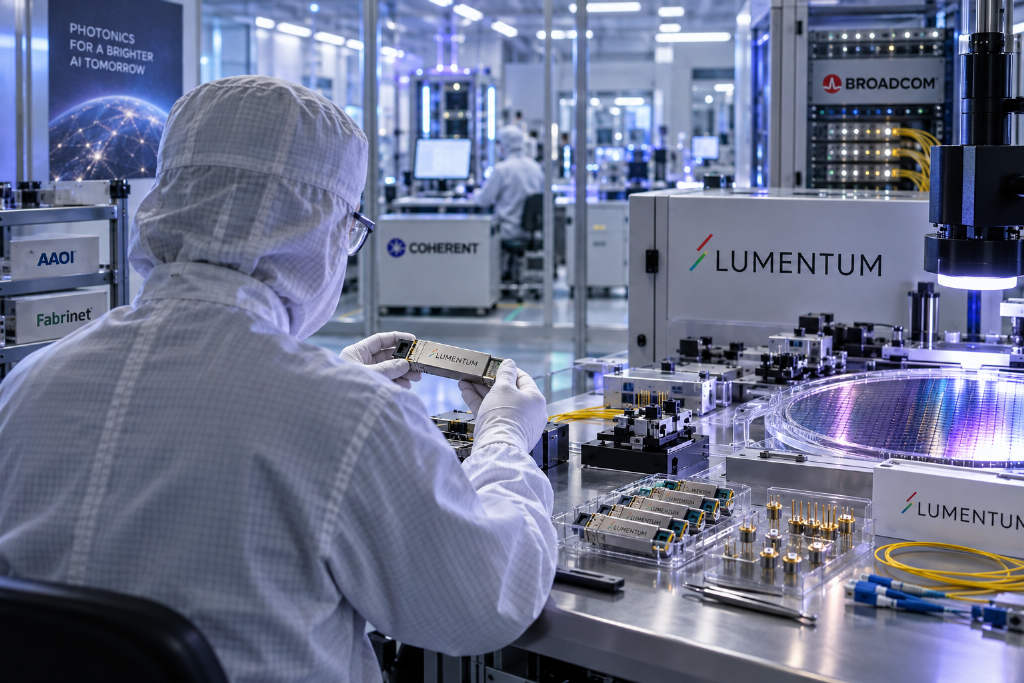
Mizuho said the optical interconnect market for AI data centers is entering a new phase as silicon photonics pluggable modules and co-packaged optics, or CPO, move closer to wider adoption. In the firm’s view, demand for continuous-wave, or CW, lasers is set for rapid growth over the next five years, and Lumentum (LITE) is positioned to hold a clear margin advantage over Coherent (COHR).

How Mizuho maps the supplier landscape
Mizuho described Lumentum as the largest supplier of electro-absorption modulated lasers, or EML, with about 33% market share. In CW lasers, it put Lumentum at roughly 11%, with the company focused on higher-ASP products such as UHP and NPO ELS. The report said Cloudlight, acquired in November 2023, is expected to generate about $900 million in revenue in 2026 and $1.2 billion in 2027, with market share above 6%. Mizuho also said Lumentum depends entirely on self-manufactured laser chips, which supports a stronger gross margin structure than peers.
For Coherent, Mizuho said the company is the largest transceiver assembler outside China, with around 17% market share. Its main differentiator is deep InP vertical integration. The report added that Coherent received a $2 billion strategic investment from NVIDIA and signed a multi-year CPO/CW supply agreement running through the end of 2030. Even so, Mizuho said some flagship products still rely on externally sourced lasers, limiting margin upside relative to Lumentum.
Broadcom (AVGO) was listed with about 21% share in EML and about 18% in CW. In ultra-high-power CW lasers, Mizuho said Broadcom leads the field, with share ranging from 24% to 32% depending on product category. It also described Broadcom as an important supplier for silicon photonics pluggables and NPO/CPO architectures, with pricing power in UHP CW lasers.
Mizuho identified China-based SELI and Yuanjie as the main leaders in the CW laser market, with combined share of about 56%. It broke that down to roughly 32% for SELI and 24% for Yuanjie. Their exposure, however, remains concentrated in standard low-power CW products, and the report said they have not yet established a clear position in higher-value areas such as UHP and ELS.
Applied Optoelectronics (AAOI) was described as an important U.S. assembler with three sites in Taiwan and a new 800G/1.6T production line under construction in Pearland, Texas. Mizuho expects that line to enter mass production in early 2027. Fabrinet (FN), meanwhile, was presented as a key contract manufacturing and assembly partner handling NVIDIA-designed transceivers and OEM contracts, without competing directly in the laser chip market.
CW laser capacity could rise more than fivefold by 2029
Mizuho forecast global CW laser capacity at about 83 million units in 2025, climbing to about 427 million by 2029. That would represent growth of more than five times.

The report split the demand curve into two waves. The first comes from large-scale production and adoption of 1.6T and 3.2T silicon photonics pluggable modules. The second comes from initial commercial penetration of NPO and CPO architectures between 2027 and 2029, assuming packaging yields improve on schedule.
At the same time, Mizuho said conventional pluggable modules are unlikely to lose their leading role in AI data center optical interconnects anytime soon. As optical engines move closer to ASICs, the existing pluggable ecosystem still carries substantial upgrade demand.
According to Mizuho’s shipment outlook for InP modules, CW modules will rise from a single-digit share of total shipments in 2024 to about 55% in 2029.
EML remains the near-term workhorse, even as share slips
EML still anchors 800G optical interconnect designs in AI data centers and also supports newer 1.6T and 3.2T architectures.
Mizuho expects EML’s share of the overall laser market to decline from about 62% in 2025 to about 45% in 2029. Even with that mix shift, absolute shipment volume is still projected to rise sharply. The firm sees EML shipments growing from about 309 million units in 2024 to about 1.231 billion in 2029, roughly a fourfold increase, driven by bandwidth demand from AI training and inference clusters.
On the supplier side, Mizuho put Lumentum first in EML at around 33%, followed by Coherent and Sumitomo Electric at about 22% each, Broadcom at about 21%, and Mitsubishi at about 6%. In Mizuho’s reading, Lumentum is one of the most complete vendors in the optical interconnect transition because it serves both the legacy EML engine and the newer CW engine.
Mizuho ties the Lumentum-Coherent margin gap to business model differences
Mizuho said the margin gap between Lumentum and Coherent is not a short-term distortion. It linked that gap to the companies’ underlying business models.
For Lumentum, the report said the core strength lies in laser chip manufacturing, with revenue weighted toward higher-value upstream components and full reliance on internally produced laser chips. Mizuho expects gross margin to move from the low-30% range in early 2024 to the mid-40% range by 2028.
Coherent, by comparison, remains centered on transceiver assembly, a lower-value downstream integration segment. Some flagship products still depend in part on laser chips purchased from Lumentum. Mizuho expects Coherent’s gross margin to improve only gradually into the low-40% range, leaving a persistent gap of about 4 to 6 percentage points versus Lumentum.
That leads to a simple conclusion in the report’s supply chain framework: the laser chip layer earns more than the transceiver assembly layer, and the spread widens as CW and ELS penetration rises.
ELS pluggables are flagged as another growth leg
Mizuho also highlighted external laser source, or ELS, pluggable modules as a growth area the market has not fully priced in. The report described ELS as a backplane-pluggable component that preserves the serviceability advantage of traditional pluggables when parts fail, while also allowing optically converted laser drive signals to support more efficient NPO and CPO optical architectures. In that sense, Mizuho sees ELS as a bridge between conventional pluggables and CPO.
On pricing, the firm said content per connection for ELS modules could reach about twice that of selling a laser chip alone.
Mizuho’s ASP assumptions put standard CW lasers at about $7 to $9, ultra-high-power CW lasers at about $50 to $75, and 120 to 150mW lasers for NPO ELS use at about $115 to $200. That last category is about 15 to 25 times the price of standard CW lasers. The report added that Lumentum has already started receiving ELS orders, making it Mizuho’s most direct beneficiary in this segment.