

Why modular chains emerged
Foresight describes Bitcoin, early Ethereum, and Solana as monolithic blockchains. In that model, one network handles transaction execution, consensus ordering, raw transaction data storage, and final settlement at the same time, with the same set of nodes doing all the work.
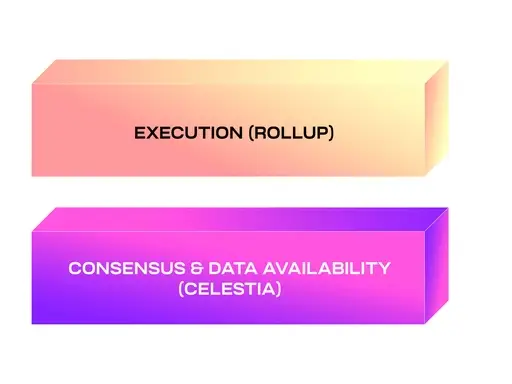
The article argues that this creates an inherent trade-off. Higher TPS often means heavier hardware requirements and weaker decentralization. Full validation across the network keeps block space tight, which can push fees up during congestion. Code coupling is another limit: changing consensus, scaling design, or storage architecture can require a chain-wide hard fork, slowing iteration.
Modular blockchains, as framed in the piece, split those four functions into separate and pluggable layers: execution, consensus, data availability, and settlement.
The four layers in plain terms
Execution layer
This is where user-facing activity happens. It packages transfers, runs smart contracts, and updates on-chain state. Foresight places ZK-rollups, OP-rollups, and sovereign appchains in this category. Because the execution layer does not need to store all raw data, run full-network consensus, or finalize asset ownership, computing resources can be directed toward throughput. The article says this can support transaction processing in the tens of thousands per second.
Consensus layer
The consensus layer has a narrower role: ordering transaction batches from execution layers and producing blocks so the network agrees on sequence. It does not run contracts or keep full transaction details. Foresight notes that some dedicated DA chains merge consensus and data availability into one layer.
Data availability layer
Foresight calls DA the security base of the modular stack. Its job is to store raw transaction data from execution layers so any node can download and verify the full record. That is meant to prevent sequencers from hiding or altering data. In monolithic chains, DA is tied to execution and consensus, which makes scaling expensive. Dedicated DA chains aim to provide low-cost storage as a service.
Settlement layer
The settlement layer verifies fraud proofs or zero-knowledge proofs, handles asset movement across layers, resolves disputes, and provides finality. The article says Ethereum remains the main settlement layer in the market today, with many L2s and sovereign rollups anchoring final asset security to Ethereum mainnet.
Monolithic vs. modular
According to the article, monolithic public chains still have advantages. Their architecture is simpler, they avoid multi-layer coordination, and they use a unified security model. Native ecosystems also face fewer cross-layer compatibility and messaging issues.
Still, Foresight says the limits are hard to ignore. Functional coupling puts a ceiling on scaling, congestion drives up gas fees, and changing core functions often requires hard forks. Building a monolithic chain from scratch also means developing consensus, storage, and execution systems in-house, with timelines of more than one year and costs in the tens of millions of yuan for labor and audits. Nodes must compute, store, and validate at once, which raises hardware requirements and can weaken decentralization.
Modular chains offer a different trade. Each layer can be optimized on its own: execution for TPS, DA for storage cost, settlement for security. Developers can mix components, upgrade one layer without forcing a full-network hard fork, and keep governance or forking power at the execution layer through sovereign rollups.
The article also lists the downsides. Multi-layer systems are more complex to operate. Cross-layer communication and proof synchronization require tooling. More layers also mean more trust assumptions, and choosing the wrong DA model can introduce extra risk. Tooling is still immature in parts of the stack, some niche execution environments take more work to support, and fees can stack across layers through gas and staking costs.
DA networks: Celestia, Avail, and Ethereum Blob
Celestia
Foresight presents Celestia as the first dedicated modular data availability chain and a flagship project for the modular thesis. The article highlights data availability sampling, or DAS, which lets light nodes verify data completeness without downloading full blocks. It also points to Namespaced Merkle Trees, or NMTs, for isolating data from different rollups and appchains, and notes that Celestia uses Tendermint BFT for consensus. Its role is to provide low-cost, high-throughput data storage for sovereign rollups and ZK or optimistic L2s. Use cases listed in the piece include vertical appchains, gaming rollups, RWA chains, and lightweight ZK L2s.
Avail
Avail is described as a newer DA network positioned against Celestia, with an emphasis on lower storage costs and higher throughput. Foresight says it improves erasure coding for better data compression and a smoother verification experience on mobile devices and light clients. The article also says Avail is natively compatible with the Ethereum ecosystem, ZK Stack, and OP Stack, making it easier to integrate with Ethereum-based rollups. It adds that the network includes built-in data fraud detection that can trigger penalties if data is missing or tampered with. Target use cases include high-frequency, low-value applications, AI on-chain interactions, and large-scale NFT minting.
Ethereum Blob under EIP-4844
The article notes that Ethereum also serves as a DA layer through blob data for L2 transaction storage. It describes Ethereum-native DA as the highest-security option, though more expensive than Celestia or Avail. In Foresight’s breakdown, L2s that prioritize security, including Arbitrum and zkSync, are more likely to use Ethereum-native DA, while application chains seeking lower cost and higher throughput may choose external DA providers such as Celestia or Avail.
From building chains from scratch to assembling components
A major theme in the article is that modular architecture lowers the barrier to launching a chain. In a monolithic model, teams need to build consensus, distributed storage, P2P networking, virtual machines, and scaling systems themselves. Foresight puts the development cycle at 10 to 18 months, with high audit and security costs.
With modular design, teams can reuse DA and consensus infrastructure and rely on Ethereum for settlement security. The article says they can focus on the execution layer instead, whether that means a ZK-rollup, an OP-rollup, or an app-specific chain. It says this can cut development workload by more than 70%.
Foresight points to tooling such as OP Stack, Polygon CDK, Cosmos SDK, and Rollup-as-a-Service. For EVM-compatible chains, OP Stack can be used to deploy an optimistic L2. For high-performance ZK chains, Polygon CDK can be used to build a zkEVM execution layer. The article says full build cycles can shrink from one year to 2–8 weeks, while labor costs can fall by 85%.
The modular model also lets teams choose different security and cost profiles. The article gives a simple split: financial and large-value asset use cases may choose Ethereum DA plus Ethereum settlement for maximum security, while gaming and micropayments may use lower-cost DA from Celestia or Avail to reduce fees.
For sovereign rollups built on external DA, Foresight says teams can keep their own token model, governance rules, and contract upgrade rights instead of aligning with Ethereum or the underlying DA chain. It also argues that security costs are shared across the stack, since DA and settlement are protected by larger networks and new projects mainly need to audit their own execution-layer contracts.
Foresight’s conclusion
The article closes by arguing that modular blockchains are not just a scaling patch but a long-term direction for blockchain architecture. In that framework, Ethereum acts as a settlement layer, dedicated DA chains such as Celestia and Avail provide the data base, and ZK or optimistic rollups serve as diverse execution layers.
Foresight’s view is that this division of labor addresses long-running cost and infrastructure barriers more effectively than the all-in-one design of monolithic chains. It adds that many vertical chains and application rollups are likely to be built on modular stacks, while monolithic chains may remain better suited to simpler and lower-interaction niche use cases.